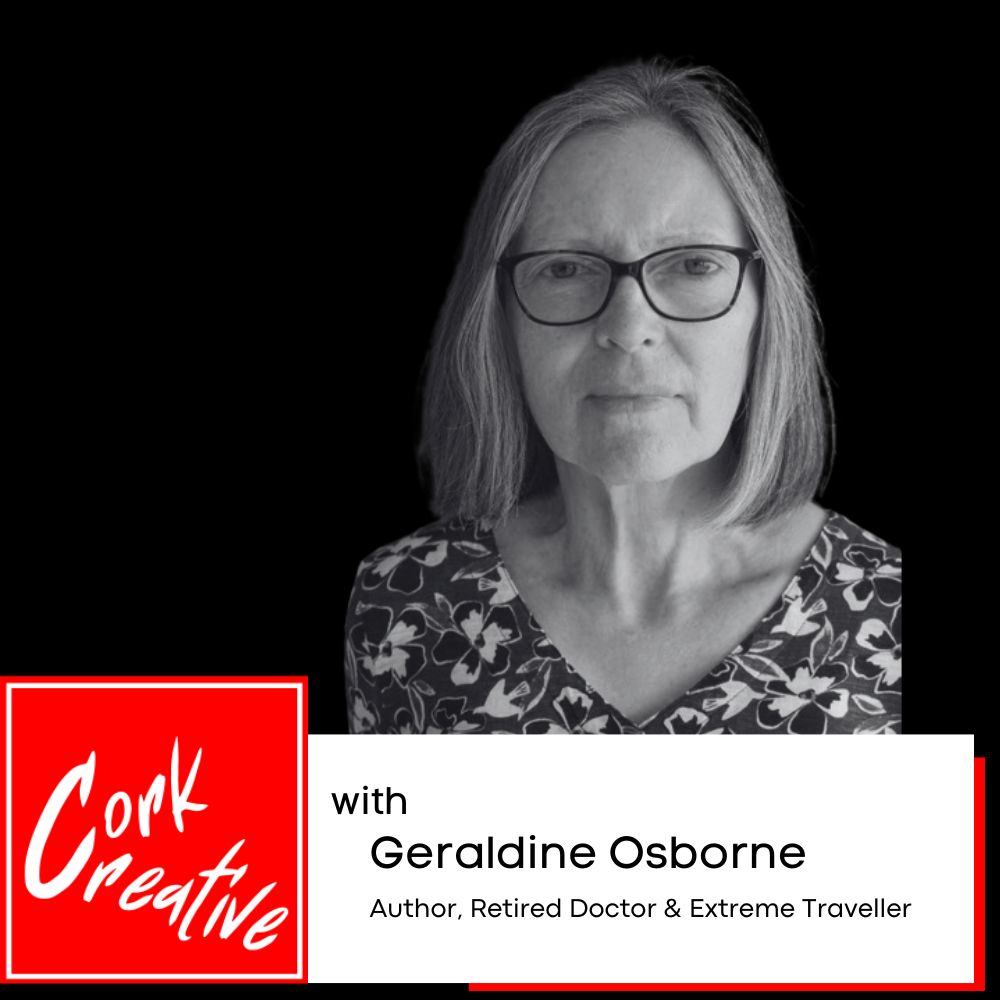
Geraldine Osborne is a retired medical doctor who has worked in General Practice and Public Health. Alongside her artist husband Danny, she has explored remote regions including the Arctic, South America, and the Himalayas. She co-created an award-winning film on exploration, as well as documentaries for RTE radio, and travel articles for the Sunday Tribune Newspaper.
Working for over ten years as the Medical Officer of Health in Iqaluit for the Government of Nunavut, deepened her appreciation for the Inuit people, their culture, and their environment.
Geraldine lives in West Cork, Ireland, yet regularly returns to the Canadian Arctic for trips with Danny .
In this episode, Geraldine chats about their rich cultural exchanges with the Inuit, the profound impact these experiences had on their lives as well as the invaluable life lessons learned about resilience, community and the connection with nature.
About this podcast
Date: 27/11/2025
Duration: 29:04 mins
Geraldine's takeaway tip
“Do something different that will stretch you a little bit.”
Listen ....
Watch ...
Episode Chapters
00:00 Introduction to the Frontier Land
00:54 Meeting Geraldine Osborne: A Life of Adventure
02:34 Journey to the Arctic: Family and Exploration
04:42 The Historic Inuit Migration
07:04 Challenges and Resilience in the Arctic
16:27 Cultural Insights and Personal Growth
21:06 Lessons from the Arctic: Community and Nature
26:53 Final Thoughts and Advice for Adventurers
Share this page
Transcript
Download transcript as a PDF here
Requires Adobe Acrobat or Equivalent. Also opens in web browsers.
Note: This transcript is machine generated so errors may occur.
[01:00:00:05] Geraldine Osborne:
Well, you know, the thing is, it’s like a frontier land. You’re living even in Iqaluit, which is the city, but it’s less traditional than say Grise Fiord; it’s further south and less traditional. But it’s kind of on the edge of wilderness. And there is so much freedom and possibilities, you know, the opportunities that you… it’s quite exciting. So they were setting up their own government. So it’s pretty exciting for me because I was involved in setting up a whole Department of Public Health in the government. We went for supposedly—I got a career break and went for two years—but I stayed for more than 10 years traversing the Chilean Andes with seven llamas. And that was a wonderful trip that was, you know, we’re completely alone above human habitations and just the two of us.
[01:00:57:01] Geraldine Hennessy:
So today I’m joined by a retired doctor, extreme traveller and author, Geraldine Osborne. Geraldine, welcome to the podcast.
[01:01:00:22] Geraldine Osborne:
Thank you.
[01:01:02:00] Geraldine Hennessy:
So your book Somewhere Cold details an incredible journey that began in the Beara Peninsula. So to start, could you tell us about what brought you, I suppose, first to make your home in West Cork?
[01:01:13:22] Geraldine Osborne:
Well, my husband, Danny, has been living here on the Beara Peninsula since the early 1970s, in fact. And I met Danny when I was a medical student in Dublin in 1980. He was actually at that time staying in Dublin because he was preparing to go on the first Irish Arctic expedition in 1981. So he was going with two other people and they had a warehouse near where I lived off South Circular Road where they were preparing all the gear. So I went in one day to help them out. And then we were married two years later. The rest, as they say, is history.
[01:01:53:21] Geraldine Hennessy:
Very good, very good. And how did life on the Beara Peninsula prepare you, or maybe not prepare you, for remote travel?
[01:02:02:19] Geraldine Osborne:
Yeah, I think it did prepare me. And I, you know, I never really thought about that much before. But in fact, Danny had a small cottage on top of a cliff overlooking the Atlantic and it wasn’t accessible by road. So we had to go over fields. So I’m sure that helped me in my fitness. It was pretty basic as well. Yeah, until the children arrived, I was happy enough with that. I thought it was very romantic. But that impression changed. But yeah, I’m sure it did help. All right.
[01:02:31:07] Geraldine Hennessy:
So you mentioned there like that, that Danny was already kind of passionate about the Arctic, having participated in the first Irish Arctic expedition. As a young family, how did you decide to spend a year in the high Arctic? And what was the reaction from friends and family to your decision?
[01:02:51:20] Geraldine Osborne:
Yeah, well, you see, after we married, travel was always on the agenda. Like I always knew I’d go to the Arctic. But first I thought we should go somewhere else because he’d been there, you know, and there were lots of places I wanted to explore. So we went to South America. We just opened the atlas and looked for the highest concentration of volcanoes. We had this idea that we’d love to visit some volcanic country. And anyway, we picked the Andes, Chilean Andes, and we spent six months there traversing the Chilean Andes with seven llamas. And that was a wonderful trip. That was, you know, we were completely alone above human habitations and just the two of us. So that was fantastic.
And then after that, well, I had a baby at that time and my family looked after the baby, Tempe, my first child. And then after the second child, we went on a Himalayan expedition, a climbing expedition with other climbers. And then after the third child was born, we said, we have, you know, this is now time for the Arctic because you can bring children there. It’s quite feasible. The Inuit live there. They travel with children on the ice. So it just seemed a perfect time to do it.
[01:04:07:17] Geraldine Hennessy:
OK, so you always, I suppose, had that adventurous spirit as such.
[01:04:11:21] Geraldine Osborne:
Yeah, I did. And yes, you asked about the reaction. Well, you know, at that stage, yes, my parents were used to and friends were used to my travels. Thinking back on it now, I’m sure they were terrified at some of the things I did, especially with the children. But they never expressed it. They supported me fully. And that was great. Yeah. I mean, they knew if they’d objected, I still would go.
[01:04:44:14] Geraldine Hennessy:
So the original plan was to retrace a historic Inuit migration to Greenland by sledge. What was it about that specific story that captured your and Danny’s imagination?
[01:04:52:09] Geraldine Osborne:
Yeah, that’s an amazing story. And it comes down through oral history because Inuit don’t have a written history. But in the 1980s, a book was published by a French priest called Guy-Marie-Ricelier about this amazing migration of the Inuit. It’s a long story, but basically in a nutshell, a shaman called Kedlar-Suac managed to persuade a group of people—maybe about 35 to 40 people—to travel with him, travelling further north, because he had a vision of people living further north who were as yet unknown to other people.
So they set off from Baffin Island and it actually took them five years to finally reach Greenland because they travelled from Baffin Island up through Devon Island and Ellesmere Island. And obviously, they were hunting en route and staying in different places. But when they got there, they found the Greenlanders who lived at that very remote part of northwest Greenland were living in terrible conditions. They had no bows and arrows or kayaks for hunting. Because years previously, an epidemic killed all the older people with all this knowledge, and the kayaks and bows and arrows were buried with them as per tradition. So the younger people had just lost the knowledge.
So they reintroduced these skills and technology, I guess, to the northwest Greenlanders and improved their lives greatly. It’s a marvellous story. And I mean, that’s just basically a nutshell. But they had a lot of different adventures en route and mishaps and tragedies. And it’s just a nice story. But also the other thing that appealed to us is that it was quite a feasible journey for us to do with the children. Like we didn’t set off from Baffin Island. We were actually, you know, on Ellesmere Island. So it was a shorter journey, one particular stage of their journey. And it just seemed, you know, a good journey to do with the children.
[01:07:05:15] Geraldine Hennessy:
- And speaking of the children, an essential theme in the book is balancing your paternal instinct with that spirit of adventure. Was there a particular moment where that internal conflict felt most acute?
[01:07:16:12] Geraldine Osborne:
Yes, I can remember. Actually, it was the first day of setting off on the journey from Greenland. It wasn’t a great day. The weather was windy, blowing snow and poor visibility. But we planned to leave on this day and we thought we’d go anyway and see, you know, just get a few miles down, just get a start on the journey. Because there’d been a lot of delays before that. So we set off and yeah, it was just awful blowing snow. The snow was soft, it was deep and the dogs were having a hard time pulling. So I don’t think we’ve mentioned—have I mentioned that we were travelling by dog sled?
Yeah, it was just kind of a miserable day and it was a very long day because we were trying to find somewhere to shelter, to set up camp. And that took a long, long time. And the children were fractious because they were confined to the sled. You know, because normally we’d break up a journey and let them run around. But it was just such a horrible day. So I think it was a real crisis moment. And I thought, oh God, it’s going to be like this every day. Just the next day was beautiful. Yeah, it was a bad day.
[01:08:27:10] Geraldine Hennessy:
OK, OK. A bad day to start, but maybe start off at the worst and then everything seems better, isn’t it?
[01:08:34:13] Geraldine Osborne:
Yeah, that’s right. Yeah. Yeah. Yeah.
[01:08:35:18] Geraldine Hennessy:
And as a doctor yourself, you were uniquely aware of the potential health risks. How did your medical training influence your preparations and daily life?
[01:08:44:20] Geraldine Osborne:
Yeah, I think actually the biggest advantage was probably that I could recognize if an illness was serious or not. You know, Tempe did have, just before we set off, she had some tummy pain and some vomiting. But I recognized that it was gastroenteritis. It wasn’t appendicitis. But, you know, on the other hand, say it had been appendicitis and you’re on a journey. Like, that’s a very serious thing and there’s not much I can do about it, except we had a radio and, you know, we could call for help if needed. So we did have backup. We weren’t entirely on our own.
[01:09:28:00] Geraldine Hennessy:
And how did you and your family cope physically and mentally with the three-month dark season? That must have been like really, really hard?
[01:09:38:03] Geraldine Osborne:
It was very hard. It was very hard. I thought very hard because, yes, it’s three months of night, of black night. But the children, it never bothered them. They never said that. Well, of course, the two younger ones were quite young. Tempe was going to school. All right. But she never remarked on going to school in the dark and coming home. And Danny was out with the dogs a lot. You know, it’s a novelty in the beginning. I didn’t mind. But as time wore on, it became much more difficult. The lack of routine, the constant darkness made me very lethargic. And actually, towards the end, I noticed I was becoming more irritable. And just generally down, I definitely think I was suffering from seasonal affective disorder. Absolutely. Yeah. Yeah. I know the last month, January, was very hard.
[01:10:32:24] Geraldine Hennessy:
And I was just reading in the book, you know, about that first glimmer of sunlight, you know, although it wasn’t maybe lasted that long. You felt like you were so joyous, but everyone else in the community seemed so not bothered about it. I found out, I can imagine myself like if it was after three months of winter and darkness and then a bit of sunshine, like, oh my God, thank you. You know, like it was just I thought it was quite striking that you were obviously so joyous and then the community around you were like, you know, they’re so used to it. Obviously, they don’t take any notice.
[01:11:06:02] Geraldine Osborne:
Yeah. We don’t have to see the sun back. Yeah. Yeah. We’re quite happy. But, you know, they’re glad winter is over. Yeah. Yeah. Yeah. That’s a big fanfare.
[01:11:13:20] Geraldine Hennessy:
Talking about your children, just taking no notice, they seem to adapt kind of incredibly well. What was the one, I suppose, of the most surprising things you learned about resilience by watching them navigate that new world of ice, snow and months of darkness?
[01:11:28:13] Geraldine Osborne:
Yeah, they never remarked on, say, the cold either. They never, you know, that much. It was all quite normal for them, I suppose, because everybody else was living in it. This was the community they were living in. And everybody else was doing the same thing and their parents were. And I suppose so long as all their needs are met, you know, shelter, food, all the rest. You know, it’s all pretty normal for them. But I think, yeah, so in terms of resilience, I think. And the other thing, too, about all children is they live very much in the present. You know, in the now, I think that’s a good way of approaching things. You know, OK, that’s the thing you kind of learned from them. So just living in the present. Yeah, yeah, yeah. They certainly are very good at that.
[01:12:16:13] Geraldine Hennessy:
- And food is a huge part of the cultural experience in the book from trying seal meat for the first time to the unforgettable smell of towing walrus. What was the most challenging food for you to adapt to?
[01:12:29:00] Geraldine Osborne:
Yeah, there are lots of different animals I’ve never eaten before, for sure. Well, seal meat was probably the most challenging and, you know, funny enough, seal meat is a staple as well. So there is quite a lot of seal meat. But I did eat it quite a bit. And seal liver was probably the easiest one because it’s not as strong. But it was a hard one to get to like for sure. But the other meats, other foods were delicious like caribou is wonderful, musk ox and fantastic fish char. You know, it’s the Arctic version of salmon, I suppose. It’s similar to salmon and even whale skin. I didn’t mind much. It was kind of very rubbery, but it had a quite kind of nutty flavour. It was. Yeah.
There are a lot of other foods like walrus. No, thank you. Eat their food raw. They eat it. Yeah. Mainly they prefer it raw, which makes sense because traditionally they didn’t have any fruit or vegetables. So they needed the raw meat was very high in vitamin C. So that was much more nutritious for them. It would be very difficult. So if you’re a vegan and you decide to go live up in the high Arctic… Very different. Now, there was a shop, there’s a store, but, you know, there was all, you know, dried or canned food, more or less. Most of it. It wasn’t as nutritious as the fresh country foods. Yeah.
[01:14:02:18] Geraldine Hennessy:
- And the book vividly describes the changes of travel. So from falling through the ice to navigating in the dark. What was the scariest moment for you during your time on the ice?
[01:14:12:02] Geraldine Osborne:
Well, fortunately, we didn’t have too many scary moments, which was great. When Danny was out with the dogs, he did go through the ice and had probably more scary type episodes than we had. But he did go through the ice on one occasion. It was a long day. We were travelling at this stage. It was 24-hour daylight. But again, it was a kind of snowy, overcast day with poor visibility. You know, when it snows and sometimes you get this condition called whiteout where you can’t see very far, snow horizon and navigation is very difficult.
But anyway, on this occasion, the dogs did go. They were fine, but they took the angle of the sled. Well, we went through what’s called a lead. It’s a crack in the ice and it was covered in snow and the sled took it at the wrong angle. And we didn’t see it because it was covered in snow and whiteout. But it went down. But fortunately, the handlebar, which is at the back of the sled, caught on the other side because it wasn’t too wide. And Danny jumped off very quickly, pulled us all out. And we didn’t get too wet. I mean, a few things got damp inside, but luckily it could have been bad, but it wasn’t. It wasn’t. He survived it. Yeah, we had to just make camp and dry out a few things. OK. Yeah.
[01:15:36:16] Geraldine Hennessy:
And you lived this adventure in 1989. What was it like revisiting those journals and memories after so many years to write this memoir?
[01:15:45:16] Geraldine Osborne:
Yeah, I had a lot of fun doing that. I enjoyed. Yeah, remembering it. I could. It’s funny, of all my journeys, it’s the most vivid one. Probably it was the one that made the most impression on me. Yeah, I enjoyed very much recounting and remembering things that happened. And as well as that, I used Danny’s journal because he spent a lot of time in the winter bringing the dogs out, training them, and he recorded all those events in a journal as well. So I had access to that as well because I was really part of it. I didn’t go out with him. I was part of the kids at home.
[01:16:29:18] Geraldine Hennessy:
OK, OK. And you’ve since returned to the Arctic and even lived and worked in Iqaluit for 10 years. What is it that kept drawing your family back to the north?
[01:16:36:14] Geraldine Osborne:
Yeah, so Danny went after we came back. Well, because I didn’t even want to leave Grise Fiord, we had to… let’s come home and make some money, get back to work. We were in debt at the end of it all. So he went back, though, about two years later with Orla Noceen, the two youngest, and he went back actually twice with them just in the summer or in the spring to paint. And he brought them with him and they went to school. I mean, he loves the place.
And I got a job in Iqaluit to work as a Medical Officer of Health. In two years prior to that, the new territory of Nunavut was created. So Nunavut had their own self-rule or self-determination. So they were setting up their own government. So it was pretty exciting for me because I was involved in setting up the whole Department of Public Health in the government. We went for supposedly—I got a career break and went for two years—but I stayed for more than 10 years.
[01:17:38:05] Geraldine Hennessy:
Gosh, you must really love it.
[01:17:40:16] Geraldine Osborne:
Well, you know, the thing is, it’s like a frontier land. You’re living even in Iqaluit, which is the city. But it’s less traditional than, say, Grise Fiord; it’s further south and less traditional, but it’s kind of on the edge of wilderness. And there is so much freedom and possibilities, you know, that the opportunities that you… it’s quite exciting.
[01:18:05:09] Geraldine Hennessy:
OK, OK. So what unique aspects of the Inuit culture impressed you the most?
[01:18:07:05] Geraldine Osborne:
Yeah, there was quite a lot. I think about it. I think probably their child-rearing practices were really impressive. You know, from the time a baby is born, it stays on its mother’s back in the amauti, this garment they wear with a pouch on the back for carrying the baby. So when I arrived in Grise Fiord I was so impressed. Every woman was wearing an amauti with a baby in a jacket. Everybody seemed to have a baby. But you know, you can wear one indoors. They can wear them indoors doing domestic chores or even at the checkout. The woman at the checkout would have a baby on her back or in the office. And we can bring a baby and they say it makes the baby calmer. That physical contact with the mother makes the baby calmer. So the baby cries less. That seems to be the case. They seem to be pretty happy in there.
I know Warshin loved it when I got an amauti, he adored being in there. Yeah, yeah, yeah. Well, it’s nice and cosy. It’s… yeah, I did wear it inside sometimes. Just the outer part because you get too hot. But yeah, because it’s amazing. It seems to balance their weight very well. So it doesn’t drag on your shoulders. You know, the way a lot of carriers today can pull. It doesn’t. It’s fantastic.
And the other thing that really impressed me with, you know, in child rearing is they’re very… they use discipline very sparingly for their children. And so they say, then children listen when you are not constantly telling them, don’t do this, don’t do that, whatever. If you use it just when it’s needed, then the child listens. And they say, you know, sometimes it’s all right. You know, if a child’s doing something you don’t like, just let them, because if it’s not doing them any harm, if there’s no harm in what they’re doing, they’ll figure it out and play is also really important for children. They say play. And this is actually quite true, I think, that through playing, children learn how to regulate their emotions like fear or anger. If they’re playing with other children, they have to figure these things out themselves.
[01:20:10:04] Geraldine Hennessy:
Hmm. It’s actually one of the things that I picked out from your book was their relationship with their children. And just even though it seems like such a harsh environment, like the children seem to have so much freedom, you know, like even though there’s obviously risks and danger, but they seem to have so much freedom and it’s such a positive impact on their lives.
[01:20:27:22] Geraldine Osborne:
It is. It really is. And that’s why they do it. They say because they have to learn to survive in a harsh environment, it’s important for them to develop these skills. And unfortunately today in our world, we’re overprotective with our children and more and more so now. And they don’t get to learn how to navigate risks. And, you know, it’s a shame. Yeah, absolutely. No, I picked it out as I suppose being a mother myself. I picked that out from your book. It was a very noticeable thing to me. Yeah.
[01:21:05:03] Geraldine Hennessy:
And looking back, how did that year permanently change your perspective on what you might call or what we might call normal life back in Ireland?
[01:21:14:16] Geraldine Osborne:
Yeah, one of the other outstanding aspects that really impressed me, I guess, too, and we’re lacking in normal life here, is our distance from nature. Like for them, they are part of nature. And I think this is true of all indigenous people. In fact, you know, they don’t… they’re not like us. They don’t see it as separate, that we’re superior or above it. And, you know, we seem to want to dominate it, to bend it to our will, to exploit it for our own gain. But they use nature, but as part of nature and they use it, you know, they’re grateful for what nature provides for them. They respect it because they know they need nature in order to continue to survive, and so they don’t take more than they need. And, you know, they give thanks to the spirit of the animals that they hunt. Yeah, so it’s done in a very respectful way.
[01:22:19:19] Geraldine Hennessy:
OK, OK. And do you think they’re like their normal life is just it’s so far removed from our normal life, but it’s in some ways it’s almost more superior. Would you say that?
[01:22:30:10] Geraldine Osborne:
Well, a lot of the things, you know, that’s when I was thinking back on it too, a lot of the things that are very culturally appropriate for them are things that even now with research are very important to us as human beings, you know, and we’re losing more and more. But they have managed to hang on to them now. I don’t know, you know, with the encroachment of modern life as well, if that will change in the future, I hope they’ll always keep their values. But research has shown that the aspects that make our life… that make us happy in life are our connections with family and friends, our relationships. Like they’re really important. But now we have an epidemic of loneliness happening. So we really have to learn to reconnect, to stay in touch, have fun, socialise.
You know, it’s not all business, business and, you know, fun. They adore games, community and they have a lot of community events where it’s just a lot of laughter and yeah, just having a lot of fun. They have a great sense of humour and they enjoy a good joke. Very good. Yeah. Even at the expense of somebody else, you know, to just be all very funny. Yeah. Things like that and their connection with nature. And I think these things have been shown now to be really, really important. Yeah. And keeping us healthy and happy.
[01:23:59:10] Geraldine Hennessy:
And you must laugh when people say that it’s colder like there is no comparison really to like here. Ireland’s mild temperatures and like minus 40.
[01:24:11:14] Geraldine Osborne:
That’s right. Well, it’s a different look. It’s a different kind of cold. Like I can still be cold because it’s damp, but it’s incredibly dry. There it’s, you know, it’s a polar desert and there’s very little precipitation. So it’s a different kind of cold. It’s much healthier. So even minus 18 is very pleasant, you know. And of course, you’re dressed for it as well. Yeah. Totally dressed like when it’s in winter, when it’s yeah. Minus 14 and the wind is like a knife. You just have to cover up everything, cover up your face with just your eyes peeping through and get all the layers, all the layers on. Yeah, it’s but it’s quite doable when you’re kitted for it. Yeah.
[01:24:56:05] Geraldine Hennessy:
And your time in the Arctic was obviously a period of great personal growth. What key lessons do you believe the modern world could learn from the people of Grise Fiord? Is this just that kind of connection with nature?
[01:25:07:13] Geraldine Osborne:
Yeah, the connection with the nature. Well, I think overall just the community and a lot of sharing and caring within the community, sharing in particular, there was a lot of like they don’t have the concept of private property. The land isn’t owned by individuals. It’s for everyone. I mean, it would be… they would think it’s totally bizarre to own land. You know, it’s there. And yeah, a lot of caring in the community and looking after each other because that’s how they survive, because the next day you might need help. So it’s yeah, it’s a lot of that and being part of nature.
And it was kind of funny when I was reading your book about the, you know, that when you arrived, there was nothing there in the house. But then everyone just started bringing all the stuff in. It’s quite an amazing sense of community. I was just standing there looking at what was going on. Yeah, because I was like, yeah, yeah, it was amazing. Yeah. And even the way that they told you not to knock on the door, just come in. There’s no sense of privacy. Just whatever things are very hard to do, actually.
And you know, the other thing is there’s always food in the house and they’d have meat. Often it’s on cardboard on the floor. They’d have a, I don’t know, piece of seal and even a whole seal there. You know, all are maybe chopped up into different parts. And you’re supposed to help yourself. They don’t ask, you know, they don’t stand on ceremony at all. It’s good. You just help yourself. Or if you want tea or coffee, you just help yourself. Yeah, it’s very hard to do because we’re so used to… that would be seen as very rude here. Yeah. Yeah. Yeah. I suppose just the cultural differences. But it’s amazing. Yeah. Yeah.
[01:26:52:01] Geraldine Hennessy:
And finally, for our listeners, inspired by your story of kind of stepping out of a comfort zone, what is the one piece of advice you’d offer them?
[01:27:00:15] Geraldine Osborne:
Well, first of all, I’d say great. Go for it. And it doesn’t have to be on the other side of the earth or some really remote place. You know, there’s even not too far from home within Ireland. There’s some wonderful, wild places to visit and maybe go camping or something. Do something different that will stretch you a little bit. And the advice I would give, it would be to prepare well. I think it’s really important and especially if you’re going somewhere even more remote to just think of it from all angles, all eventualities. And then you won’t have to, you know, you’ll have a better time and you won’t have to worry about it. It’s just, yeah, put in the research, put in the preparation. We always did. We’d always spend a long time, a year or more preparing for our trips.
And of course, in those days, like nowadays, it’s easier because you’ve got internet and you’ve got GPS. We didn’t have internet or GPS with us when we were going. And yeah, and yes, and I said in the book at some point, there was a quote from a woman from Greenland called Navrana, who said, you know, if you don’t try, you’ll never know what you’re capable of. I agree with her entirely.
[01:28:20:20] Geraldine Hennessy:
Very good. Well, that’s a great way to end the podcast. So thanks so much, Geraldine, for sharing your experience of life in the high Arctic. If you’d like to learn more about Geraldine and her book Somewhere Cold, you can find links on corkcreative.ie.
[01:28:38:21] Geraldine Osborne:
Great. Thank you so much. Thanks, Geraldine.
