Danny Manning
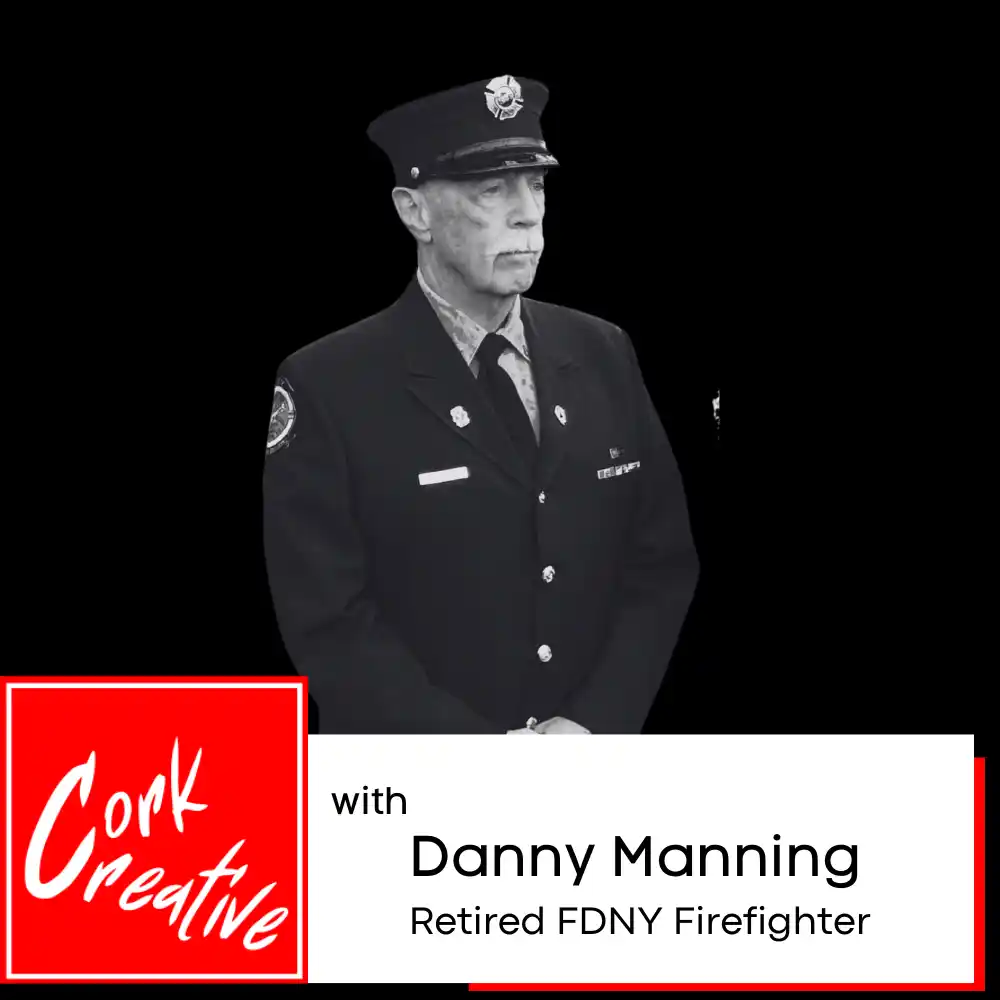
Danny Manning is a retired New York City firefighter whose life has been shaped by two places: Manhattan and West Cork.
The son of Irish immigrants, Danny grew up in New York but spent many childhood summers with relatives in Innishannon, and he still has family in Innishannon, Bandon, Old Head, Ballinspittle and throughout Kerry. He holds dual Irish and American citizenship and is a member of the FDNY Emerald Society.
He joined the FDNY in 1979, starting with Engine 257 in Brooklyn before moving to Ladder 43 in Spanish Harlem, a house proudly known as El Barrio’s Bravest. He served for more than two decades, retiring in 2003, and went on to spend many years as a trade union official.
On the morning of 11 September 2001 Danny was off duty at home, close to the Twin Towers. He flagged down an emergency vehicle and made his way to the scene, where he helped injured civilians, joined the rescue effort and survived the collapse by diving under a truck. Several colleagues did not come home. Danny is careful about the word hero, saying the only heroes were the first responders who never returned.
Finding a way to honour those lost friends ultimately brought Danny’s two worlds – New York and West Cork – together. He found a unique sanctuary at the Ringfinnan Garden of Remembrance near Kinsale, a place where his lifelong Irish roots and his FDNY brotherhood intersect. The garden, planted by Cork nurse Kathleen Murphy in November 2001, holds 343 trees, one for every FDNY firefighter lost on 9/11. Danny has described it as a living memorial with nowhere like it in the world. In September 2024 he joined around 90 Irish and American firefighters who cycled 225 miles from Dublin to Kinsale, and helped plant a sapling from Ground Zero’s Survivor Tree in the garden. He returned for the 2025 ceremony and remains a regular presence at the annual commemoration.
Today Danny speaks widely about his experiences and about the mental health of first responders.
About this podcast
Date: 11/09/2026
Duration: 59:06 mins
Listen ....
Watch ...
Episode Chapters
00:00 Meet Danny Manning
01:03 Roots in Cork
02:59 Why He Joined FDNY
04:43 Firehouse Brotherhood
07:10 September 11 Memories
18:42 Rescue to Recovery
22:15 Stories and Firehouse Humour
24:39 Grief Funerals and Pipes
29:02 Mental Health After 9/11
33:43 Passing On the Legacy
35:57 Finding Unity Again
39:36 Ringfinnan Garden Explained
42:06 Walking Through the Trees
46:26 Families and Visitors Impact
51:57 Future of the Garden
55:12 Pride Thanks and Farewell
Share this page
Transcript
Download transcript as a PDF here
Requires Adobe Acrobat or Equivalent. Also opens in web browsers.
Patrick Kiely (00:00)
Today on Cork Creative we are very fortunate to be joined by Danny Manning, a retired FDNY firefighter who gave twenty-three years of service to the Fire Department of New York, initially in Brooklyn and then in Spanish Harlem with El Barrio’s Bravest. A proud son of West Cork and Kerry lineage, a keeper of the garden at the Garden of Remembrance in Ringfinnan near Kinsale, County Cork, and a member of the FDNY Emerald Society Pipes and Drums.
Danny is here today to speak of his experiences on 9/11, his wonderful work with the Ringfinnan Garden of Remembrance, and all that he does to support the families of the 343 FDNY firefighters lost on 9/11, 2001. You’re very welcome to Cork Creative, Danny.
Danny Manning (00:59)
Thank you, Patrick. Very nice to be here with you.
Patrick Kiely (01:02)
Thank you, sir. How did your personal connection to County Cork first begin?
Danny Manning (01:07)
Well, that’s an easy one, that happened because of my father. My father is from Inishannon, and my mother is from Tralee, so as young boys, myself and my brother Patrick, we’d be over here from the time I could walk, visiting the family in Inishannon and then on to the family in Tralee. As a young boy coming over, those are fond memories: playing with my cousins in the fields, going down to the village for ice cream. It all started there many, many years ago, when I was first walking and my brother wasn’t even walking yet, as a baby. So those fond memories of the connection go far back.
Patrick Kiely (02:00)
And as you’ve mentioned in our conversations, both your parents are laid to rest behind Inishannon Church, and you’re a proud carrier of Irish citizenship, just like your family.
Danny Manning (02:20)
Yes, I am, and my children are Irish citizens and carry Irish passports as well. We’re in the process of getting my wife squared away with that too, through her family, she’s from Kerry, and her grandparents. So all good with that. And yes, my mom and dad are laid to rest behind St Mary’s Church in Inishannon, and that’s a beautiful place for them. So, continuing that memory, I’m there as often as I can be.
Patrick Kiely (02:52)
So, we’ll come to Ringfinnan and your connection there, but first, let’s discuss the FDNY. What drew you to join the FDNY?
Danny Manning (03:04)
Well, that goes back to the mid-1970s. At that time I was working in the nightclub business, out in the resort areas, and doing other jobs, you know, putting myself through college. I came across two fellows who were working with me and got to know them at the place I was working. The only reason they were there was because they’d just recently been laid off from the New York City Fire Department. The fire department in the city of New York was going through some tough times, and there were massive lay-offs, through no fault of their own, they got laid off.
They came out to the resort area and started working where I was, and we became good friends. I thought about that, I said, ‘Jesus, these guys were so enthusiastic about the fire department,’ and they kept encouraging me: ‘There’s a test coming up, Danny, soon, you should take the test, you’d like the job, you should take the test.’ And I said, ‘Gosh, that’s very odd, these fellows just got laid off, they’ve no paycheque coming for them any more, and instead of being bitter about it, they’re encouraging me to take the very job they just got laid off from.’ I thought that was profound, and I said, ‘I think I should think about this.’ Getting to know a little bit about the lifestyle of the firefighter, and getting to know them and know the firemen, I knew it was meant to be, me joining the force.
Patrick Kiely (04:47)
And, of course, you dedicated twenty-three years of service to the FDNY. Looking back on those twenty-three years of service, how would you describe the unique camaraderie of the firehouse?
Danny Manning (04:56)
Oh, the best word to use there would be a brotherhood, a second family would be another way of putting it. We become so close because, in the New York City Fire Department, you work and you live in the firehouse, you sleep in the firehouse on your night tours, and you become a close family. You’re spending as much time with the guys as you are with your own family, in a sense. A lot of the extracurricular things we do together, playing ball together, having family picnics together, it really becomes your second family, and it becomes more of a lifestyle than a job, in that you’re around each other so much. You could say, ‘Gosh, I found a second family.’
Patrick Kiely (05:49)
When you speak of the FDNY as your second family, that must be key to how you build a culture of absolute and unquestionable trust, where colleagues are willing to run into danger for one another.
Danny Manning (06:02)
Well, it does, you could tell, because of the closeness and the family atmosphere of working together and living together, the brotherhood, and getting to know each other, you get to know the size of a man, what he’s made of. You absolutely want to do everything you can to work together as a family, we’d call it a team working together, and the trust that you build by getting to know and working with them, seeing how they react under pressure, that goes a long way in giving you confidence when you’re going into a fire and you’re going to rescue people, or, God forbid, another brother, one of the firefighters, you know they’re coming to get you if you get stuck. That’s the way we go about it: we don’t spare anybody we can to help, and you rely a lot on the trust of knowing the people you’re working with, that if you get stuck in a bad spot, they’re coming to get you.
Patrick Kiely (07:10)
So, Danny, when you reflect on September the 11th, 2001, what are the memories that stay with you the most?
Danny Manning (07:16)
Oh, Jesus, there’s quite a few. I guess, because of where I live, I live very close by, sometimes we’ll be in the car, and we have to go a similar route to the one I took to get to the World Trade Center that morning.
What sticks in my mind, I guess, among the many memories of that morning: my wife, Mary Ellen, was watching television. I was in the back of the apartment, in one of the back rooms, and I heard a loud yell from her, ‘Oh my God!’, and I came running to see what was the matter, and she showed me the TV: a plane had just hit the World Trade Center. After watching it for a little while, it made no sense to me, because there was a clear, blue, beautiful sky looking out my window where we were.
Then we sat watching, and it seemed like the plane had hit deliberately, at that time I knew things were different, this wasn’t a small plane, as I’d originally thought, that might have gone off course and had navigation or control problems and crashed into the building, that had happened before in Manhattan. I just got up and started getting dressed, and she said, ‘What are you doing?’ I said, ‘I’m getting dressed to go down there, we’re under attack, and they’re going to need every hand they can get down there.’ I got dressed and went out the door, gave her a hug and said goodbye, I knew this was something bigger than anything I’d ever experienced before.
Memories of that ride down there, I flagged down a fellow. The way down by me was shut off, which is right where I live, along the water, and only emergency vehicles were allowed to go down there, so I went up and flagged down a fellow. He pulled over and picked me up, he was with the Joint Terrorism Task Force, and he was racing down there as well. The two of us were in the car, and he was in communication with his colleagues as we went down. I looked to my right when we got to an area called the Seaport, and I saw the first tower coming down. He lost communication with his men at that point, they were in that tower.
Then we knew what kind of day we were in for. He tried to get us through an underground tunnel that comes back up on the other side of the World Trade Center, the other side of the island, but we couldn’t make our way through, we kept bouncing off the walls because the smoke was pouring in, and we turned around and got back out again. I said, ‘Well, how am I going to get there?’ Fire trucks were going through at that point, so I jumped on the back of a fire truck and went down with some of the boys I didn’t know, just another fire truck with men on it, and I joined them and went down there. From that point on, everything changed.
A memory that always sticks with me: we were trying to rescue people and help people. There were thousands of people running towards you, masses and masses of people running and screaming, covered in dust and everything. I came across a woman, I found her, and she had a small baby in her arms, running with the baby, hysterical, crying. I went to comfort her and help her, and she said she’d lost contact with her mother, who was with her other daughter, it was the four of them. I said, ‘Okay, I have to get you to safety now,’ so I got her and the baby to safety in a fire department vehicle, I was worried about the dust with the baby, and then I said, ‘Tell me what they look like, what clothes they were wearing,’ and I said I’d try to go and look for them, which I did.
I went to look for her mother and her other child, and I never found them, and to this day it’s still a mystery to me. I often wonder: did they survive, were they reunited, were they among the ones who made it out of that area? At least I knew, as a comfort, that the woman and the baby were taken to hospital and were going to be okay, but that’s one of the things I’ll never know the answer to, I guess.
Then there were many other things, it was a day that, it flashes back every once in a while, especially, as I said, when I’m down in that area.
We were working, and we were doing whatever we could, I had no air pack or anything, I was just in my street clothes with a fire department shirt and hat. We got word, after the first hour, we came down, we were doing our best to team up in groups. It was so chaotic, there was no organisation, no command centre really structured at that point. A lot of those fellas got wiped out, and when the second building came down, it was a run-for-your-life situation. It didn’t matter that I had over twenty years’ experience on the job in busy firehouses and had seen my share of fire duty, none of that mattered that day. What mattered was which way you ran, and that’s what saved you. All the experience in the world didn’t kick in, at that point it was just a matter of luck, which way you ran. I was buried under a truck, and all the people were buried under debris. Then they got us out.
At that point, because I’d been through, as I said, a bunch of stuff, a bunch of good jobs, good firefighters, I’d seen my fair share of tragedies, I just said, with no air pack, trapped there like that, I’m not going to let this end here today, not like this, after my career. Thankfully, I got out, and we went to work, everybody teaming up, trying to help the people we could. The surprising thing was there weren’t as many people to help as we would have liked. All that was coming down at the time was papers and clouds of smoke, and you couldn’t see the sky any more, what had been a beautiful, clear, bright blue, sunny sky, all of a sudden there was no sky at all, and there was nothing but debris and ash. And where were the people? Well, there was nothing but steel. Where were the desks, the computers, the restaurant equipment, everything that had gone into those towers, they were all pulverised in the steel coming down. That was another memory.
One of the things we, me and my guys, were able to do was find some good stories, mixed in with the bad. One of the fellas we came across, we’d got into a void looking for people, and we saw a firefighter trapped, far in the distance, but it was really difficult to get to him. We didn’t know if he was dead or alive, what we saw was his white helmet, and him lying there amongst a lot of debris and rubble. We were doing our best to get to him, and we got ordered to pull out, nobody paid attention to that, we just kept trying to go forward. There were no signs of life from him, but we always held out hope that maybe he was, and we kept moving forward. After several attempts, we got pulled out of there, and we were never able to recover him, because the area we were operating in suffered a more total collapse, that’s why the chiefs had ordered us out of there.
But there is a good story, my company, El Barrio’s Bravest, was involved in it. It’s known as the Miracle of Ladder Six. There were fellows who were coming down with a woman from one of the towers, helping her get out, and she needed a pause to catch her breath, and because of that, when the building collapsed, they found themselves in a void that protected them, the whole building above them pulverised down, and they were protected by this small void where they were. My guys got word, through a radio transmission, and they were able to locate the area where they thought they were, and everybody went to work. We were assigned to that rescue, and sure enough, those people, the firemen and that woman, lived that day, thanks to help from my guys, El Barrio’s Bravest, and I’m proud to have been a small part of that, when the guys got them out and we were all reunited. That story is one of the good ones, there weren’t many stories like that, unfortunately, because there weren’t as many people to rescue as we would have hoped. So those are the memories that will always stay with you.
Patrick Kiely (18:42)
When you speak of El Barrio’s Bravest, and you were based in Spanish Harlem at the time, how did you, your colleagues and your broader colleagues in the FDNY find the resilience to keep going in the days and weeks after the attacks?
Danny Manning (18:55)
Well, we knew there was always a chance that people trapped might be alive, there was always that hope, so you pushed on through the minutes, through the hours, through the days, through the months. We’re always trained to do our job under extreme circumstances when there’s a fire and we’re rescuing people, but this was more challenging than most of us would have been used to. In the days and weeks afterwards, you wanted to continue, because, number one, in the early stages you thought there might still be people alive, and then, number two, when it became a recovery effort, we did everything we could to find anybody possible, to reunite that person with their family, so they had something to bring to them, in terms of closure.
So that continued for months. When it transitioned from a rescue operation to a recovery operation, we always knew that the work we were doing was to help the families of the missing people, and that’s what gave you the strength to keep going. It was really important for all the guys to do that, and for a lot of the other people who came down to help us, the police, the emergency response people, the EMS people, we all worked as a team, united, to do that.
Going back to that morning and that day, I often say that many people did heroic acts that day, far more than anyone will ever know. There were many heroic acts done by civilians, by first responders, by ordinary people, everybody did their best to help somebody. It was a unifying effort on behalf of humanity, that’s a better way to put it.
So, yes, in the days, weeks and months, it was challenging, and I’d be working alongside, sometimes, retired firefighters who were there working to find their son, who was a fireman and among the missing, those were extra special times, trying to help those fellas find their missing sons, who were part of the fire department, just as they once were. There were a few days like that I’ll never forget.
Patrick Kiely (21:59)
It’s something I’ve heard mentioned at the garden at Ringfinnan, when people are visiting, walking past the trees and seeing the pictures of the firefighters, they comment on how young so many of them were. So, Danny, storytelling is a huge part of both Irish and firefighter culture, how important is it for you to keep talking about the colleagues you lost, and to tell those stories of bravery from 9/11?
Danny Manning (22:29)
Well, I think you said that well, especially the part about Irish storytelling being part of the culture of the Irish, and it’s part of the culture of the fireman too. There’s nothing like a good story, as they say, sometimes. The culture of that, I guess you could put it this way: we always get together at gatherings, and we like to joke and kid with each other, and you’ll tell stories about fires and different scenarios, what happened with a guy at a fire, kidding him around, and it just lightens the mood of the firehouse kitchen.
My firehouse had a very tough kitchen, you weren’t allowed to lie in the kitchen, but if a fellow was going to tell a lie, he’d step outside the kitchen a bit, put one foot outside the kitchen and one foot in, and then he’d think he could tell the story, because that story didn’t sound right. When he stood outside, straddling the doorway, you knew there was something up with that story, he wasn’t telling the truth.
So, yes, the firehouse kitchen, the firehouse humour, was fabulous, and other fellas would come into our firehouse to work, get detailed to other firehouses to fill in, and they knew that the firehouse they came from didn’t have the same level of chop-busting and banter that we had in our kitchen. It was a tough kitchen, everybody knew it, and it lightened the load and the mood, if it was a bad day going on, or you’d just come back from a tough fire, that’s part of the humour, I’ll say, that firefighters have.
Patrick Kiely (24:36)
Danny, for you personally, how did you process the grief and find moments of joy after experiencing the profound loss of so many of your colleagues?
Danny Manning (24:46)
With the grief, I guess we didn’t have much time for that, because, in addition to working all the time down at what we call ‘the pit’, trying to recover people, we were also going to funerals for our firefighters. So you were back and forth, you’d work on the pit, then go home, get cleaned up, get into your uniform to go to a funeral.
I’ll never forget the very first funeral, by the way, Father Mychal Judge, who was our chaplain. Everybody knows the iconic photograph that went around the world and was on the front pages in Ireland too, of Father Mychal being carried from the rubble by a few of the boys. I’d been planning to go to Father Mychal’s funeral, because I knew him personally, but what happened was, overnight we were up at the top of the pile, working our way in from the top, and we found a group of firefighters huddled together in an area.
We had a tradition that if we found a firefighter, we would call it down the line, and they’d get word to that firehouse that we’d found a member from there, and we’d extract the member and wait there until the fire company came to recover their own man, they always had the honour of carrying one of their own. That was a very meaningful thing, we found all those fellas in the middle of that night, but because of that, I wasn’t able to go to Father Mychal’s funeral mass, which was attended by thousands of people. All of New York was captivated by it, but I think the job at hand was more important, and I think Father Mychal would understand that, for sure.
So that’s what life was like, we didn’t have time to grieve. The Fire Department Pipes and Drums, oh, I’m honoured to be part of it, I don’t know all of the fellows from the time I came on the job, and I was with them in Ireland as well, they made a vow amongst themselves that they were going to make sure every funeral, every memorial, was covered by the band. So, in addition, when there’s a line-of-duty death, the full band will attend the funeral and march the fire truck with the casket on it in and out of the church. They made a point to themselves that they were going to split up, because there were so many funerals going on every day, they’d go to one funeral, play a man in, then rush to another funeral, play a man out, the band split up amongst themselves. But to think about that, they made that commitment that they were going to let no funeral or memorial go without a member, or several members, of the band being there, for that dignity.
That, in turn, is why we didn’t have much time to grieve, because of all that was still ongoing at that time, and that helped, in a way. Now, sure, there were many tears, but it helped, in a way, that you had more things to do, and this was bigger than you sitting in a chair grieving about something.
Patrick Kiely (29:00)
Danny, how has the conversation around mental health and support for first responders changed since your early days in the FDNY?
Danny Manning (29:05)
Well, that’s a good question. Years ago, it all changed since 9/11, to be fair, years ago there was always a counselling unit in the department, and they would counsel guys who were going through tough times, for many different reasons, whatever the personal situation might have been, and that counselling unit was always there, whether it was counselling a fellow after a bad fire, or problems at home, or dealing with tragedies.
After 9/11, fair to say, it evolved and became more pronounced that it was necessary. A lot of the guys saw some horrific things that day, and there were quite a few younger fellows on the job at the time who probably wouldn’t normally have seen the tragedies that maybe some of the senior guys in the busier companies would have seen, so they were in much more need of it, and still are, I believe. Counselling is needed for firefighters, whether they’re in Kinsale Fire and Rescue or in any city, anywhere in between, because what firefighters experience is so different from what other people, say, military people, would experience. What may be normal experiences for us and for people in the military and the police, the everyday citizen wouldn’t have to face, so counselling units in any department, I think, are important, extremely important, especially, as I mentioned, after what happened in New York City.
There’s a group called Friends of Firefighters, they started, not long after 9/11, a private, non-profit organisation, because they recognised the need for FDNY firefighters’ well-being and wellness, let’s call it. They offer counselling, and they have clinical specialists in their fields to do that, and they took a lot of the burden off the firefighter counselling unit of the department. Fair enough to them, they’re trying to expand to other departments in other cities that need this kind of help, and Ireland is among them, I believe they’re going to launch an initiative to try to expand their footprint into Europe, outside of New York City, because whether you’re a fireman in rural Kinsale, or a firefighter in Paris, or in any of the big cities around the world, that’s needed for people, now, the way things are. So it is important.
In the old days, when I was working, if you had a bad job, you toughed it up, you sucked it up, and you moved on, it was part of, I don’t know, the lifestyle, the way you adapted. Not that you ever become numb to those situations, but it helped that the guys would give you a pat on the back, ‘good job,’ when we had a tragic fire or loss of life, you know, we did what we could. Now you have that on the outside as well, and these are people who specialise in those fields. The counselling units, and the tools that are out there now to help people deal with tragedies, have come a long way since the pat on the back and ‘you did a good job, kid, let’s move on.’ So fair play to everybody who helps in that regard, and I’m proud to know many of them personally, so I thank them for all the work they do.
Patrick Kiely (33:43)
How do you find the words to explain the legacy of Ground Zero and the World Trade Center towers to the next generation?
Danny Manning (33:53)
Well, you know, obviously, as people will well know, it’s twenty-five years, there are people born today who weren’t alive when the towers came down and all those innocent people were taken from us, as well as at the Pentagon and in Pennsylvania. So you would hope that history never forgets a day like this, a day that changed the world, let’s be fair about that, that forever changed the world that day. You would hope that history would never forget it, and that through generations and generations that follow, I’d hope, in families, those stories will continue to be told, about the bravery of many of their family members, and those stories should never be kept quiet, they should be told, as well as the stories of all the civilians who were lost that day. Those families should continue those memories through their generations, of that person’s life and what they meant to them.
So you would hope, in that regard, that the schooling and the history books, those chapters, haven’t truly been written to an end yet, I hope. In the fire department, there are many firefighters on the job now, men and women, who are sons and daughters of firefighters killed on 9/11, and I’m proud to know a few of them myself, and they carry on the legacy of their fathers, and that’s something to be said about that, for sure.
Patrick Kiely (35:52)
After 9/11, Danny, there was a brief window where race, creed and politics dissolved, and everyone was simply united. In our modern, increasingly fractured world, how do we rebuild that sense of collective community? Do you think we should need a tragedy to trigger it, or would you hope not?
Danny Manning (36:18)
Oh, Jesus, you would hope it wouldn’t take a tragedy, but people often remark about how that day unified not only the people of New York, but the people of the world, that was a beautiful thing to say. I’ve heard a story before, one day, on one of my days, I had to go down to headquarters. I was walking through headquarters, you could barely walk through the lobby of the firefighters’ union building for the amount of bouquets and wreaths of flowers standing everywhere you looked, everywhere you were walking, you were amongst them, and those were sent from people all around the world. I don’t know why, but I was walking by, looking at them all, and one caught my eye, it was a big wreath of red and white flowers, massive, and it said ‘from the people of Cork’. I said, ‘Look at that, right from where my family’s from,’ and that’s the thing that caught my eye. That was beautiful.
So, in tragedy, sometimes it does bring people together, and you would hope it wouldn’t take another tragedy to do that. For myself and my family, we like to judge people by who they are, by their actions, instead of their words, sure, words matter, but your actions and how you treat people, I think, are the most important. Thankfully, my wife and my lovely son and daughter live by that creed, and it’s beautiful to say, and I think if people judge each other by their actions, and how they hold themselves, and what they do to help other people, that’s where it is.
You know, firefighters, like I mentioned to you earlier, it’s a lifestyle that we have, and whether you’re a firefighter in Kinsale Fire and Rescue, or New York City, or Inishannon, wherever you are, a firefighter from New York to Kinsale, it’s a lifestyle of trying to help people. Think of it this way, as one fellow put it: when people are having a bad day, the firefighters come to make it better for them, in whatever way, and it’s a way of helping people that I think is unlike most other professions. Firefighters tend to be people that your neighbours look for if they need help with something, they don’t have to ask twice, it’s just how it is, it’s inbred, I think, and it’s contagious, and if we get more of that going around the world, I think it will be pretty good, for sure.
Patrick Kiely (39:38)
So, Danny, you’ve seen memorials all over the world to the FDNY and to 9/11, what makes the Ringfinnan Garden of Remembrance near Kinsale stand out for you?
Danny Manning (39:50)
Well, the Garden of Remembrance in Kinsale is unique to any other place in the world, I tell people. From the first time I stepped foot in it, after Kathleen Murphy, oh, by the way, many people will know she was a nurse here in New York City for close to four decades. My firehouse being in Spanish Harlem, I was often brought, myself and the other fellas, to Lincoln Hospital after we got banged up on a fire, when we needed medical attention, we’d often go to her hospital. So the irony to me, when I first stepped foot there and saw this garden here in Kinsale, built by a woman who looked after the firefighters in New York, on a property a few miles down the road from where my family’s from in Inishannon, I thought that was just so unique in itself. But then, when I came to realise, I knew I had to be involved from that minute on, I just knew it had to be that way, and my family knows it well.
What’s unique about it is, I’ve seen many memorials around the world, there are many around New York and around the United States, and I’ve been in a few countries where I’ve seen other memorials to 9/11, but all those memorials are either glass, stone or steel, there’s nothing like this Garden of Remembrance. This is a living memorial, unique to any other place in the world, a grove of trees, think about that, that continue to grow and blossom and flourish in the beautiful Irish countryside, in honour of each and every one of our 343 fallen forever heroes. It’s unique, it’s special in its own way, and many people come to visit it and understand that, because there’s nothing like it anywhere in the world.
Patrick Kiely (42:06)
And, Danny, how would you describe the atmosphere when you walk through the trees at Ringfinnan?
Danny Manning (42:09)
I would say serene, tranquil, you don’t hear much, it’s very quiet. The only thing you’ll hear, on a windy day, is the flags flapping in the breeze coming up off the water, the wind whipping around and flapping the flags, which even makes it more significant to hear and see happening. But it’s a solemn and sombre place, and I believe you feel that as soon as you walk through the gate, many people have told me that. I’ll give you an example: my cousin, Danny Cafry, from up in Kilflynn in Kerry, works for Kerry coach tours, and he’ll often pick up golfers from the Old Head Golf Course and put them in the small van, and he’ll tell them, ‘I’m not telling you where I’m taking you, but I’m going to take you somewhere you probably don’t know about and have never heard of.’ He’ll pull up to the gates of the garden, and they’ll look and say, ‘Where are we, what is this?’ Usually, what happens, he tells me, is they’ll get out and wander around the garden, realise where they are and what’s there, and eventually they’ll make their way back onto the little minibus, and he says you could hear a pin drop, some people are wiping tears from their face, and there’s no talking, they’re just overwhelmed by what they’ve just witnessed, thanks to him taking them there. I’ve heard that many times, and I’ve heard stories from people coming from other parts of the world, and all these people have nothing to do with the fire department, they’re just people from everyday walks of life, whether from the United States, Ireland or throughout Europe, and they all come out of there with the same feeling. It’s unique, that’s what I keep saying to people, it’s special and it’s unique, to think that this garden, that this woman from Kinsale built out of her own pocket, with the help of volunteers and friends from the community, what she built there to leave to the world, is now visited by people from around the world, to come and see this living memorial to the firefighters who are there in that garden.
I can only imagine what she’d be thinking today, of what’s taking place there, and all thanks to her. We try to make sure we live up to it, we have a little committee that looks after the garden, and John Murphy, his wife and their children are often out there tending to the garden on their own. John was entrusted, after Kathleen passed away, to look after the garden, he made her a promise that he would look after it, and now, with the help of many local volunteers from around the community, especially the Kinsale Fire and Rescue boys, who come up there on their time off from the station, they’ve been an absolute blessing and a godsend to help with everything we do there. Because of the work of the people in the Kinsale community, hopefully we’ll make her proud of the way the garden looks today, and we’ll continue to look after it for many, many years to come.
Patrick Kiely (52:03)
Absolutely, and, Danny, as a keeper of the garden, you’ve brought family members to Kinsale and to the garden to visit it yourself. What impact does visiting the garden have on them?
Danny Manning (52:06)
Like I was saying before, telling you the story about some of the visitors last year, it has a profound effect. I know I keep using that word, but I think it signifies the best explanation of their feelings. Last year we were having a ceremony at the garden, I was staying at the family’s house at the time, at the White House in town, and I got a call down there: ‘Danny, there are three family members coming up to the garden, they’re on a little holiday in Ireland, and they’re being taken to the garden today, and they’re very nervous about coming, would you kindly come up and be available to meet them?’ I said, ‘Of course’, this was on the day of the ceremony, I said I’d drop everything I was doing, I’ll be right up. They were nervous because they’d never been there before, and I just wanted to be there to reassure them and be a soft shoulder for them, that’s what the other fellows, like Jeremiah Ahern, John Murphy and his family, and Dave O’Donovan and the guys from Kinsale Fire and Rescue, try to do, to help, because it’s emotional for the families.
These girls were very, very anxious about how their feelings would take over them that day, and it’s, you want to be there for the families, because to all of us, it’s all about the families, that’s all it’s about, it’s about nothing else. It’s about the families, and making sure we honour the memory of their family members who are there, and we hope to do them proud and continue to do that, because the feelings they experience when they come into the garden, they take their own feelings home with them, to their other family members, just like when you visit a loved one after their passing, you know, it’s the same to them, it’s as if they’re going to their own personal little memorial to their loved ones, so the emotions can be quite high sometimes.
I’ll give you a little aside to that story, in addition to last year, we were getting ready for the ceremony, and I’m in the background and I see a fellow walk up to the Maltese cross monument that’s there, right in front of the reflection area, amongst the benches, and I watched him, for some reason he caught my eye, kneel down, bless himself and lay some flowers down at the monument. So I’m thinking he’s a family member, and whenever I come across somebody in the garden, I always walk up to them and say, ‘What brings you here, would you be a family member, how are you here today?’, and I get told many different stories in that regard. This fellow, I said, ‘Oh, for sure he’s a family member, let me go and introduce myself,’ and it turned out he wasn’t, he said, ‘I’m from Spain, and I’ve travelled here today from Spain to be here, because I’m a volunteer firefighter in Spain, and I heard about this place, and I wanted to come and see it for myself, and be here today.’ How special was that? That says a lot to me, my God, if Kathleen only knew that’s taking place.
Another time, I went up to a couple sitting in the garden, I walked into the reflection area, where all the benches are, and I saw a couple just sitting there, nobody else in the garden, so I walked up to them, introduced myself, and said, ‘What brings you here?’ As soon as they opened their mouths, I knew they weren’t from the States, they were local, and they said, ‘No, we just love this place so much, the calmness of being here, we often like to come up and sit in this serenity and relax and take it in.’ So there’s another purpose the garden serves, the local folk taking advantage of it for themselves, and that, again, is beautiful.
Patrick Kiely (59:50)
For sure, Danny, it’s a credit to you and the keepers of the garden, the garden and everything it stands for is a wonderful space. What are your long-term hopes for the future of the Ringfinnan Garden of Remembrance? What would you like it to be twenty-five years from now?
Danny Manning (60:06)
Well, the long-term hope for it is that John and his wife and children get the continued support to help maintain this beautiful vision of Kathleen Murphy’s. The community of Kinsale, the local folk of Kinsale, have been a blessing in that regard, with so many people helping, I hope that continues, and I anticipate it will. I hope future generations of firefighters and families will continue to support it, because the only way the garden is maintained is through the generosity and donations of people, when they come there, there’s no public funding, no money from the village, the town, the city or the government, anything like that, it’s all just people’s generosity, from their own hearts, in support. They come up to the garden and hang Christmas baubles on all the trees for the Christmas season, how beautiful is that, and Jeremiah Ahern will help people come up and do that, and the guys from Kinsale Fire and Rescue. Little traditions like that, that have started and continued now for years, I hope they continue as well.
The garden has been lucky to have the generosity of many people from the United States and Ireland, to be able to carry out a couple of phases of renovation and restoration there. It all started, by the way, three years ago, when the FDNY Emerald Society Pipes and Drums came for a visit, they were part of a trip, coming into Ireland and then on to Dublin Castle afterwards, and they brought a five-thousand-dollar cheque with them, out of their own pockets, from that trip, and presented it to John Murphy to help renovate the garden, because it takes a bit of a beating from the salt coming up from the sea, and the winter weather. The maintenance that started through the generosity of the Pipes and Drums continues to this day, they’re now in phase three or four of it, and it looks quite different than it did three years ago, it’s really turning out well. So, hopefully, that continues, and I’m very confident that the support will, over the years.
Patrick Kiely (65:10)
I honestly hope so. So, Danny, to conclude, when you look back at your incredible career and your deep ties to Cork and the community here, what are you most proud of?
Danny Manning (65:22)
Oh, that’s an easy question, my mother and father. I think back on them, and it’s because of them giving me the opportunity to be an Irish citizen, to be able to walk into my local, whether it be in Inishannon, or up in Tralee, or Kilflynn, and the greeting I get is, ‘Welcome home, Danny.’ It’s thanks to them, and giving me all this opportunity to be part of something I am tremendously proud of. If it wasn’t for my mother and father, they gave me everything, they gave me the opportunity to be who I am, to be the firefighter I was, and to have the relationships with people that I’m so fortunate to have in my life, it all goes back to my mother and father. They were the most fabulous people, everybody loved them, as we all do in our family. So that’s an easy question, it all goes back to that.
Yeah, if I may just say one more thing, I’d like to express thanks, not only for myself and my family, but also on behalf of all the families of my fallen 343 brothers, who we will all be memorialising shortly in the garden in Ringfinnan. I’d like to thank the people of Kinsale, who continue to never forget the tragedy of that day, for all the lives lost. Like I said earlier, whether there are ten people or two hundred people, people from the community show up to this garden every year, on 9/11, to offer their sympathies, their remembrance and reflection for the families. To the families, it’s much appreciated, and I convey that all the time, in New York, to them, what goes on with the people of Kinsale and the people of Ireland in general. It’s obvious that, in New York, the saying amongst the fire department is ‘Never Forget’, and it’s truly, truly the same here in Ireland, the people of Kinsale, the people of Ireland, have shown, often and every year, and beyond that, that they too have not forgotten the tragedy of that day and all the innocence lost. So, on behalf of all of us, I really want to express thanks to the people of Kinsale and the people of Ireland in general, for all your years of support. Thank you so much, and thank you for having me on.
Patrick Kiely (72:08)
Well, thanks so much, Danny, for taking the time to speak to Cork Creative today, to talk about your experience, your career, and the Ringfinnan Garden of Remembrance. I look forward to meeting you in person on Friday.
