Ciaran MacArtain
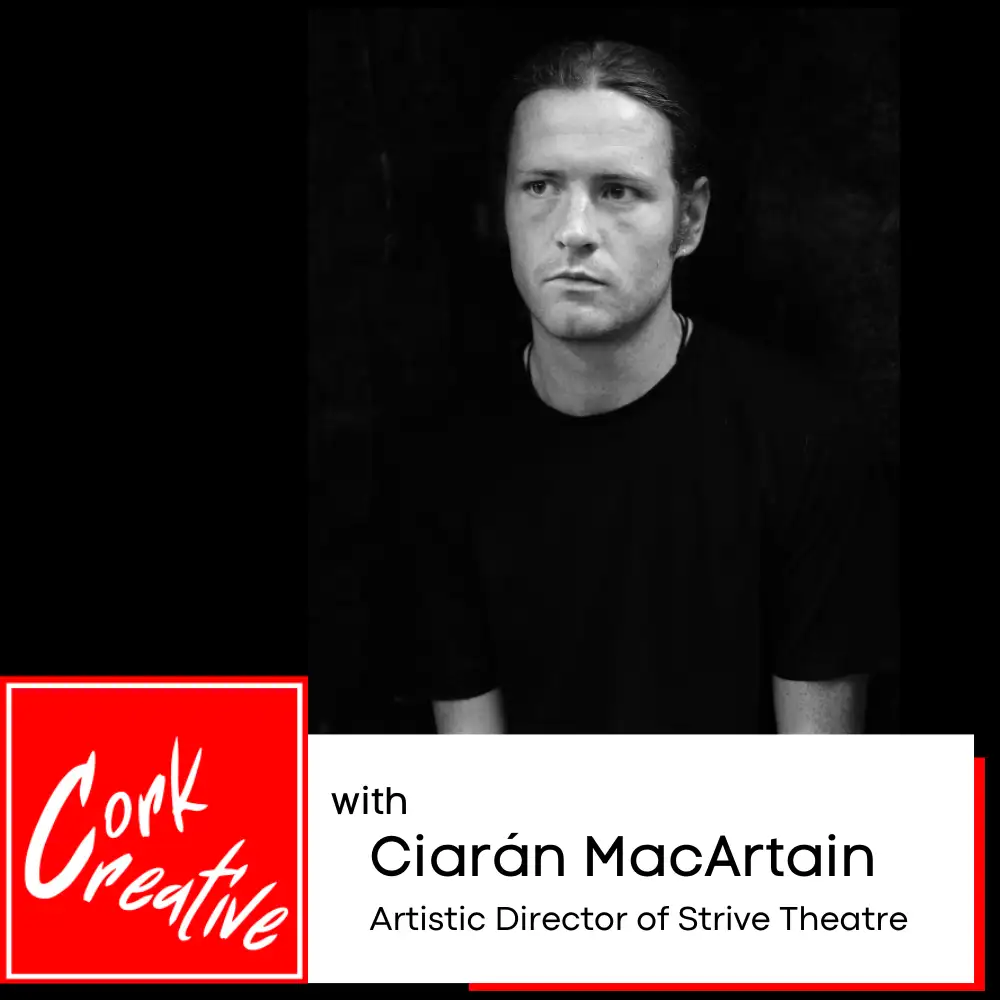
Ciaran MacArtain is a theatre artist, producer, and poet from Glasheen in Cork City. A Drama and Theatre Studies graduate from UCC with international training in New York and Montreal, he is best known as the Artistic Director of Strive Theatre.
Under his direction, Strive has produced 10 original plays, embarked on an international tour, and launched initiatives like their Play Development Scheme to nurture new local work. His wide-ranging theatrical practice encompasses directing, lighting, acting, and producing, with recent credits including Carina McNally’s The Crow’s Old Gold and Goll – a multidisciplinary folk opera developed with Cork band MacBóchra.
Beyond the stage, Ciaran is a prolific poet and frontman for the experimental performance group The Choke Collective. He represented Cork as a cultural ambassador to Coventry in 2017, has performed his poetry at festivals across Europe, and is currently preparing his debut poetry collection.
In this episode, we chat about making accessible theatre in Cork, play development, and his folk opera, Goll.
About this podcast
Date: 22/10/2026
Duration: 42:12 mins
Ciaran's Lesson Learnt:
“Just because you are extending yourself maybe too far to sustain something doesn’t mean you can expect that of other people”
Listen ....
Watch ...
Episode Chapters
00:00 Introduction & Early Artistic Roots ( Intro, early inspirations, and youth theatre)
04:01 Founding Strive Theatre & Accessible Arts in Cork (The origins of Strive, site-specific venues, accessibility, and Cork’s influence)
11:42 Developing New Work: Process & Priorities (Selecting plays, the Play Development Scheme, and why development matters)
20:23 The Realities of Running an Indie Theatre Company (Administration, funding realities, building the right team, and evolving artistic approaches)
27:06 Staging ‘Goll’: An Experimental Folk Opera (The MacBóchra collaboration, mythological inspirations, rehearsal processes, and audience takeaways)
35:21 Funding, Sustainability & Business Lessons (The financial and sustainable aspects of the theatre business)
Share this page
Transcript
Download transcript as a PDF here
Requires Adobe Acrobat or Equivalent. Also opens in web browsers.
[00:00:00] Ciarán MacArtain: You’re not doing it to have your name in the poster. You’re not doing it to further your own career. Like obviously, hopefully your career will be furthered by it and hopefully, you know, there’s other things that come of it. But ultimately, the reason that you’re going to work is for the benefit of the project and that’s I suppose a key sort of rule of thumb. We just find it really interesting and also very sort of important to keep these stories alive. Not keep these stories alive kind of makes you sound like a doctor, but it’s more like it’s not like keeping, it’s not like a resuscitation game. It’s like to join the annals of people who have told these stories before. You know, that production, that original production was very important to us. Now for me as an artist, like I wrote that play and that was a big moment for me to write a full-length play. My ideal sort of as a writer or as a theatre artist is to, you know, you’re responding to the environment in which you live. So Cork City is that place for me and that’s, you know, that’s inextricably linked to Cork City like you know.
[00:01:11] Geraldine Hennessy: So today I welcome artistic director of Strive Theatre Ciarán MacArtain onto the Cork Creative Podcast. Hi, Ciarán.
[00:01:19] Ciarán MacArtain: Hi Geraldine, how are you doing? Thank you so much for having me on.
[00:01:23] Geraldine Hennessy: Great. How did your journey into theatre and the creative arts begin?
[00:01:30] Ciarán MacArtain: It began when I was maybe 15 when I was in school. And so basically, yeah, when we were in school, we had a friend of mine Colm Deasy. We used to write songs together and play in a band together. And then around about that time, I also, so that was like one kind of creative endeavour. And then I think it was that Christmas when I was about 15, I saw my younger sister in the panto. I used to just be like into playing football. That was the only thing I was really interested in when I was that age. My mum was going to shoot a free ticket to the panto because my sister was in it and she invited me along. And I had no notion of going really. I couldn’t start and then I just, I don’t know, something came over me and I decided to go down and watch the panto. It was the one in the Opera House. And yeah, it just looked really fun. I saw my sister having a great time up on stage and I thought I wanted to get involved in that. And so then originally I joined a musical theatre class from there and then musical theatre wasn’t really my thing so much. So then I joined a youth theatre, activate youth theatre up in graffiti up in Blackpool. And so I joined there when I was 15, 2016. And then it was kind of in that youth theatre for a couple of years. Had a great time up there. Really, really special place, really fantastic organisation. And so that was it really. That really kind of set the ball rolling for me. It was when I was up in graffiti.
[00:03:07] Ciarán MacArtain: We kind of devised the play when I first went up there. Gave us great insight kind of into that sort of process of making the play as a group, devising work. Before that I’d only ever thought about the idea of writing a play, but actually devising a play together was really interesting process. And so then we put that on. And yeah, I just loved it. We just drinking it in. I absolutely loved it. And then they kind of got on so well there and I applied to do drama and theatre studies in English and UCC and then went on and did drama and theatre studies and stuff. So that was kind of the start of it. That was the start of it. Let’s have it.
[00:03:49] Geraldine Hennessy: The panto began it all really.
[00:03:50] Ciarán MacArtain: Yeah, it was a funny thing to say, but it actually was the panto yeah.
[00:04:01] Geraldine Hennessy: And what initially sparked the idea for you, I suppose, to take the leap into co-finding Strive theatre, a fairly significant leap.
[00:04:11] Ciarán MacArtain: Yeah, I suppose we were in second year in college and I don’t know, it was interesting. I think we were quite a small class, like 20 of us, and we got on really well in the class. And we were just so into theatre at that time. We were just completely drinking it in. We couldn’t get enough of this. And we were also heavily involved in Dramat. And that was during a really fruitful period for Dramat. There was lots and lots of shows going on. So that’s the drama society in UCC. And there used to be four main stage productions per term. So the eight full production of the year plus a pantomime plus a short play festival plus music. There was all sorts of things going on. And we were heavily involved in them. And then we had our own productions. We did a first year production, we did a second year production. So we just had lots of shows going on at that time. And really passionate about it, and the one thing, we used to do all our work in the Granary at that stage. I was accessible to the theatre department, but also to Dramat. So we were doing all our shows in there at that time.
[00:05:24] Ciarán MacArtain: And then we kind of had a notion. I had written a play called The Rooftop to Paris, and it was set on Barrack street. And we really wanted to do it in another location other than the Granary. And we wanted to kind of do it in a site specific location. And then that was difficult to facilitate through Dramat. And basically then me and the other guy who founded the company, whose name is Andy Weston, he was in my class, we were in the same class together. We just went driving around in his car looking for another venue to do the show in. And then we ended up doing the show. We found there’s like a performance place at the back of Nancy Spains, they used to do gigs in Nancy Spains isn’t there anymore, obviously, but they used to do gigs there and things. And it was actually like the play was set in an apartment that was overlooking this space. So we were like delighted with ourselves. We’d like to stop cold, you know, and then Tom Lynch was the guy who was in control of that space at that time. He was running Nancy Spains because he owned the bar next door as well. And he was just really supportive of us, really, really nice man.
[00:06:33] Ciarán MacArtain: So basically then we sort of rehearsed the play in UCC and the technically we were students at the time, we could get rehearsal space very easily. And then we produced it ourselves basically. And then once we were decided to produce it, I felt that’s when we decided to found the company in order to produce this play. And I suppose at the time, we didn’t know like how long it would last or, you know, the idea was around producing the play. But yeah, I kind of had a clear set of ideals as well. And so far as kind of wanted to get new people into the theatre, we’ve kind of felt the theatre at the time was very sort of in its own sort of world. And a lot of people didn’t really go to the theatre. And, you know, there was kind of a high brownness about it. And maybe a sort of a barrier, a kind of cost barrier there as well for people. And we were just interested really in putting on shows that like asked me spoke about the community and were like, you know, true to life that new plays that were responding to the situation which we were living at that time. And so yeah, that’s kind of they were our goals.
[00:07:39] Ciarán MacArtain: And so then, yeah, I mean, at that time, I saw it seems like kind of like a pretty ambitious thing to do to find the theatre company. But actually, at the time, like we were all studying theatre and we were super interested in theatre and lots of us acted and some of us were designers, you know, like you, you know, you couldn’t throw a stone for it in the theatre. And we were hanging around together, you know, so it made sense, I suppose the next kind of logical step really.
[00:08:00] Geraldine Hennessy: Yeah, yeah, exactly. Yeah. So your idea was to kind of bring it more to a kind of more making a lot more accessible, was it to everyday people?
[00:08:11] Ciarán MacArtain: Exactly. Yeah.
[00:08:12] Geraldine Hennessy: Okay.
[00:08:13] Ciarán MacArtain: So like for that show, the tickets were only a fiver.
[00:08:16] Geraldine Hennessy: Oh, yeah.
[00:08:17] Ciarán MacArtain: And we gave free tickets to all the businesses on Barrick Street. They had like they were just invited to come in to see the show. Like we were students and we didn’t pay ourselves to the show. We barely even but that wasn’t really the point. We got a lot of favours done for us. Like a lot of people like lent us things, Tom Lynch, like, like let us work out in this beer garden for ages and ages, like building set and things. And we kind of, it was that type of production, but we were keen then to have people from Barrick Street see the show, you know, because it was set on Barrick street and it was set like in that day, like it was set out at times as well, you know, so it was not kind of, there was a big, that was a big thing for the company. That was a big ideal that we had at that time.
[00:09:01] Geraldine Hennessy: Yeah.
[00:09:02] Ciarán MacArtain: As we kind of maintained that, like we try to keep the ticket prices like as cheap as we could affordably do it at and things like that. And like obviously with inflation and other things and, you know, an increased professionalisation over the years, you know, longer doing it for free. So the tickets inevitably go up at one level. It’s like as a professional endeavour, but we still maintain that ethos really of like trying to get people in to see show who maybe wouldn’t be a traditional theatre going audience, you know. So yeah, it’s been a priority for us. Yeah.
[00:09:35] Geraldine Hennessy: Okay. And how has you mentioned there about Barrick Street and wanting, I suppose, the locals to see that first play, like how was your connection to Cork shaped your creative identity and the stories you want to tell?
[00:09:49] Ciarán MacArtain: A lot really, like, you know, especially, I suppose, that story, you know, that production, that original production was very important to us. And then for me as an artist, like I wrote that play and that was a big moment for me to write a full-length play. And like, as my ideal sort of, as a writer or as a theatre artist is to, you know, you’re responding to the environment in which you live. So it’s like very much Cork City is that place for me. And that’s shaped, you know, is my own practice as an artist cannot be, you know, it’s inextricably linked to Cork City. Like, you know, it cannot be, you know, cannot be separated from the environment of which I live, you know, talking the same, like I write a lot of poetry and things. And that would also be influenced by, you know, the modern day in Ireland, social, the zeitgeist in Ireland, the kind of social setting that we live in. And, you know, obviously that changes many times over the years and things, but the place itself is like vital, I suppose, to that in terms of it’s like, that’s the arena in which all of that writing and all of those pieces of art are made. It’s like, you know, that’s what it’s being responded to. So yeah, I would say it’s very important. Like, yeah, it’s shaped me a lot, you know, and for this company, that’s definitely the type of work that we strive to make is like we only work with new plays. Oftentimes, you know, new plays that are set in the, they’re often set in the present day. They’re all set in, you know, in Ireland, because we are an Irish company. So it’s like, and then because we’re based in Cork City, you know, that inevitably has a big impact.
[00:11:40] Geraldine Hennessy: Okay. And as an artistic director, like how do you go about selecting or developing the narratives you want to bring to the stage?
[00:11:50] Ciarán MacArtain: So it kind of has changed a few times, like throughout the history of the company. It’s like, company is going to be, it’ll be like the 14th anniversary of the company in October. It’s like probably different chapters of its life, I suppose. Originally with me and Andy, we’re running the company together. And then me and Hana and Sheedy ran it together for three years. And then there’s been kind of multiple sort of collaborations with different producers. So like, we work with the writer of, maybe we’re working on a project, we work directly with the writer of that play, say, and then myself and the writer would generally co produce the play. So we’re kind of the model, kind of has been the model since then. And so there’s a couple of different ways in which we still, I suppose it can be sort of like for our most recent play that we’re doing, which is “Goll,” which is coming up next weekend. That was like, I initiated that process. So I saw, I approached Brendan, who’s the leader of the band, MacBóchra, to initiate that collaboration. We spoke about how that might work and we sort of devised a structure for how we might develop that piece. But then other times, there would be like a submission to the company. So we would take submissions, we would read scripts in various pages, you know, in different drafts and things. And there’s a structure there for the development of the new script. So it’s called the “play development scheme,” and it has like a three-phase structure for developing a new play.
[00:13:32] Ciarán MacArtain: So basically, if a script was submitted to us, we would read the script, maybe give it to, you know, a few people in the company read the script, have a little meeting about it, discuss it with the writer. And depending on what stage it was at, you know, they might have, this might be the fifth draft or sixth draft, and like, they might have been working out for a long time or might just be first or second draft. But we discuss like where they’re at with the process and what their ambitions are for it. And then we kind of make an offer to develop it with them and you know, you look for like development funding, first off, from like Cork City Council, the Arts Council,try and get money into develop the play. So there’s a whole kind of a couple of phases of that development to include like a reading phase, where you do a closed reading. And then after that reading, you allow the writer to make some edits, and then do an invited reading with the public will come in, or like public that you’ve invited maybe other theatre artists or experienced theatre artists around the place who come in, and then they will have a chance to ask questions themselves, but then also the writer would have a chance to ask them questions, and the company will ask them questions.
[00:14:47] Ciarán MacArtain: And then there might be another editing process then. And then basically, we have another meeting with the writer and then we go and devise a kind of program for like a week long workshop. So oftentimes, we’d use the Theatre Development Centre, which is now run by Cork Theatre collective, it used to be run by by Cork and Orca. So we’d go in there then for a week or two weeks depending on funding really, and look to develop the play. So there’ll be a bunch of different techniques we’d use at that stage of the process, to sort of develop the script, make it as strong as it can be, I suppose, test different things out. And then there’ll be like a working progress performance at the end of that. And then there’s feedback session at the end of the working progress, and then the writer will be taking notes the whole time. So the writer will be involved in that process whole day, like, they’ll be in the room the whole week, you know, and they’ll be taking notes all the time. But then also during that feedback session and during the working progress, they’d have a chance to take notes. And then they go in make more edits to the script after that process, and then we’d read it again. And then we’d see what we’re at with it, you know, is it ready to be produced? What would it require to produce this? If it came to a stage where it was like, okay, this is like a really, this is going to demand a really big production, like huge production, and maybe we don’t have the availability to do that right now, or we didn’t have the resources to do it, then we wouldn’t take it any further. But oftentimes, we would take it further. Oftentimes, we would like after having that process done, you often like have a yeah, you try and fund the full production of it then. So you then work together to apply for funding. And then, yeah, make a plan for the production. And then after the production, if you have the momentum there, you look to tour with the play then.
[00:16:36] Geraldine Hennessy: Okay, it’s quite a complex process, isn’t it? When like it’s a new play, like, like a comparative of an existing play, is there is that part of that whole complexity, almost like something that you thrive on, like you like that whole bringing it from like, it’s right infancy right up to the final product, it must be, it’s very obviously time consuming, and it takes an awful lot of work. And it must be difficult if you can’t get it to a final produced piece. But it must be also extremely rewarding if you do.
[00:17:10] Ciarán MacArtain: Yeah, I suppose it is. Yeah, it’s a big motivator. You know, older plays, like that work has already been done at some level, whether or not it’s been by the writer themselves or other companies, you know, Fish Amble, or great developer of new work, and there’s other companies around that develop new work really well and have structures there as well. And I suppose the thing about it, like, I suppose it comes from a kind of like, I would also be a writer, and I would also, you know, I’d appreciate this kind of support in my process, well, when I was younger anyway, would definitely seek that kind of support out. I suppose it came from a place of like, when we were younger, the few plays that we did, that you kind of end up flipping all this time and energy into, and then when you pull it off, you kind of realise actually it’s the script itself was not really ready to go like the script could have done with like a longer period of incubation and could actually be stronger. And but that time is too late, like, you know, we’ve like spent all the time in rehearsal, you know, spent all you’re resources on the design and then put up the show and then you’re like, oh, actually, it would have been a lot stronger if we had spent longer developing that script and then pulling the trigger on the rest of it. And that’s kind of a hard lesson to learn, you know, because it’s only six months or something in your life, like, you know, it’s like, it’s the whole while, like, you know, so, and like, especially at that time, like, we didn’t have much money at all, you know, it was like, it was obviously something is hard to come by and when we were younger, and, you know, you’ve heard of it’s like harder to come by again. So, you know, it’s kind of an expensive lesson to learn when you are just starting out.
[00:18:57] Ciarán MacArtain: So basically, after that happened, with an earlier project, we kind of felt, okay, I was also getting mentored by a girl called Irma Dorito, who was my mentor between 2016 and 2018, right when I finished college, and she runs a company called Blue Roses in New York, and they use a similar structure for developing new work. So then it was kind of like, that company is really successful, it’s been running for years and years, and that’s the method that they use. I was like, okay, that’s good enough for me, you know. So even though it’s quite like a creative process, obviously, there is a lot of kind of structure, system and processes behind the creative issues that make it work so well. So it’s labor intensive, and then it’s cost intensive as well. So it’s like how many times you do it, like, you know, the feasibility of it is always a challenge. But the theory of it is strong, and like, the plays that we’ve produced have by and large, like, being very well received from a… Yeah, so they’ve benefited from the… From a critical and audience point of view, like, you know, so yeah, they’ve benefited from the process, you know, like, if you look at the draft of the script that came in, and the draft of the script that was produced, that you could definitely see the development there, you know.
[00:20:23] Geraldine Hennessy: And how do you balance like the the creative and the logistical sides of running a theatre company?
[00:20:29] Ciarán MacArtain: Yeah, it’s really challenging. It’s kind of like, like, we’re up in the Civic Trust house at the moment, that’s where I’m sitting now, and we’ve shared office here on the top floor. And so you come in here, reach… It’s like a great space that you can kind of come into and do your sort of administrative side of the work. I suppose there’s always a balance, you know, there’s times of the year where you’re doing a lot of administration, applying for funding, very labor intensive to apply for funding. And I know people in other sectors kind of see us free money, but definitely not that. And because you might get one out of every six or seven, you know, your strike rate probably goes up as you get older, but you don’t get that much funding in, and it takes an awful lot of time, might be like 40 to 50 hours of work to put together a funding application, especially if it’s a touring application or something, you know, quite extensive. So yeah, I mean, learn November, then the lead into November, like October, November, it’s like heavy administrative burden coming into the summer, after the end of July, there’s another deadline there. So they’re usually quite administrative, and then obviously for the production themselves, like usually we’d hire a production manager, which would support that. And we usually also work with the co-producers, so they support us with that process of producing it. But no matter what, like, there’s always a lot to be done and the communication side of it, depending on how big the team is, that’s always a challenge because it ultimately falls down, you know, like ultimately comes back to, you know, you have to make sure everybody’s getting communicated with, and that could potentially be 10 people, you know, it’s just like, so yeah, there’s a challenge, there’s always going to be an administrative side of it. But yeah, I suppose it’s like without it, the other side of it doesn’t happen. So you just kind of have to eat that really.
[00:22:36] Geraldine Hennessy: And speaking of the team there, like what’s kind of key qualities do you look for when building a collaborative team for new production?
[00:22:46] Ciarán MacArtain: Like an openness to work together and being like, actually some of is, you know, there’s your track record your track record as an artist and like your vision as an artist is one side of it, but actually your ability to work together and be and listen and be, you know, working in collaborative space is important as well. And like people who kind of understand that like the project comes first, you know, that’s one thing that we, I mean, how do you say to each other a lot when we run this company together, it was like, you know, project, like the, it’s the play is the most important thing. The thing that we are working for is for the good of the play and the good of this production and the good of this, like in terms of the people that we look to work with, they have to understand that, I suppose, we have to have an understanding of that, of that fact that like you’re not doing it to have your name in the poster, you’re not doing it to further your own career. Like obviously, hopefully your career will be furthered by it and hopefully, you know, there’s other things that come of it. But ultimately, the reason that you’re going to work is for the benefit of the project. And that’s, I suppose, a key sort of rule of thumb. And when we would be hiring for a team, for creative team or casting or anything like that, you kind of like, you need people who have that who are all pulling in the same direction. And that’s, you have to try and sense that, you have to try and…
[00:24:26] Geraldine Hennessy: Makes the job a lot easier, doesn’t it? Like everyone’s pulling together with the same vision, yeah.
[00:24:31] Ciarán MacArtain: 100% Yeah.
[00:24:32] Geraldine Hennessy: And how has your own artistic vision evolved from the early days of the theatre to where you are now?
[00:24:40] Ciarán MacArtain: Definitely, when we were starting out, it was definitely based on a writer-led model. Like the company was interested in producing new plays and like supporting the writer in the writing of new plays. But as you probably know, like a lot of the time now in theatre, like contemporary theatre shows will be devised as well, like working as a group. And we were all like, well, personally, I was definitely very resistant to this model for a long time. And I feel kind of wary enough of it. But also, in the last few collections that we’ve made, we have worked more in that way of like, we didn’t start with the script, we kind of started with a concept and went into a room and worked on it with other artists and kind of came together and developed this idea. It was a show that we did in 2022 called Styx, which was like a docudrama kind of thing. It was based on real stories of migration to Ireland and it was based on like the used actors and non-actors. So the content of the show was built around the stories of the people who were performing the show. And so that would have been a far cry from like work that we would have made earlier. Earlier, it would have definitely been about the writer and the writer’s process and works of fiction. So that was kind of a kind of marked a new departure for us. And it was a very interesting process. And it was made in a different way. And I suppose we sort of experimented with new technology or experimented with the form a bit, you know, like a walkthrough performance. That’s the other one in the Cork Arts Theatre Theatre, but we started in the foyer. We used the dressing room as a performance space and then we walked into the main space and then all the audience sat on stage. And then there was another like exhibition, like a seating bank was used as an exhibition space. And like when they walked back through it into the foyer and that’s where it ended. So it was just kind of like, yeah, it was kind of deconstructed in that way.
[00:26:51] Ciarán MacArtain: So like, yeah, I suppose we kind of, for ourselves, I think we experimented a lot during that show and kind of it’s been interested in doing that in a more recent work, more and more. And then I suppose this play that we’re doing now is a collaboration with a band in six episodes. It’s not really a play. Trying to figure out for a long time what to call it, but it’s like that kind of it’s an experimental folk opera. So it’s kind of like based around these six songs, which have been by Cork band MacBóchra and they were around this character. And Fintan mac Bóchra who appears like over 500 years, like in Irish mythology, he was a salmon an Eagle and a hawk in different stories throughout the ages. And they’ve written these six songs about different passages from his life. And they worked together with the band to adapt them into six episodes of theatre. So it is like inherently theatrical, but I suppose it wouldn’t follow the conventions of playwriting or like, you know, the narrative conventions of a play. So that again would be like a new departure, definitely for us, you know, like that’s not us. The first way before five productions that we did were all based around supporting the writer, making it worth it and being more traditional following the structure of a play. So they’re like, they both represent sort of new departures for us. And it’s interesting, like, you know, there’s something gained and something lost in changing that structure, but it’s been definitely stimulating creatively.
[00:28:41] Geraldine Hennessy: Absolutely. It must be incredibly interesting if it’s like a complete new direction. And we’re just like, where do you get the inspiration from, like for something like Goll?
[00:28:51] Ciarán MacArtain: Yeah, I feel this project Goll, I suppose the inspiration was to see the band play like Brendan Duffin writes the lyrics and then it kind of collaborate on the music. But Brendan’s writing is really, really very visual, real strong images in the writing. And like, I suppose just looking to them sing those songs really tapped into something for me. And like, the instrumentation is quite traditional and so far as like, baron features heavily, there’s a jaw harp yeah, there’s a tin pond, the hammered dulcimer, all these kind of quite old instruments. And I don’t know, it’s very much moved me when I saw them play the first few times that I saw them. And I see I saw them two or three times in a row and every single time I was just like seeing images in my head and I’ve seen like how things might develop there, how it would work really well in a theatrical setting because the stories are really rich, like they’re really laden with images and also very poignant stories that have survived like millennia, you know, so long. And like, from that point of view, we just find it really interesting and also very sort of important to keep these stories alive, not keep these stories alive, kind of makes you sound like a doctor, but it’s more like, it’s not like keeping, it’s not like a resuscitation game. It’s like, to join the annals of people who have told these stories before and…
[00:30:34] Geraldine Hennessy: Give it new life and in your life.
[00:30:35] Ciarán MacArtain: Give it new life, it’s a new interpretation, you know, it’s a new interpretation of these stories. That’s where we see ourselves at the moment is like we’re just retelling a story, you know, like it’s an oral tradition, we’re retelling the story in an oral way and a contemporary way. So that’s where we see the importance of the work, I suppose. Yeah.
[00:31:02] Geraldine Hennessy: And what has the rehearsal and the development process been like for leading up to this run now up in the Cork Arts Theatre?
[00:31:11] Ciarán MacArtain: It’s been interesting. So we premiered the show in February in the Briery Gap, but we’ve rehearsed some period before then. And before that, we had quite a long period of development. So we did, we kind of been working on the project for the last three years or so. And we did a couple of different like works in progress. We like, for the show up to Electric Picnic, performed up there two years in a row with different versions of the show. We did a couple of different development weeks in different places. We were in the everyman for a week. We were up in Monaghan for a week. We did some field research at the Hill of Tara. And we did like a bunch of standalone workshops and the meet up to different performances. We also performed quite a work in progress at the Winter Warmer in Nano Nagle Place poetry festival, Ovale host. So each of those processes had different periods of work, just leading up to them. And then the show evolved in each of those different renditions of it. And then the ice was leading up to the premiere, really kind of like a solid period of rehearsal. And then I suppose for these performances coming up now, we’ve just been rehearsing to make it familiar to us again, with the other too many changes since we did it in the Briery Gap. But I suppose the Cork Arts Theatre and the Briery Gap are quite different, a space. So yeah, I suppose we’ve been discussing how to adapt the design to make it fit into this new space and then also what does it mean for the actual movement of the show to be in a new type of space and also, yeah, we’re also rehearsing to just get it back. I mean, it’s kind of like February’s a long time ago now. So for the performers and stuff, we’re trying to really just get it back into our bones. Make it new again, make it again. So that’s what the priority has been.
[00:33:23] Geraldine Hennessy: And like, what are you hoping the audience will take away from from that after the curtain falls on it?
[00:33:30] Ciarán MacArtain: I suppose we’re hoping to stimulate their interest in those stories. We’re hoping that they have an understanding of who this character is or an impression of who this character is. So it is quite experimental or quite abstract but. There’s definitely, I suppose, strong images there in the stories and they thought, yeah, I suppose what we’d like the audience to gain is an interest in this character and an impression of the character and stories that have made up this character’s life and why they’ve been so important in the folklore tradition. Yeah, we’re looking to do this in a kind of contemporary way, that it’s a contemporary retelling of an old story or old series of stories. So that’s the experience that we’re looking to share. And then also, we hope for them to have a stimulating experience in there. There’s a lot of different elements to it. There’s very comprehensive audio visual design by Benjamin Burns, there’s shadow stance, contemporary dance, and some shadow puppetry. There’s quite different elements of spectacle and things like that. Obviously, there’s the music, which is at the heart of the whole thing. There’s some more dramatic moments. The Irish language features heavily throughout it. It’s old, middle, and modern Irish. They all feature throughout the performance. So, yeah, I suppose we hope for people to be stimulated. I mean, we hope for people to gain that bit of an understanding and of the intimate folklore of these stories. Yeah.
[00:35:19] Geraldine Hennessy: And building a theatre company from the ground up, it’s no small fish. What’s one of the biggest hurdles you’ve had to overcome, do you think?
[00:35:29] Ciarán MacArtain: Yeah, it’s funny. There’s a lot of challenges, but I think your own personal sustainability is a big part of it. How much it can sustain you as a career, how much being self-employed in the theatre, how viable is this over a long period of time? And there’s definitely been periods during the history of the company where it hasn’t really been that viable. There’s been times where I’ve worked other jobs to compensate for the lack of income coming through the company. So, I mean, these are challenges. And I suppose it’s like when the going is good, the going is very good, but there’s also moments there where like you’re not that stable financially, you might be working a lot of hours in another job. Par for the course, you know, you’re working in a bar, working in restaurants, working wherever you need to work. And then, you know, at one level, working in those other sectors kind of feeds your artistic sort of process at a level, but then at another level it can be exhausting. And so, with the stage where I was working in bars and things, it was like, you’re paying rent on an office that you only have access to like nine to half five, but then you’re working like whatever time because you’re in the bar and then you’re like not getting into the office to be there at four nine o’clock. So, it’s hard, you know, it takes a bit of balancing that, you know, and just like, so, yeah, I suppose financial challenges really are the big challenges, you know, I suppose lately we’ve been fortunate enough to get a bit more funding into the company and they’ve made us more sustainable. I was on the Universal Basic Income pilot scheme there for three and a half which was fantastic and it made that need to go and work other jobs less and less. And so then, that was a really big time of growth for the company because I was able to dedicate myself to the company and have an income and be a sustainable where as previous to that. And since that ended, it’s like you’re only really being paid like per project, you know, so you take a fee from the project and you take a fee for that role for like for the background administration and this kind of stuff like unless you can get, yeah, that also takes funding. So, unless you have funding in there to do that, I mean, yeah, I suppose when I was on that scheme that that work was being covered, so it like made it more sustainable, I suppose, but because without some funding there to cover your time as an administrator and a kind of manager, it’s difficult because things can slide, you know, things like, it’s like we were saying a while ago about communication and, you know, people need to communicate with whether or not you’re being paid to communicate with them or not. So, if you want to do is like, you know, that’s the brass tax, you know, so, yeah, they’re the challenges. That’d be the big, like, that’s the big challenge really for me. But I suppose lately, like I said, it’s been more sustainable.
[00:38:52] Geraldine Hennessy: Okay.
[00:38:52] Ciarán MacArtain: And it’s been kind of in a healthy place that way.
[00:38:55] Geraldine Hennessy: So, long way continue.
[00:38:57] Ciarán MacArtain: Exactly.
[00:38:58] Geraldine Hennessy: And what’s the most valuable lesson you’ve learned about the business side of the creative arts?
[00:39:04] Ciarán MacArtain: I suppose the most valuable lesson for me is that like, just because you are extending yourself maybe too far to sustain something doesn’t mean you can expect that of other people, you know, insofar as like when it’s your own company or a company that you’re involved in, since its foundation, like, you’re always going to be inspired to go the extra mile, do the extra thing, even like I was saying, whether or not maybe you’ve maybe you’ve worked the hour that you’re getting paid for, but the listen this and this needs done. So, you’re going to go and do that. It’s like, just because you are willing to do that, doesn’t mean you can expect that from anybody else, you know, and that, Yeah, that lesson is very important because it’s like, if you do get into a mindset of you’re expecting other people to do that, well, it’s like, then experience that you’re providing for other artists, just isn’t as good as it should be. And the conditions worsen then, you know, if you if you if you’re going to go and ask them to do ask people that you’re working with to do more than they should have to, then the conditions of the job are decreasing the more and more you ask them. So I think when I was younger, I kind of suffered, like, took me a while to learn that lesson, like, and there was definitely moments there where I was like, maybe expecting too much from people versus what they were getting out of it both financially and artistically, like, so yeah, but I suppose it’s a good lesson to learn too, like, you know, and then it’s also like, you have to kind of step back from the whole thing and be like, well, why are you asking yourself to do that, you know, you can’t, ultimately, after a while, it has to be like, if you’re going to be a professional, then it’s got to be professional. And every hour that you work, you know, it’s got to be, so that’s where the goal is now is just to maintain that level of professionalisation and yeah, we, it’s, I don’t think that struggle will ever go away. But it’s, you know, it’s just as well, you have an increased awareness about it. And I suppose that’s helpful, you know.
[00:41:32] Geraldine Hennessy: Okay. Thanks so much, Ciarán for chatting with me today. If you want to learn more about Ciarán, the Strive Theatre and the forthcoming performance of Goll you can find links to socials, the website and corkcreative.ie.
[00:41:45] Ciarán MacArtain: Super, thank you.
[00:41:46] Geraldine Hennessy: Thanks so much.
[00:41:47] Ciarán MacArtain: Thank you very much Geraldine.
[00:41:48] Geraldine Hennessy: Nice one!
