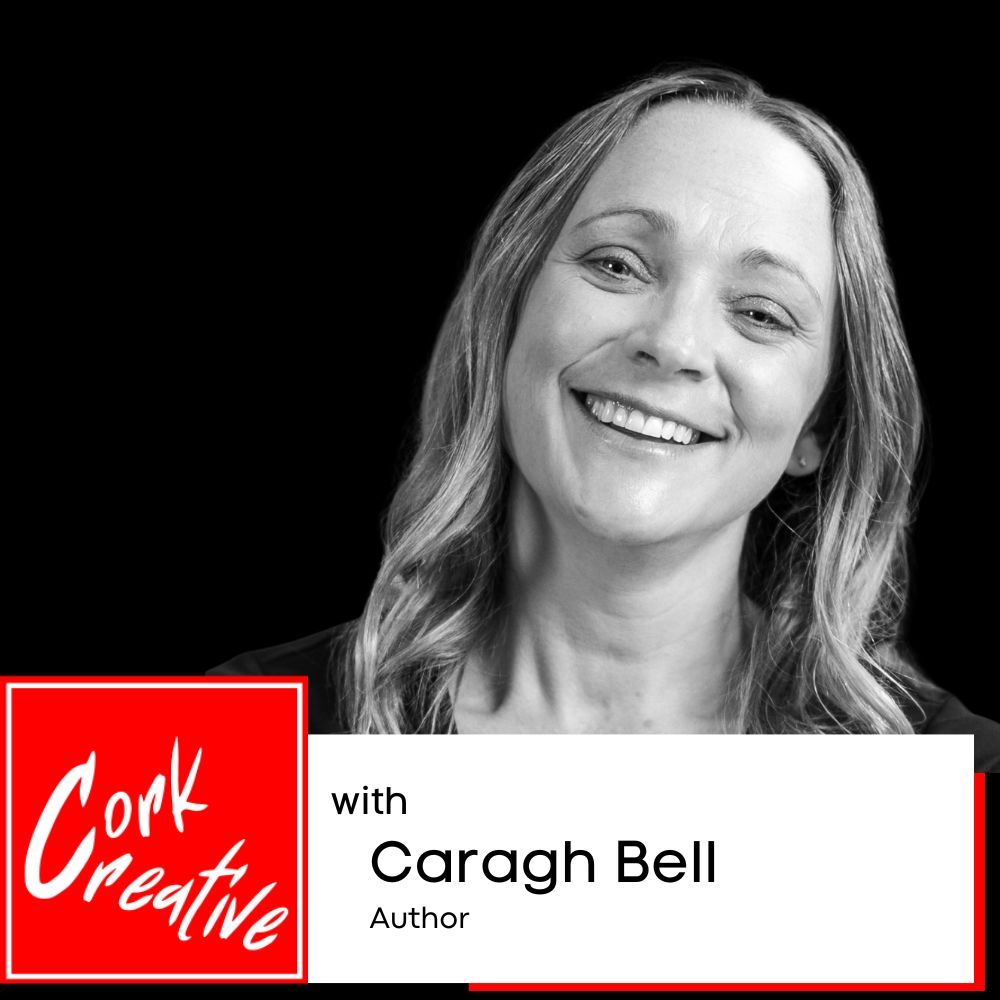
In this episode, we revisit the first Cork Creative guest, Caragh Bell, a Skibbereen native, mother to five wonderful children, a French and English teacher in Sacred Heart Secondary School in Clonakilty and a rising star of the literary world with seven books published and another, Fortuna, launched in August 2024.
As well as being all these things, in colloboration with her students, she has developed a successful podcast series: SHSS podcast and has become more enmeshed in the wonderful Skibereeen Arts Festival programme each year.
In this episode, we chat about her recent projects, her experiences with self-publishing and her future plans along with rubbing shoulders with some literary giants.
About this podcast
Date: 25/07/2024
Duration: 28:40 mins
Listen ...
Watch ...
Share this page
Transcript
[00:00:00] Patrick Kiely: Welcome to this episode of Cork Creative, the podcast that gives those working in the creative arts and business in Cork a platform to discuss their journey to now, lessons learned and plans for the future. This is the first Cork Creative podcast that revisits a previous guest to check in with them and see where they are with their craft and get an update on their future plans.
And it’s only fitting that it’s our very first guest who we revisit today on this podcast, Caragh Bell. This is the second podcast, which we are recording on video also, to give our listeners another channel to connect with our guests through. But that’s enough about Cork Creative. When we last spoke to Caragh, we introduced her as a Skibbereen native, mother of five wonderful children, a French and English teacher in Sacred Heart Secondary School in Clonakilty, and a rising star of the literary world, with six books published and another due to be released in 2021.
In the intervening four years, Caragh has published her 2021 book Mosaic with Poolbeg Press and is now self publishing her latest Fortuna, which will launch on the 8th of August, 2024. As well as this, Caragh has developed, in collaboration with her students at Sacred Heart Secondary School, a podcast series, SHSS Podcast, and has become ever more enmeshed in the wonderful Skibbereen Arts Festival program each year.
So suffice to say, we have a lot to get through today. So you’re very welcome back to Cork Creative, Caragh.
[00:01:16] Caragh Bell: Thank you.
[00:01:17] Patrick Kiely: So for first question, for those unfamiliar, you cite a hiatus on your social media posts and notices about the launch of Fortuna. Do you want to fill our listeners and your readers in on the challenges you’ve navigated since 2020?
[00:01:30] Caragh Bell: Yeah, I was shocked when I read that our first podcast was in 2020. It was around the time of Gabriella. And I launched Gabriella the week before lockdown. It was March 2020. And I had so many events that I had to cancel. I was supposed to go to London and all these events. And it was so disappointing.
But I suppose at the time retrospectively, it’s disappointing. But at the time it was, you know, the least of my problems. We were so frightened. But since then, you know, book sales and book promotion and all of that was very difficult. When Mosaic came out in 2021 we had to cancel the launch because there was kind of a rise in COVID cases again.
It was meant to be in the Ludgate hub, Holly Cairns was supposed to launch it. It was so disappointing. And ironically, I had COVID myself that week. So I remember cancelling it and thinking, oh no, so I made a video launch, but it wasn’t the same. And I couldn’t visit bookshops, I couldn’t sign books, I couldn’t do the normal kind of, you know, you know, run of when you publish a book.
So, I think it was the summer of 2021, so this was kind of prior to Mosaic’s release. I was kind of, you know, writing a new book. I had an idea for one, and I had 90,000 words done. And then my husband was diagnosed with cancer. And he was diagnosed with serious cancer really. It was colorectal cancer and you know, we weren’t given much hope, but thankfully he had an operation and he’s still to the good at the moment anyway.
But again, when you’re not in the headspace to write, you don’t write. And I was under a lot of pressure. I mean, he was going through chemo. I was working full time. So books really weren’t on the agenda. But then he… after his he got better, you know, his scans had been clear. So then I got back into writing in the summer of 2023 and I went back, revisited the 90,000 words and thought, Oh my God, you know, there’s something there and I need to finish it.
And it just was such escapism to go back into my little world that I’ve created. You hang out with my characters and, you know, play around with it. And it’s just been a joy and I finished it and then kind of pushed it aside again, work gets in the way, school gets in the way. But now finally it’s coming out and I can’t wait.
Yeah.
[00:03:43] Patrick Kiely: And you spoke about revisiting your own little world and revisiting the characters and you’ve certainly situated Fortuna in your own literary universe. And you mentioned previously about writing what you know. So how has your life experience over the last four years, challenges that you’ve well-articulated here, how has that fed into the book and your approach to writing this book?
[00:04:02] Caragh Bell: Well, all my books, anyone who’s read my books will know that they’re very much based on relationships. You know, I look at human relationships some, I’d hate to call it chic-lit, it’s not and not that I’ve any problem with chic-lit, it’s, it’s a little bit deeper than that and I look at, you know, loss, grief, heartbreak, you know, I think Mosaic was about adoption, things like that, and that takes quite a bit of research.
So in Fortuna, yeah, definitely. I mean, when I wrote it in 2021, it was very much embedded in COVID culture. And when I revisited in 2023, I had to change all of that because I was just exhausted and jaded from the whole COVID thing. And I said, God, the last thing people want to do is read a book and be thrown back into that. So that took a big change. And actually Fortuna begins sort of March 2022 when we, you know, when the world was slowly kind of getting back to, back to normal. Yeah, Madison, who’s a character in Mosaic comes back in Fortuna and she’s, you know, awful, but actually there’s an awful lot of Madison in me.
I think when I was editing at this time, I was like, Oh God, you know, that’s exactly what I would do. I think that’s the thing. I could be in a coffee shop. I could meet somebody, you know, serendipitously and suddenly, you know, that person could crop up as a character or something they said. And I think all writers say that, you know, we watch everything and we take in everything.
And I get a lot of inspiration, you know, from watching TV and stories and inspiration is everywhere. And it just depends, you know, where the time is.
[00:05:32] Patrick Kiely: Does it make people paranoid to be in your company?
[00:05:35] Caragh Bell: No, no, because it’s not that obvious. But definitely phrases I hear or if somebody says something interesting, and I think that’s cool, that will crop up.
But you’d have to be a mega mega mega fan to get that.
[00:05:48] Patrick Kiely: There’s nuggets in there to be found for those who want to go hunting.
[00:05:52] Caragh Bell: Yeah.
[00:05:52] Patrick Kiely: You mentioned that Madison returns and Fortuna is a sequel and that you also consciously called back to your previous books. So, how do you maintain continuity and the timeline?
Is there a cork board somewhere in your house with twine and pins?
[00:06:06] Caragh Bell: No, and I mean that was a problem because when I wrote the books and when they were traditionally published with Poolbeg, I worked with an editor. So we’d, you know, rub off each other and she’d say, no, I don’t like this and I don’t like that and, you know, sometimes we’d change it, sometimes we wouldn’t, but names were always an issue because, you know, you don’t think when you’re writing, but I could have seven characters with a name starting with C, you know, and she’d say, Nope, you can’t do that. So, when I was writing this book, I originally in Gabriela, Isabel was Isabel Jones, and she changed it to Isabel Flynn because she had red hair. But actually, when I wrote Fortuna, she was Isabel Jones. And it was only when I was editing it, I was like, Oh, my God, everything that I…. It was still Jones in my head, if you know what I mean.
So I had to go back and really look at it, you know. But in my new book, just to say there’s a main character called Rosa and her mom is Cassandra Rosso, who’s an opera singer. And I did that on purpose, just in case you think I didn’t. Because Cassandra wanted her daughter to have a name like her.
And I suppose a variant of her, of her name. So just FYI, just in case.
[00:07:12] Patrick Kiely: That serendipitous commonality of name aside, what can readers expect from Fortuna?
[00:07:17] Caragh Bell: Well, Fortuna is important because Mosaic for me was always kind of truncated. It ended, but I wasn’t finished. And I think I allude to an awful lot of the events that happened in Fortuna are alluded to in Mosaic.
So I would really recommend people read that again. Just various things. You know, at the end of the book, people might have thought, Oh yeah, I never expected them to you know, stay together or be together, whatever. So I just kind of move on and develop their characters and, you know, it was really enjoyable.
So I’ve tied up an awful lot of loose ends. I’ve brought back loads of characters because that again is, you know, I’m my own boss. I can self publish. I can do what I want. So yeah, yeah, it is my literary universe. So I brought back Luke and Lydia and Colin and, you know, all the ones from my original trilogy.
So again, my mega fans will will like that. But possibly an editor would have said no way. But I did it. So, I’m delighted.
[00:08:10] Patrick Kiely: Your re-entry into the world of self-publishing. And Fortuna marks that return to self-publishing for you. Can you describe that journey and how it differs from engaging with a publisher?
Yeah. You’ve already mentioned some of the changes.
[00:08:22] Caragh Bell: Yeah. Like, I mean, I self-published originally. And I think we spoke about that in the last podcast. And it was a great learning curve because I learned everything from the bottom up. How to brand, you know, my work, how to brand myself really. The characters, all of that.
Then I got signed by Poolbeg and they took on my, my self-published work and my new work. They changed the names, you know, and I learned an awful lot from it. When I signed on the dotted line back in 2017 or whatever it was, I imagined it to be a totally different thing to what it turned out to be.
It was kind of a disappointment actually. And I don’t mean any disrespect to Poolbeg or anything like that, but I really thought it was going to be far more than it ended up being not monetary terms. Now I don’t care about money. It was never about that, but I don’t know. I just felt that the books there was just bad timing.
It’s the genre, which is flooded. That’s one thing as well. I mean, it’s not a niche genre, like crime does very well because, you know, but also I think the pandemic and also the fact that, you know, in Ireland you know, unless you do an awful lot of the kind of public or publicizing, I suppose, of your work yourself, and nobody else is going to do it for you.
Okay, so like with Poolbeg, you’d get maybe two or three weeks of attention. And then they move on to the next writer. And I think that’s the same for everybody. But I found it frustrating. I felt not living in Dublin. I was kind of out of the loop. I couldn’t go to events. You know, I couldn’t meet other writers.
It’s very much a networking game. So, yeah. So when it came to publishing Fortuna I really didn’t look that far. You know, I did try and get an agent, but agents are like demigods. It’s very hard to do. And you have to really fit with an agent as well for them to really advocate for your work. But to be honest, I tried one and that was it.
I also kind of said, well, I go to Poolbeg and get published by them again, because it’s easier rather than editing it myself. But again, they’ve pulled back from traditional publishing. I think everybody has. I don’t think books are selling as much as they did, which is a real, real shame. So then I thought, why don’t I self-publish?
But this time it was so different because I had all that experience of editing with an editor. I also had done it originally. So down to like, you know, picking the cover, the blurb at the back of the book. So I just found it so easy and I, I linked with Fintan, he’s in Inspired Design and Print in Skibbereen and he’s published loads of books for people.
But he was a dream and, you know, I was emailing him from my holidays in France, you know, about, you know, various things like quotes, things like that. And together we’ve just, I’m really proud of what we’ve created actually, so I can’t wait now for it to come out. Yeah.
[00:10:59] Patrick Kiely: Do you think that, I suppose, the way technology has moved on since you self-published initially, do you think that that’s lowered the barrier to entry for those who’d like to follow in your footsteps of self-publishing?
I think so,
[00:11:08] Caragh Bell: I think so, but I definitely have become more cognizant of how a book is laid out from having that professional sort of, I suppose, help with the original ones. Do you know what I mean? Like if you, if anyone, any of my mega fans again have one of the original ones that I self-published, my God, they’re embarrassing.
You know, when I look back on it, I really didn’t have a clue. Whereas now, I would be quite tight in what I do and I understand, you know, you learn a lot as you go along. So self-publishing is no joke either. I think you do need to have experience. I think you do need to have, you know, an idea of, you know, punctuation, things like that.
Of course. But editing is hard. Yeah, and you’ll always miss something. So I know I definitely have missed something or, you know, done something like that. But sure, that happened with the professional as well, you know.
[00:11:59] Patrick Kiely: Shouldn’t let perfect being the enemy of the good.
[00:12:00] Caragh Bell: Yeah, exactly. And I, I mean, I’d love to go back now to Echoes of Grace, for example.
So I’d get rid of her brothers. I hate those characters. She goes back to Justin, this horrible guy. He was in the theatre. I wouldn’t let her do that now. You know, but again, you can’t do that. It’s like going back to Enid Blyton and saying that Anne shouldn’t be the homemaker and, you know, applying, I suppose, your standards of now to something that you wrote at a time ,you know.
[00:12:25] Patrick Kiely: Could do a Dallas and have it all as an extended dream sequence.
[00:12:28] Caragh Bell: Yeah but like I had very little representation in Echoes of Grace when I think of it now. And I mean, we’re completely overrun with that now with Bridgerton and things like that. Which is, you know, not a bad thing. And I don’t want anybody to think that.
But, you know, I’m mortified. Everybody’s white. Everybody’s, you know, back then. But I didn’t even think about that. So the world is changing so rapidly. I’m just going to draw a line under it and let it go. But, you know, definitely with Fortuna, it would be more, you know, current, I think.
[00:12:54] Patrick Kiely: And I suppose what are your own, you’ve mentioned some of them already, but what are your own personal takeaways of self-publishing?
[00:13:01] Caragh Bell: Well, I think it’s just being your own boss. You’re not working for the man. Cause like at the end of the day it’s about sales. It’s not about how wonderful your work is. I think really it’s about money and about all of that. When you publish, you don’t make a lot of money unless you’re super famous, you know, like Daniel Steele or something like that.
So it actually kind of nearly cost me money to write books because I had to go to Ludgate and go down there to get away from the babies cause they were all small. And but like, no, so it’s not definitely for money. I would never say that. And it never defined me either. Like I always had my teaching.
I have my podcast, you know, things like that, that, you know, So, it was never, it was more a hobby than anything else, but I enjoy it and it’s definitely something I will keep going with. But you know, I’m just glad to have Fortuna out. I think that was a real labour of love, you know, with everything that was going on.
[00:13:54] Patrick Kiely: Okay.
[00:13:54] Caragh Bell: Mm hmm.
[00:13:55] Patrick Kiely: And for our listeners and for your readers who are looking to pick up a copy of Fortuna. Yeah. Where will they find that?
[00:14:01] Caragh Bell: So yes, it will be on Amazon on Kindle. So I’m getting it. Fintan is doing that for me. Actually, he’s going to make it into an e-book. It will be there in print with CreateSpace, you know, where they print as you order.
But I’m also going to print them with, with Fintan. And then they will be in local bookshops and things like that. So I’ll go on a little tour and put them all around there. But yeah. And I mean, Obviously if anybody really wants one they can contact me on my many platforms of social media But I think kindle is probably a big one, you know, a lot of people use them really so it would be grand.
Yeah
[00:14:34] Patrick Kiely: It seems somewhat churlish to bring up future plans when you’re just about to self-publish your book, but what are your plans for the future beyond Fortune?
[00:14:42] Caragh Bell: Well, so I’m going back to college actually. I’m going to do a PhD in UCC and it’s it was just accepted, the proposal actually in May, and it kind of stems from my, you know, the podcasting that I do with you and Flux but it also, it’s kind of, I’ve been waiting for inspiration for years for something that I really, really wanted to research.
And I think looking at learning and especially since COVID you know, engagement with learning. So this will be about experiential learning. So co-curricular activities that kids do say in TY. Why does it not sit comfortably between, I suppose, third year and fifth year? A lot of parents and kids think it’s a waste of time.
I think it’s brilliant. I think it made my kids, you know, when they went through it. So I’m going to look at, I suppose, the way we value education. Tends to be a little bit points driven, not a little bit, actually a lot you know, you look at places like Bruce College and things that, you know, people pay thousands.
So just, just the end justifies the means. I’m not sure how, you know, educational that all is, but I’m not going to go into that. But so I’m looking at kind of activities or learning that students do in a non-pressurized environment where they develop real life skills, things they can use. So the podcasting was the kind of birth of that, but I’m going to look at musicals.
I’m going to look at mini-company, maybe the morality of teaching them to be capitalists, you know, we’ll see. But like the idea though, that you know, TY, oh my God, could be, you know, incredible. But again, there, there isn’t a standard TY around the country. It’s not obligatory for schools to do it.
Like most of them do. But, you know, so I think it’s important. It’s going to be really, really interesting and really current. And in the post COVID classroom as well, I’ve noticed that kids they’re slower to take responsibility for their own learning, I think as well. And I think that’s coming from being locked down and only kind of a chacun pour soi, you know, they only look out for themselves because that’s the way everybody was.
Whereas, you know, I’ve noticed it very much in school now kind of lack of responsibilities. You’d make an appointment to meet a student and they just wouldn’t turn up. And they wouldn’t even email you and say they weren’t coming, you know? And it’s not, it’s rudeness on one level, but it’s not, it’s, it’s kind of this…this is the way they’re all behaving at the moment. It’s kind of, you know, socially, there’s just been a shift, I think, in how things are done. So yeah, I’ll, I’ll stop talking now, but that’s my next plan. And that’s going to take three years.
[00:16:58] Patrick Kiely: Okay. Yeah. And that’s quite a deviation from Fortuna. And with the last podcast, you discussed dabbling in screenwriting or looking at screenwriting. Is that still something that you’re interested in pursuing?
[00:17:11] Caragh Bell: Yeah, a hundred percent. But again, with everything that’s been going on, I haven’t had a chance. But I do have the pilot of Echoes of Grace. Well, I call it Aurora, which was the original name I had for the book. I have that written. It’s just a case of meeting the right person, pitching it to the right person.
You do need an agent for that kind of thing. But you know, when I watch Bridgerton or any of those things on Netflix, you know, people love that. that kind of stuff because it’s, it’s escapism. It’s something you can sit down. You don’t have to think about anything else. And my stories would be kind of similar in that way.
And I think they would be really good. And actually The Echoes of Grace one I had divided into 10 episodes and they’re all named and the whole lot. So I put an awful lot of work into that, into COVID, you know, during COVID, but it is definitely something. I’d like to do. And that’s why self-publishing Fortuna is a good thing too, because the rights are mine as well.
You know, if I get very lucky and I say this, this is my kind of mantra. I said, you can all party on my yacht when I’m, you know……
[00:18:04] Patrick Kiely: So Netflix and Disney if you are listening….
[00:18:09] Caragh Bell: I know. It’s definitely something I’d love to do though, but I’d love to be involved in it. I don’t want to hand over my stories to people because no, I’d have to be in there controlling everything.
[00:18:21] Patrick Kiely: No, no. Yeah. Maybe not quite everything.
Caragh Bell Well, no, but, you know.
Patrick Kiely: Yeah, yeah.
[00:18:26] Patrick Kiely: I suppose mentors are vital in life and professionally and personally. And I’ve had the great fortune myself to have had several in my life and career. How have you sought mentorship with your writing and developing those supports during your literary career?
[00:18:38] Caragh Bell: Yeah, so, I mean, I spoke about this the last time but I would have made contact with Gillie Cooper when I, when I wrote…when Echoes of Grace was published. I wrote to her agent just to say that I was kind of emulating her in a way that she would have her literary universe where she has Rupert Campbell Black and all the books sort of link and characters turn up here and there.
And that’s one aspect I loved about her books because it was just lovely to see them in different contexts and things like that. So when I wrote to her first, they obviously forwarded it on to her house in Gloucestershire because she wrote this beautiful person letter back. So then over the years we, we just kept writing during COVID and then I met her in… she invited me for lunch in 2022.
So I went down on the train from London and we had the best time and we had loads of wine and we were drinking about, or drinking, talking about poetry and we had the best time. And then the year after.
[00:19:32] Patrick Kiely: I think all the best poets drank about poetry. John Keats was drunk.
[00:19:33] Caragh Bell: Well, yeah, pretty much. But we had a great time.
And then the next year then John and I, my husband and I, went over and we, and we had the best time and then we went again this year. So she is incredible. I love her. She’s so kind, so humble. And this year she was made a Dame. She got her DBE and it was just an amazing experience. And we were there just before it happened actually.
So she was all excited about going. So I wanted to, Oh yes. So when her book Tackle, which is her latest book, was released last year. She’s so lovely. She put in The Guardian her favourite writers, and she liked Jojo Moyes, and she had Oh, Helen Fielding, and whatever. And then, and Caragh Bell is a beautiful writer.
And I’d see people reading it going, who’s that? But anyway, I was so touched. And I think it’s going to be my epitaph when I die. “Caragh Bell was a beautiful writer”. And I said, Oh my God. So I said that to her at the time.
So of course, when it came to self-publishing, I wanted to put that on the front. Of course. Like, why wouldn’t you?
So I emailed her, her personal secretary, which is Amanda. And I said, look, would she mind? So she said, yes. And I said, you know what I’m going to do now? I’m going to say Dame on the front, you know? And so there it is. Fortuna. Caragh Bell. Caragh Bell is a beautiful writer and yeah, the hill I’ll die on anyway, love it.
[00:20:54] Patrick Kiely: The hill you’ll die on and your epitaph, all in one, excellent.
[00:20:58] Caragh Bell: Yeah, yeah.
[00:20:59] Patrick Kiely: When you were speaking before about the movement to self-publishing and the fact that you’re out of the Dublin literary circle I suppose, so it’s, networking is still important and you’re very involved in the Skibbereen Arts Festival.And that would soon be upon us again and the line-up is ever very impressive. What benefits do you get from that engagement locally here in Skibbereen with the creative community and with your creative peers?
[00:21:21] Caragh Bell: Oh, I love it. I got involved, I suppose the first time really was 2015, 2016 and I’ve worked my way up.
You know, when I started, I was cleaning toilets in the town hall and I was, you know. But, you know, I just…now I do literary events. So I think the first one was women in literature. So, there was a reading it was lovely. Last year I did a crime one that you recorded, actually, Cork Creative where I spoke to four Cork crime writers.
It was about Cork noir. And this year I’m interviewing Marita Conlon McKenna, who’s just an icon, and also a local author, Leanne O’ Donnell. She has a beautiful book called Sparks of Bright Matter. So, yeah, so it’s, it’s, it’s amazing. And you get to meet people and, and, you know, everybody knows everybody. And because the festivals are all quite linked here, everybody helps each other really.
So, you know, if you ask, I’m a big believer in asking. And if you get there, you do. And if you don’t, you don’t. We did ask Lizzie Nugent to come down a couple of times. She’s been very busy but we’re hoping she’ll come next year, which would be amazing. But it’s amazing. Even in the literary world, the networking, once you know somebody who knows somebody who knows somebody, and most of them are delighted to be asked as well, because that’s the nature of it, you have to have a platform to kind of talk about your work, to promote your work.
So no, the Arts Festival for me is, it’s just, it’s the highlight of my summer. I really love it. And I love the street party that we have. And this year, of course, is our, our theme is the Olympics because we’re unique. Skibbereen has four Olympians heading out there to row. So we’re going to really harness that kind of energy and excitement and it’s going to be great.
[00:22:57] Patrick Kiely: Brilliant. You mentioned previously your work with podcasts and how this has inspired or part of the inspiration for your pursuing the PhD. So we’re on a podcast at the moment and you’ve introduced your senior cycle students in Sacred Heart Secondary School to podcasts and a procession of fascinating guests with the Sacred Heart Secondary School podcast, SHSS podcast, so can you tell us more about your rationale for that project and your key learnings from it?
[00:23:22] Caragh Bell: Yeah. So it was in 2021 again, kind of coming out of COVID slightly, we’re still masked, we’re still restricted. And it was actually, you know, obviously with you and Flux Learning, did a little bit of training. And we said, do you know what, we’ll start this as a TY kind of module. But it has just grown and grown and grown.
And I suppose our first season, there was a little bit overzealous. We were doing nearly one a week. Cause I had so many people to ask and everybody was like, yes, this is great. Because I think podcasting was one of those things in COVID. Sourdough and getting puppies, which I did – the best move ever.
But anyway so the podcast started off and of course I looked around and of course. Skibbereen, Clon, everywhere is just full of creative people. So we had amazing guests. We had Holly Cairns again. She was great. We had David Putnam who was incredible and his interviews is one I would really recommend people to listen to.
He’s just amazing. And we had local historians. We had Doctors. My God, we had musicians, Justin Grounds played Bach. Oh my God. Just the most amazing experience for the girls because they didn’t know who any of these people were. And then through researching them and, and coming up with questions and interviewing them, it’s just really widened their worldview and, you know, giving them a sense of, you know, life after school because their whole world is the Leaving Cert, Leaving Cert, Leaving Cert.
And suddenly they see that a lot of these people. Maybe weren’t the best at school or the most academic and have just really, you know, found loads of success in their lives. So I think that’s really important. And that’s where it kind of links into my, my PhD as well is to value learning as learning. It doesn’t have to be about getting a H1 in chemistry or maths or whatever, you know, I want to kind of debunk that kind of hierarchy because some of the most talented and interesting people I know would have been excellent musicians or artists or whatever, but we just don’t rate that as much as we should.
Does that kind of make sense? So the podcasting for me has been just incredible and working with you guys has been amazing. The kids, I’ve gone through maybe three years now of them, and actually this year the Leaving Certs when they graduated were my original podcasters and actually Cáit the girl on the on the intro was one of them as well.
And it was just really emotional. I said, Oh my God. And they remembered the people they had interviewed. And it was, it was really lovely and it’s there on Spotify and I would really recommend listening to them. They’re ideal. They’re 20 minutes. You’re out for a walk. They’re not too long. And you know, For example, I mean, it was amazing, you know, really, really interesting.
So check it out.
[00:26:02] Patrick Kiely: It’s peculiar. The people who have listened to it, we’ve come across a retired teachers who are using it to still check in with the school. There’s a community that has built up that I suppose it wasn’t our initial plan or target audience, but it has grown to there. So it’s great to see indeed.
[00:26:16] Caragh Bell: Well, I’ve loads of people in London who listen to it as well. My sister, her friends I was actually having lunch with a friend the other day and she said, yeah, and that podcast you did. And I was like, do you listen to it? She was like, yes. So they get notifications when we have a new one. It’s great.
I was like, you know, because they are really good. Like I always kind of go, God, that person was very interesting, you know, because we don’t stop and listen. I don’t stop and listen. I’m always so busy that when I’m on like I have the earphones on and I’m listening to someone’s story so inspirational.
Yeah, amazing.
[00:26:48] Patrick Kiely: As indeed is your story Caragh and thanks for taking the time to check back and record creative today. Every good luck with the Fortuna launch and with your future plans. If you would like to purchase a copy of Caragh’s books, including Fortuna, we will post all relevant links with the podcast and the transcript.
You will find details of the Skibbereen Arts Festival and the SHSS podcast there also. Thanks again, Caragh.
[00:27:07] Caragh Bell: Thank you so much.
