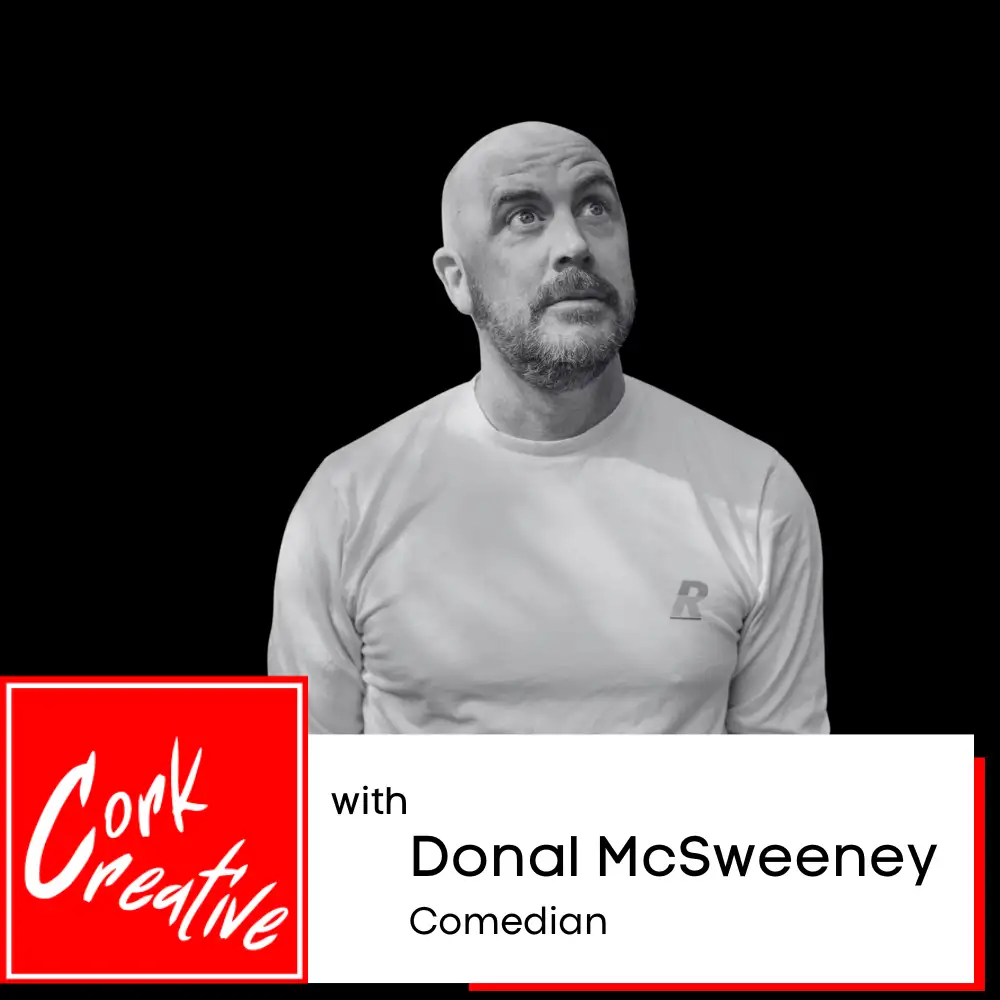
Donal McSweeney is a standup comic and actor. He has been a member of the award winning drama group Kilmeen since the early 90’s. He first dipped his toe into stand up comedy in 2018 and hasn’t looked back since. His standup consists mainly of real life stories brought to life on stage. He has worked with some of Irelands biggest acts including Kyla Cobbler, Chris Kent and Mike Rice. He has helped a number of different comics with stage craft and story structures, using his theatre knowledge to crossover into standup.
In this episode he chats about stand-up nerves, local theatre roots, and building a touring show.
Connect with Donal:
About this podcast
Date: 16/11/2026
Duration: 33:12 mins
Donal's Takeaway Tip:
“If you were interested in doing an open mic, I would suggest getting pen to paper, writing it down, sounding it off a few close friends, see what they think of it…but at the end of the day, you just have to go out there and do it. “
Episode Chapters
00:00 Highlight Clips
01:23: Intro and stagecraft lessons
03:58 Switch to Stand Up
08:16 Finding Humour Early
09:25 Relatable Comedy Mindset
12:36 Writing and Testing Jokes
15:11 Handling a Bad Set
17:47 Building West Cork Comedy Nights
20:08 Hosting and Audience Energy
24:04 Big Stages vs Local Pubs
30:01 Open Mic First Steps
30:50 Goals and goodbyes
Share this page
Transcript
Download transcript as a PDF here
Requires Adobe Acrobat or Equivalent. Also opens in web browsers.
[00:00:00] Donal: It’s like the death of your ego, there and then. It’s a very sobering and very grounding thing to happen to anybody. But when you’re putting yourself up in front of a room of strangers, and it’s just crickets, silence, and yeah, it’s, you know, I’ve seen it happen. It’s happened to me. It’ll happen again. You know, if you’re not dying on stage, you’re not trying. My goal would be to get a solid 45 to an hour show and possibly tour it in a few venues around Cork and, you know, see where it goes from there. And if it does, okay or whatever. We’ll just, you know, maybe go outside the county and so on. All 26 counties even. Well, you know now, sure you wouldn’t know. And I remember Tim had noticed that I probably wasn’t in the best of the form. He said, everything all right, Donal. I said, I’m not in the mood for this. I was just not in the mood. And the next thing he just patted me on the shoulder and he said, that’s why it’s called acting, Donal. I’ll go out there and act. Get out with it, boy. Get on with it. The show must go on.
[00:01:22] Geraldine: So you’re very welcome to Cork Creative Donal.
[00:01:26] Donal: Thank you very much for having me.
[00:01:28] Geraldine: So what did your years with Kilmeen drama group teach you about stagecraft?
[00:01:33] Donal: I suppose starting off in drama and having grown up across the road from the local theatre in Rossmore. Firstly, I suppose it made me become comfortable with going up on stage in front of people. It’s something that you, you know, if you talk to a lot of people about going on stage or public speaking, most people generally get very nervous about it. And I would say that I would be the same as most people even to this day getting up on stage. I still get nervous because I think that if you’re not nervous going out in front of a room full of people or trying to, you know, capture their attention. And if you don’t find that nerve wracking, I think there might be something wrong with you. So I think that my time with Kilmeen drama group taught me how to control those nerves and how to be comfortable with being slightly uncomfortable, I suppose, for the want of a better description. You said stagecraft, I suppose. Stagecraft comes after time when you are comfortable enough to, I suppose, impose yourself on stage or having to stand out if the character you’re playing, if that’s what’s required of you or whether it’s to be sheepish or in the background, you know, you have to learn those things over years and having worked with different directors over the years, you know, directors, they have their own approaches. Yeah, I suppose just from years of acting from very small bit parts to up to the bigger roles. And you’re constantly learning and you’re learning. But you probably learn most from other actors and more experienced people who’ve been doing it a lot longer than you. And, you know, they give you little pointers along the way. And but you obviously have to just go out there and learn yourself as well. Make the mistakes and be willing to, you know, it’s not always going to go right. And it’s not always going to be your best performance of whatever. But you have to dust yourself off and go again. You know, so.
[00:03:56] Geraldine: Okay. Okay. And Drama is a team effort. But stand up is completely on you with nowhere to hide. Like, what was the scariest part of stepping out on stage as a solo performer?
[00:04:09] Donal: Stand up. Yeah, that was a completely different animal. And it was something that I was always hugely interested in growing up different comedians. I would have always just loved the fact that someone could go out on stage and hold people’s attention and then get the laughs. And having acted for years with Kilmeen drama group in that there came a time when I wasn’t able to give the time commitment, which is huge for, as anybody knows, who has been involved, whether it be acting or doing technical stuff, lighting or set you, you still have to be there at the rehearsal. You still have to turn up and you could be rehearsing a number of times a week. And then you’re also spending time, your own time outside of rehearsals, learning lines, you know, trying to find different things about the character. So that time commitment, I wasn’t able to give it anymore. So I said I would scratch the itch of stand up. And I had, I had played around with it in probably in my early twenties, played around with the idea of doing it, but I never, I was never brave enough at that time. So it kind of came late to me. A good friend of mine, Ray Blackwell in DeBarra’s would have been a big driving force behind me, actually getting up there and doing it because I think he got sick of me saying that I wanted to do it. And I suppose he was able to facilitate me giving it a go. And he, he gave me the final push on, he kind of called my bluff and said, well, the opportunity is here. I’m going to give you the opportunity in DeBarra’s, you know, an incredible venue. So he, he called my bluff basically. And I ended up, my first gig ended up supporting one of the best comedians in Ireland. That’s Chris Kent. And was hugely grateful for the opportunity. It went okay. I was an absolute bag of nerves and had a big feeling of imposter syndrome because of the realisation that I was going to be opening the opening act for one of my favourite comedians personally, and a lot of people’s favourite comedians. But he was incredibly calm and sound and, you know, I think he realised how nervous I was backstage and whatnot. And he just, you know, he was just gave a calming sense his whole thing. And I went out and did it, but it is just when you’re walking out there and the lights hit you and there’s just a microphone stand and the microphone and it’s you, you have to, you know, you have to make people laugh in a dark room.
[00:07:22] Geraldine: It’s your locality as well as such, so that must have been challenging. Was it, or did you mind that or was it easier or harder?
[00:07:29] Donal: Yeah, but I suppose that kind of goes back to being comfortable acting on stage for years, which is always, you know, generally quite local. And I suppose I was of an age where I wouldn’t be as bothered about what people think of me, whether it went well or not. So I just had to take the leap of faith and went with it, but never looked back.
[00:07:55] Geraldine: Never looked back. And that’s, you know…
[00:07:57] Donal: Onwards and upwards.
[00:07:58] Geraldine: A good one to start though, to be fair, yeah.
[00:08:01] Donal: Yeah. No, I was hugely privileged to open up for Chris Kent and very grateful to Ray in DeBarra’s for giving me the opportunity and giving me the push and calling me out.
[00:08:16] Geraldine: And was there a specific moment growing up that made you realise you’d a knack for finding humour in everyday life? Were you a bit of a messer?
[00:08:24] Donal: I probably would have been, yeah. I suppose if you were to ask any of my past teachers, you know, what would you think if you found out that Donal McSweeney is doing standup comedy now, I think they would all just go, yeah, I could see that coming. Yeah. Yeah. Yeah.
[00:08:45] Geraldine: Yeah. Yeah.
[00:08:46] Donal: There was one of my teachers was, yeah, she always kind of pushed me to, she said, you should do acting or comedy or whatever. You know, used to be doing readings in English there. And she was getting me to, I think it was to stop me from distracting the rest of the class. She would get me to read out plays. And I would just love it.
[00:09:06] Geraldine: Clever woman.
[00:09:07] Donal: Yeah. And of course I used to like doing the accents and everything. So I used to act out all the things in class. So I was holding the attention of the class while not distracting them.
[00:09:21] Geraldine: Clever. Yeah. Very good. Very good. And I think like the best comedy is the ability to turn kind of a relatable mundane observation into comedy. And I feel you do that really well. Is there like a specific trait in your personality that makes you notice things that maybe other people would just kind of walk past or, you know, a lot of people can be quite closed off when they’re in the presence of a standup comic. And some people, they would think, oh, I want to say a bit, no, sure. You know, you’ll use that now and whatnot.
[00:09:56] Donal: I think I like to find comedy in the mundane or the day-to-day, whatever way you want to put it, because, you know, life is hard enough without taking everything so seriously. So, like, I think I’m a believer that there is even comedy in some of the, you know, the tougher moments in life.
[00:10:21] Geraldine: Tragic. And well, if you don’t laugh, you’ll…
[00:10:25] Donal: Yeah yeah, the old classic. So yeah and I suppose with standup comedy, the more relatable it is to people, you know, that people find those little eureka moments when you break something down or when they go, yeah, I feel the same way about that. And, you know, it’s just shared laughter.
[00:10:44] Geraldine: Yeah, exactly. That’s the best laughter, isn’t it? Like when you’re like, that’s it.
[00:10:49] Donal: Exactly. Like, you know, it’s very funny. I think I always find they’re the best comedy moments. Yeah. Because like a lot of standups, I suppose they’re just articulating people’s thoughts in terms of a lot of things, whether it be parenting or, you know, relationships or work, you know, we all feel similar ways about similar things. But generally the comedians or standups, you know, they put it into words and act it out on stage.
[00:11:23] Geraldine: Is it the ability just to turn the… it’s trying to just articulate it in a kind of a funny way.
[00:11:27] Donal: In a funny way. Yeah. Like it’s the old classic, you know, it’s the way you tell them or whatever. So like, I suppose my style of standup isn’t, you know, punchline, punchline, punchline, punchline. It’s more my storytelling is more my style. So there can be a lengthy story, but you have to have the big finish. But within that story, you have to have, you know, little taglines and all these little things to tie it all together.
[00:11:57] Geraldine: You keep it going. Yeah.
[00:11:58] Donal: Callbacks and, you know, whatnot and embellishing. That’s, you know, because my standup is things that have actually happened to me, but they’re all just embellished.
[00:12:10] Geraldine: Embellished. Add bits and parts.
[00:12:12] Donal: Yeah. Yeah. That’s generally the way I go. There’s always like a little truth to it, but it might be just…
[00:12:18] Geraldine: Added in.
[00:12:18] Donal: Well, there’s actually probably a good bit of truth to a lot of things and it’s more of a sprinkling of embellishments. Yeah. But, you know, I think that’s what makes it easy to go up there and tell the story and perform because generally I’ve lived it. So.
[00:12:34] Geraldine: Okay okay, yeah. And when an idea strikes, like what does your process look like for testing and refining the new material then?
[00:12:42] Donal: I’m not great for putting pen to paper, but I will run things in my head, you know, over and over. Generally the commute to and from work is where I do most of my thinking about standup. Yeah. I run things. I don’t speak out loud or anything in the car. I just, I’ve been just thinking away in my head and going, ‘Hmm, would that work.’ People looking through the window, they’re going, ‘There’s Donal nodding again there.’ Yeah. That’s a good one. Yeah. Yeah. So, if I think of stuff, you know, our phones, like I tend to just put notes into my phone. Like there’s a lot of random notes in my phone that I look back over and go, ‘What?’ Like I was trying to abbreviate or bullet point something and it just had to be more detailed. It’s just going to go and use it. And sometimes the ideas come at the, you know, when you least expect it, but you just try and either put pen to paper or put them into your notes on your phone or whatever. So in that regard, I don’t have a set way or routine of writing for standup. So.
[00:13:57] Geraldine: Just go with the flow.
[00:13:58] Donal: Just go with the flow. I like the best way to test it is just go out there and do it. You know, there’s plenty of opportunities to go up to different clubs in the city and, you know, they have new material nights and whatnot, and you just go up there. And if you, you know, if you’re dying on your arse, you’re dying on your arse. That’s the risk you take. But the whole dying on stage is, I think it’s a very important part of standup because it’s like the death of your ego there and then. It’s a very sobering and very grounding thing to happen to anybody. But when you’re putting yourself up in front of a room of strangers and it’s just crickets, silence, and yeah, it’s, you know, I’ve seen it happen. It’s happened to me. It’ll happen again. You know, if you’re not dying on stage, you’re not trying, you know, so, but I can remember the first time it happened and yeah, that will stay with me. All right.
[00:15:11] Geraldine: And like, how do you navigate through that or like, how do you get over or do you like, do you just have to just park it and keep on going?
[00:15:19] Donal: Oh you… Well, like a lot of people who’ve tried stand up and have experienced the dying stage, a lot of them haven’t come back. Now there’s a lot of people who’ve died and continue to die on stage and keep coming back, but they’re delusional. That’s a different bunch of people. But if you’re able to deal with it and just dust yourself off and go, okay, that’s not going to happen again, you’ll put the work in. It’s like anything. If you’re doing any sort of a job and you make an absolute haims of it, you know, you’re going to try and fix it.
[00:15:55] Geraldine: You learn from your mistakes.
[00:15:57] Donal: Yeah. Yeah. It’s just a bit more humiliating when you’re a stand up.
[00:16:00] Geraldine: I can imagine. Yeah. And like how much of your set is locked in stone versus like kind of reading the room and playing with the energy that’s kind of in front of you?
[00:16:10] Donal: I suppose it depends on your own energy at the time because, you know, you’re not going to be in the super best form all the time or, you know, sometimes you might just be in the mood. You might go out and the energy in the room is a little off or maybe the act before you went on absolutely had a brilliant set. That’s a lot of pressure on you then to continue that on, or it could be the opposite. The comedian or act who went on before you kind of sucked the energy out of the room equally. And then you have to go back and try and bring it back up. So I suppose my material is kind of like I’m a 46-year-old, married with three kids. My material is generally based around family life and life’s ups and downs and little triumphs. So to get that across to a room full of 20-somethings can be tricky. And that has happened to me when I’ve gone up to the city to do new material nights or try out new stuff. And I’m faced with a room full of 20-somethings.
[00:17:19] Geraldine: Oh gosh, who can’t relate. Yeah.
[00:17:21] Donal: So you kind of a few times I’ve had to just think on my feet and go with it, you just go topical and do a bit of crowd work and interact with them or try out, you know, you still try out the new material, but you just have to take a different approach and you have to think on your feet and think fast.
[00:17:42] Geraldine: I can imagine like, oh my God, I don’t know how you do it. Yeah, fair play. And what inspired you to start hosting and anchoring the West Cork stew nights at DeBarra’s?
[00:17:53] Donal: Ray would have had a big hand in that and it’s something we’re hoping to get going again soon. But it’s, you know, if you want to go and see stand-up comedy in West Cork, it’s quite limited. DeBarra’s is at the forefront of stand-up comedy in West Cork. But I just wanted to give people an opportunity in the area as well to see different comedians, young up-and-coming comedians, and also give those comedians an opportunity to come and play somewhere different as opposed to the circuit in the city. I mean, they love the opportunity to come down and play in a different venue, and especially with DeBarra’s having such a history in terms of music and comedy and all sorts of the arts. They see it as a badge of honour. So, hopefully it’s something that I would like to possibly in time give, you know, young comics in West Cork the opportunity to give it a go, try it out, have an open mic night, because I know when I was starting off, I would have gone up and down to the city quite a bit doing open mics and you’re doing your five or 10 minutes depending on what’s available, but you still have to go to the city, you know. So it would be just a good opportunity. Like, West Cork is big.
[00:19:20] Geraldine: Exactly. I suppose like you got that opportunity through Ray, because you know him, so maybe to kind of just pass it on to other people to give them similar startup.
[00:19:30] Donal: So I think, you know, like with all artistic endeavours, whether it be music, theatre, comedy, whatever, you have to be looking at the future and you have to be, you know, looking for new and young people.
[00:19:44] Geraldine: Pass the baton on to give other people the opportunity.
[00:19:47] Donal: Yeah, and hopefully pass on some of my own experience and, you know, just give somebody a foot up along the way and sure you never know what would come out of it.
[00:19:59] Geraldine: Exactly. Discover the next Chris Kent or the next Donal McSweeney.
[00:20:05] Donal: You never know.
[00:20:08] Geraldine: And what have you learned about audience dynamic from hosting a showcase versus performing a solo set?
[00:20:14] Donal: Audiences are, you know, that’s a very funny one from say stand up to theatre. Like I suppose having experience in all types of audiences over the years, with theatre, you could go out and there’s all these little finite things and mannerisms and, you know, even someone coughing in an audience. If they have a distinctive cough, it can be off putting for, you know, it can be distracting for the audience. It can be distracting for the people on stage or if someone starts talking during a performance, it just takes your attention. And in terms of stand up comedy, then that’s a different animal altogether because some people, you know, they probably think that they’re adding to the show by heckling or saying something or they just can’t help themselves or else, you know, they’re on a night out. They’ve had a few drinks and the Dutch courage is up and they decide to have a go. Now, with that, you know, sometimes you can have brilliant interaction with an audience member. It can be funny. There can be a bit of back and forth. But when the audience member doesn’t know when to stop, then, you know, you can run into bother.
[00:21:49] Geraldine: Yeah. Yeah. Yeah. Yeah.
[00:21:51] Donal: In terms of hosting, I suppose you have to tee it up for the acts that you’re bringing in because at the end of the day, you have to make it enjoyable for the audience and the acts that you’re hosting. So, you know, you have to get the energy into the room as quickly as you can and try and hold onto their attention, you know, because people initially, you know, the first quarter or 20 minutes of a stand up comedy night, people are a bit slow to let themselves go and slow to laugh. You know, why did he find that funny? They’re afraid of other audience members’ reaction or, you know, people are a bit sheepish, but then you’ve one or two people, if they just erupt, it just relaxes the entire room.
[00:22:45] Geraldine: Yeah. Yeah.
[00:22:46] Donal: It’s like you could have in an audience some night just one person with an infectious laugh and it just spreads like wildfire and completely changes the energy in the room.
[00:23:00] Geraldine: Yeah. Everybody relaxes. They leave their guard down. They start laughing. They enjoy it. They should always settle into it. So that’s the whole point of the game.
[00:23:09] Donal: Yeah, it is. But you’d be amazed. And then there’s these outliers there who might sit in the audience with their arms folded looking up at you. Well, you can see probably. And there’s no reaction. They’re not smiling or anything. But then the gig finishes and you’re at the bar or whatever. And next thing that individual will come over and shake your hand and say that was brilliant. I love that. It’s amazing. But they’ve spent the last however long stony faced looking up at you. But apparently they were listening to you.
[00:23:43] Geraldine: Yeah. It’s very hard to tell. Yeah. Yeah.
[00:23:47] Donal: What people are thinking you might have your thoughts looking down going with this person’s looking quite scornful at the whole thing when they just cheer up and then you know that same person could come over and you know, pay you compliments. You never know.
[00:24:02] Geraldine: You never know exactly. Yeah. And what’s more nerve wracking like stepping onto a legendary stage like Everyman or performing in front of people who know you in your local pub?
[00:24:14] Donal: There is kind of very similar emotions, I suppose. But yeah, I suppose when you’re like, I was lucky enough to do stand up in the Everyman there in a solo show supporting comedian Mike Rice. And that was a dream come true for me. So I was just absolutely buzzing. But the moments before my heart rate was through the roof. And I remember just walking out on stage and just looking up and there’s just a full house. Oh, yeah. Better not mess this up.
[00:24:53] Geraldine: Yeah. Yeah. Yeah. That’s serious. Nerves.
[00:24:57] Donal: But it’s probably nearly more nerve wracking performing to local audiences at times, depending who’s there, you know.
[00:25:06] Geraldine: Because you probably know he’s going to be a troublemaker. She’s going to be a right little madame.
[00:25:11] Donal: Yeah, it’s not even that. Or just, you know, it could be a pass remarkable to you next week when you meet him down the street.
[00:25:19] Geraldine: Yeah. You know. No getting away with it.
[00:25:21] Donal: Yeah. So yeah, they’re both nerve wracking.
[00:25:25] Geraldine: How do you handle pressure?
[00:25:27] Donal: The pressure. Deep breath. I don’t know. I’ve never been one to have a drink before going on or anything. Some people do. I wouldn’t. I suppose it comes from years of being up on stage through working with Kilmeen Drama Group and just building up confidence. And, you know, after time, your heart rate goes up.
[00:25:57] Geraldine: Yeah.
[00:25:58] Donal: Once you get the first few lines out your mouth, that all just settles down, you settle into it and just try and relax into it and keep it all together.
[00:26:11] Geraldine: And what if you do like what happens if you say you’re in a bad mood or like how would you bring the energy on stage? Like that must be really difficult.
[00:26:20] Donal: I remember it was a play years ago with Kilmeen Drama Group and Tim Coffey was directing. I can remember arriving after work and I was rushing. I came straight from work and went to the hall in Rossmore, put on the costume and the makeup and just wasn’t in the form for it. I didn’t want to be anywhere, not to mind having to go on stage. And I remember Tim had noticed that I probably wasn’t in the best of form. And he said, everything all right, Donal. I said, I’m not in the mood for this. No, I was just not in the mood. He just patted me on the shoulder and he said, that’s why it’s called acting, Donal. Go out there and act. Get on with it, boy. Get on with it. The show must go on.
[00:27:14] Geraldine: Yeah.
[00:27:15] Donal: You know, so there is that you just have to shake yourself off and put on the show. Because…
[00:27:21] Geraldine: That’s why you’re paid the big bucks Donal. And comedy requires putting your own writing out there to be judged instantly. Like how do you handle self doubt and days the material just isn’t flowing?
[00:27:38] Donal: I suppose I would have had self doubt there when I have done support for bigger acts and I find myself in the green room with a national or international comic, and you just get that imposter syndrome and you can go, what the hell am I doing here? And you find that like, is my stuff good enough to be here? What now? It’s just the self-doubt creeps in and what then? You just have to back yourself and have the belief that they wouldn’t have asked you to do opening act if they didn’t think you were good enough or your material wasn’t good enough. But I think, look, it’s like anything we all have self-doubt from time to time, but when you’re in a green room or dressing room and there could be a thousand people outside waiting to see who’s coming, that’s a different type of pressure.
[00:28:48] Geraldine: Different type of pressure. Fair play to you.
[00:28:51] Donal: Yeah, no, but it’s good. I love the risk and reward of it, I suppose. But I love it the most because when you walk out there, you’re pretty exposed and it could go really well or it could go horribly wrong. And that’s the addictive part for me.
[00:29:12] Geraldine: You must be buzzing, like, when you come off stage, it must be very hard to kind of come down off that.
[00:29:17] Donal: Oh, it’s a huge, huge high, when things go well and you’re happy with what you’ve done, it’s the best high ever. Because, you know, having done gigs in the city and having to drive home after and you come home and it could take a long time to get the adrenaline out of your system before you can put your head on the pillow and go to sleep. You could do all the cleaning.
[00:29:48] Geraldine: What we’ll tell him to do, empty the dishwasher. Note to self, note to self, note to self. Use that energy wisely.
[00:29:58] Donal: Yes, exactly.
[00:30:01] Geraldine: And what advice would you give to someone who wants to step onto an open mic stage for the very first time?
[00:30:07] Donal: If you were interested in doing an open mic, I would suggest getting pen to paper, writing it down, sounding it off a few close friends, see what they think of it. And, you know, but at the end of the day, you just have to go out there and do it. That’s probably the hardest part about the whole thing is actually making the decision, okay, I’m going to do it and pick a date. You know, you can book your slot or whatever, but if you’re thinking about doing it, just do it because there’s only one way to find out.
[00:30:43] Geraldine: Absolutely. We don’t want to have a Ray Blackwell in our lives.
[00:30:46] Donal: No, no, no, no, no.
[00:30:50] Geraldine: And what is the ultimate vision for your comedy? And like what stories or projects are you hoping to explore next?
[00:30:57] Donal: I suppose the next step for me would be to try and come up with a 45 minute to an hour show. So far, I have done, you know, varying from 10 minutes to 15 minutes to 20 minutes to 35 minutes. And I suppose I’m at it long enough now to, it’s time to move on to the next stage. So my goal would be to get a solid 45 to an hour show and possibly tour it in a few venues around Cork and see where it goes from there. And if it does okay or whatever, we just maybe go outside the county and so on, all 26 counties even. Well, you know now, sure you wouldn’t know. But no, certainly I’d say that would be the goal is to write an hour long show and put a bit of effort into it and do a small bit of touring and see what becomes of it because I think I kind of do support slots for having done it for different comedians over the years. You can kind of pigeonhole yourself there very fast as just the support guy or whatever. So I’d have to just push myself and get outside my comfort zone again. And that’s why I do it. So it’s just a natural progression.
[00:32:34] Geraldine: Absolutely. Very good.
[00:32:35] Donal: That would be the plan.
[00:32:37] Geraldine: Very good. Well, thanks Donal for joining us on the Cork Creative Podcast. If you want to find out more about Donal, you can find links to his socials on Corkcreative.ie.
[00:32:46] Donal: Thank you very much for having me Geraldine.
