Rebecca Murphy
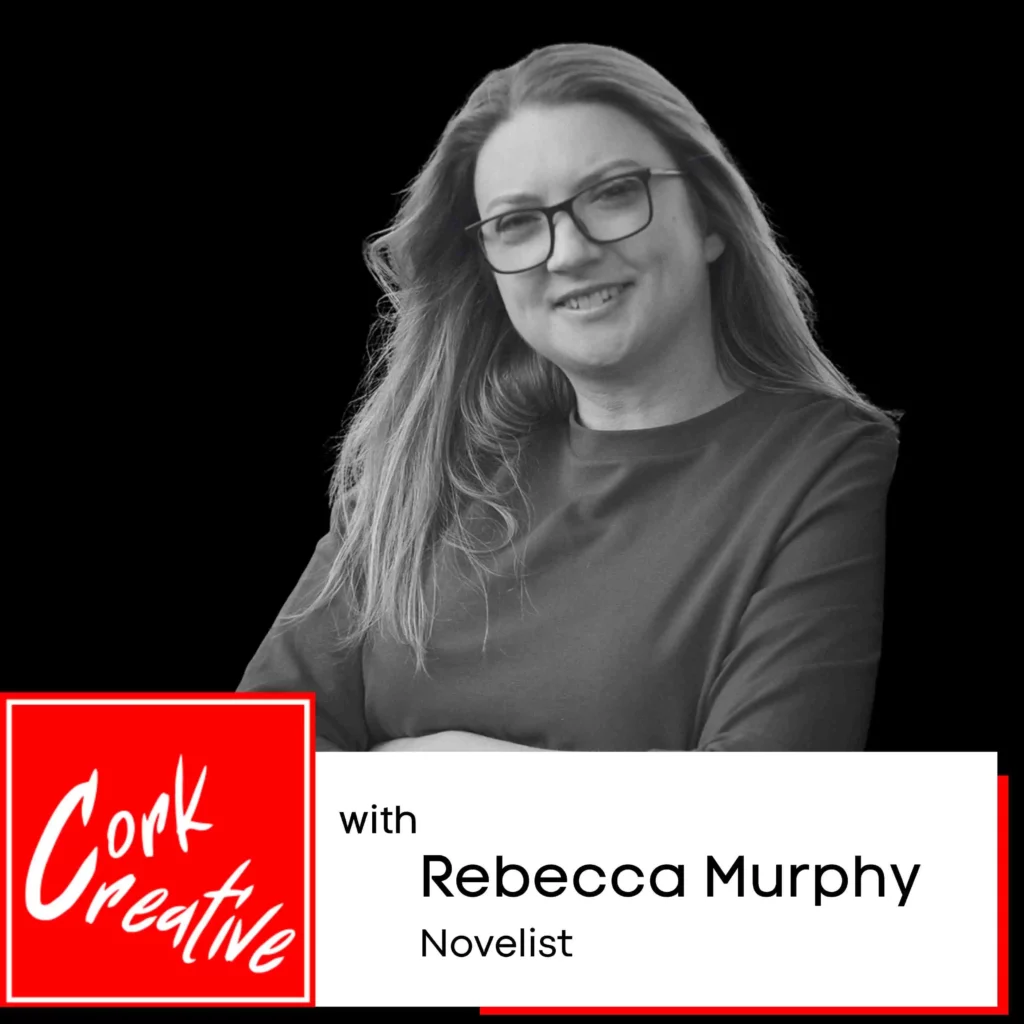
Rebecca Murphy is a writer from Cork, living in Wicklow with her wife and two dogs. Blood and Water is her debut novel. She was the winner of the RTÉ Today Show novel competition and the recipient of a Faber Academy Scholarship. Her influences range from Anne Enright to Stephen King, by way of Maeve Binchy. She has a degree in Drama and English from UCC.
In this episode, we dive into her lifelong love of storytelling. From her Cork roots and studies, to how her theatre training sharpened her ear for dialogue and scene-building, Rebecca shares how she elevates the richness of ordinary lives. She also takes us behind the scenes of writing her debut novel discussing the challenges of drafting with self-compassion and the power of writing communities.
About this podcast
Date: 30/06/2026
Duration: 33:58 mins
Rebecca's takeaway tip
“Just write….stop waiting for the perfect moment to write or the perfect office or the perfect place.”
Listen ....
Watch ...
Episode Chapters
00:00 Highlight Clips
01:20 Introduction
02:46 Drama Training and Dialogue
04:35 Influences and Ordinary Lives
07:39 Creating Blood and Water
09:49 Dual Timeline Craft
12:09 Writing from Infertility
14:08 West Cork Island Atmosphere
16:21 Courses and Writing Routine
21:03 AI, Discipline, and Hurdles
23:51 Winning the RTE Competition
26:09 From Private to Public Author
29:50 Advice and Writing Community
32:38 Book Two and Goodbye
Share this page
Transcript
Download transcript as a PDF here
Requires Adobe Acrobat or Equivalent. Also opens in web browsers.
[00:00:00] Rebecca Murphy: Yeah, it is all about storytelling and I think that I always wanted to be a writer. I think I always wanted to use my imagination to kind of go somewhere else, you know? And then I suppose as you get older and you want to start writing, I think you start looking at the discipline of it and the actual writing it down. But I think creating new worlds, thinking of new characters, it’s just always been something I’ve loved doing really since a very young age.
[00:00:25] Rebecca Murphy: Like, ordinary people’s lives are so full of richness and, you know, sadness and joy and heartache and love and loss. And I just think we don’t need it. We could stay in just an ordinary person’s life and just write stories about them; we don’t ever really have to bring in the supernatural. Sometimes I like doing that elsewhere, but I think I just love that. And I love that we can elevate those stories.
[00:00:49] Rebecca Murphy: So yeah, so I think it was a real sort of balance between sort of, you know, self-compassion, knowing when to push myself, knowing when to put it away. It definitely helped, I think, in terms of moving through it. And as I said, it kind of, you know, I like writing fiction and creating kind of new things. And I suppose it just gave me a chance to do something kind of positive with something that had, you know, a place that it was coming from—a place of, I suppose, a lot of pain and grief and that, you know.
[00:01:19] Geraldine Hennessy: So today we welcome novelist Rebecca Murphy to the Cork Creative Podcast. Rebecca, you’re very welcome.
[00:01:25] Rebecca Murphy: Thanks a million, lovely to be here.
[00:01:27] Geraldine Hennessy: So growing up in Cork and studying drama and English at UCC, how did your early environment shape your desire to become a storyteller?
[00:01:37] Rebecca Murphy: Yeah, I think storytelling is probably a good thing because I sometimes—I’ve always been writing, but I think actually when I think back, I think all of us are storytellers. I think even as children, we’re always storytelling. I had such an imagination as a kid and I loved writing even in my little stories and poems from a very small age. And then as I went up through my teenage years, I would have been writing poems and telling stories and writing plays for school and stuff like that. So it’s always been in my life.
[00:02:05] Rebecca Murphy: And then, as you say, I went on and I studied drama and theatre studies. And yeah, it is all about storytelling. And I think that I always wanted to be a writer. I think I always wanted to use my imagination to kind of go somewhere else. I was someone I’d be sat in class kind of daydreaming about things and imagining myself as—I’d be off going on adventures with the Power Rangers and going off going on adventures with someone else. So I think it’s just something that’s always been there.
[00:02:31] Rebecca Murphy: And then I suppose as you get older and you want to start writing, I think you start looking at the discipline of it and the actual writing it down. But I think creating new worlds, thinking of new characters has been something I’ve loved doing really since a very young age.
[00:02:46] Geraldine Hennessy: And does your theatrical background give you an edge with like dialogue and painting?
[00:02:52] Rebecca Murphy: I think it does. I think I have a good ear for dialogue. And I love writing dialogue. I know a lot of writers who hate writing dialogue, and I actually love it. Like so looking at screenwriting and stuff like that, it’s definitely an area I’d love to look at kind of moving into. I think I’m a very visual writer. So like when I’m writing a scene, I can see it in my head. And sometimes I can see it as if I’m watching it in a movie. Sometimes I can see it as if I’m seeing it on stage.
[00:03:17] Rebecca Murphy: And I can kind of see down to the deep. And I suppose I would have been an actor as well. And like I would have done a lot of acting as part of studying drama. And sometimes when I’m writing a character doing something, I can almost imagine how I would perform it. And even the actions and hands—I’m a bit obsessed with hands. And so like I often see that in terms of in my mind’s eye. And then the frustrating thing is that sometimes you’re struggling to get that onto the paper. So I’m like, I could see it. I can see it happening in front of me. And then it’s just to get it out there in a way that does it justice.
[00:03:45] Rebecca Murphy: And so I definitely think the training that I would have got over the years in studying drama and studying theatre definitely adds to that. And I suppose as well, just even learning about structure, learning about storytelling again, you know, knowing where you’ve come from, you know, and as a species in terms of—I would have studied, you know, when I was in UCC, we would have studied the Greeks, you know, and the Greek theatre and, you know, how we’ve been telling similar stories for thousands of years as a species.
[00:04:11] Rebecca Murphy: And there aren’t really any original stories, you know, that everything is kind of a variation of something that has been told before. And that’s great because it’s brilliant to have different voices, bringing different realities in. So, yes, I think it has influenced my craft, really, the kind of the storytelling and the stage writing and the playwriting and the acting as well, I think definitely in a number of different ways.
[00:04:33] Geraldine Hennessy: Okay. And you’ve spoken like before that you have a wide range of literary influences. How did these diverse voices come together to shape your own unique writing style?
[00:04:47] Rebecca Murphy: I wrote or said some recently that I think if I hadn’t ever read Roald Dahl, I don’t think I would have become a writer. And I know we have modern problems with Roald Dahl, let’s leave it at that. But like, I think that when I read him as a child, it was one of the few writers that I felt really got me as a child, like in terms of, you know, the kind of kids are kind of weirdos, like in the best kind of way, you know, they love a bit of naughtiness and a bit of boldness and someone saying something a bit, you know, kind of outrageous and adults getting in trouble and children getting in trouble.
[00:05:17] Rebecca Murphy: And I think that for me is probably the first time that I probably read something and went, “Oh my God, this is amazing.” Like, and I genuinely, I don’t know if I’d have become a writer because he was the person who got me reading. He turned me into an absolute reading monster. And I think he probably does, because Blood & Water isn’t at all—there’s no Roald Dahl in there. But I think probably in a lot of short stories that I would write, there’d be a little bit more of kind of the Roald Dahl sort of influence.
[00:05:43] Rebecca Murphy: The Stephen King influence as well, because I love Stephen King. And I think that, and then I know I’ve mentioned like, writers like so, there’s Anne Enright, Donal Ryan would be another writer, an Irish writer that I absolutely love and Maeve Binchy then a classic. And I suppose one of the things I love, and I particularly think of Maeve Binchy when I’m kind of writing, a lot of my stuff is the kind of the ordinary lives kind of revealed and the mundane. And I don’t mean that in an insulting way, but like, like ordinary people’s lives are so full of richness and sadness and joy and heartache and love and loss.
[00:06:19] Rebecca Murphy: And I just think we don’t need it. We could stay in just an ordinary person’s life and just write stories about them; we don’t ever really have to bring in the supernatural. Sometimes I like doing that elsewhere. I think I just love that. And I love that we can elevate those stories. And I think Donal Ryan is very similar as well, ordinary Irish people and those stories. And I read kind of a lot of different stuff. And it was a challenge then, you’re trying not to be anyone, but you’re just sort of, you know, and you’re hoping that you could maybe emulate them in some ways, even in terms of the quality of it. But I think it comes in in lots of different ways. But I think definitely for me, I kind of love that sort of, that ordinary life kind of excavation, I guess.
[00:06:58] Geraldine Hennessy: I mean, yeah.
[00:07:00] Rebecca Murphy: Yeah. You know, I just think I think there’s so much richness just in everyday things that can happen, you know, and you hear some stories and yeah, like I remember when I was campaigning for the referendum, the marriage referendum, like 11 years ago now. And I was doing loads of canvassing and I was talking to so many people and people just tell you their stories, you know, and I’m very chatty. So people just tell me things, right? And I just remember coming away from going just like the things that are going on in people’s lives and the things that have happened. I just find people’s lives fascinating. So I think that’s maybe what I have in common with a lot of the writers that I like as well, you know.
[00:07:37] Geraldine Hennessy: Yeah. Yeah. Very good. And your debut novel, so Blood & Water.
[00:07:41] Rebecca Murphy: Yes.
[00:07:41] Geraldine Hennessy: It’s out now. Like, does the core concept strike you in a single lightbulb moment or did the story and its themes kind of build slowly over time?
[00:07:50] Rebecca Murphy: So I knew I wanted to write about infertility. I knew I didn’t want to write about my own experience directly. I wanted to give it to someone else. And the idea of sending that person to an island came very quick. That was very early on. I was like, I’m sending her off to an island, seeing what happens. And then the rest kind of unfolded, you know, because something I love writing about—something I love fiction writing—is that you kind of get to create problems and then solve them yourself, you know.
[00:08:15] Rebecca Murphy: So like, what happens if Susan, who’s the main character in Blood & Water, what if she meets this person and what if this is happening? And what if she’s done this and what’s this? And sometimes you explore it and then you’re like, no, that’s nothing, but it helps you. It helps you kind of form that character. So, yes, it took a little while for the kind of full story to take place, but the very basics of it kind of came around quite early.
[00:08:36] Rebecca Murphy: And then I disappeared into a—actually, a friend of mine has a little cottage in West Cork. So I was there for a night or two with my post-its and the dog. I brought the dog with me as well. I’m planning out kind of and finding, you know, I need something to happen here to make this happen over here. And so, yes, it kind of came together sort of. Sometimes really slowly and then sometimes all at once. And then sometimes something will just strike you.
[00:08:55] Rebecca Murphy: So like the dual timeline thing, for example. So we follow Susan mainly. And then we have Frank, the uncle, which is kind of the—I mean, subplot is kind of, it’s a different timeline. And the two timelines speak to each other. But actually his story, while it was always in the book, through, say, his journals and that, the actual flashbacks, which are now a major part of the book, they weren’t really in the first draft.
[00:09:21] Rebecca Murphy: Yeah. And it was only kind of after the first draft, I was like, no, I need more here. There’s something more here. And she knew everyone loves Frank. Like everyone’s just, everyone talks to me at how much Frank broke their heart, you know? And so it’s obviously, so it just came out of various and kind of feedback. And I remember I put more into the second draft and the feedback from someone who read it was like, you need more of that. You actually even need even more. So I’m glad I leaned in more to that. And that’s the joy of working with people and showing your work to people as well, you know?
[00:09:48] Geraldine Hennessy: Yeah. And just talking about that dual timeline stuff. And like, how did you balance the psychological insight of the present with the kind of buried stories of the past?
[00:10:00] Rebecca Murphy: So as I said, it kind of emerged sort of slowly. And I always knew Frank’s story in my head. I had to change around a few things because again, it’s this like, you create these problems and then you’re trying to solve them. And I had kind of a couple of—I’m trying to remember the exact—but there was definitely a couple of details that I changed towards the end because I was like, I need to make it make a little bit more sense. Because for me, I’m always like, I think it has to make sense. Even if people don’t agree with decisions that characters make, I want people to be like, I understand why they did that. But I don’t, you know, I don’t agree with it.
[00:10:35] Rebecca Murphy: And so I did make some changes. But in terms of balancing it, like, I think Susan and Frank are similar in lots of ways in terms of how they deal with their problems or don’t deal with them, I guess. But I think Frank is probably a bit more of a blunt instrument in terms of he doesn’t have the language Susan might have about things. I think Susan has much more self-awareness, even though she doesn’t necessarily do anything better with that. At first, anyway, but I think he’s a bit more of a blunt instrument. And I think he got, he’s a lot more trapped than she is. And I suppose balancing those two pieces and not letting them crowd each other out as well, while still kind of making each relevant to each other.
[00:11:09] Rebecca Murphy: It was fun. And like, honestly, the practical thing of a dual timeline, like I have a timeline written somewhere in a note—like I’ve so many notebooks. And I’m like, okay, if this happened in 1978, and this must have happened in 2000. And so, honestly, that was actually probably more difficult than even figuring out the emotional. And because I was like, and look, I’m sure—I don’t want to know if it is—but I’m sure someone’s going to read the book and say, actually, that doesn’t, you’re missing this, or you’ve got a gap here.
[00:11:34] Rebecca Murphy: But actually balancing the sort of chronological side of it and making sure everything made sense was a big part of the dual timeline. I don’t know how people do more complex ones, because mine’s relatively simple. But yeah, no, it was great. It was interesting. It was really nice to kind of go back and even think about, okay, what would Dublin have looked like back in, I think, this is the 90s. I have them very briefly in Dublin for one chapter. And so what would it be there? What about what would be like? What would they be doing? So yeah, no, I enjoyed that. It was a really nice kind of a little escape from the escape that was the island, I suppose, sometimes.
[00:12:08] Geraldine Hennessy: Absolutely. And you mentioned there that it was inspired by your own personal experiences with infertility and all. How did you navigate the process of translating such vulnerable real-life experiences into a work of fiction, especially when delving into the complex themes like shame and sexuality?
[00:12:27] Rebecca Murphy: Yeah, so I mean, it took me four years to write the first draft. So that might tell you that there was times when it was easier and times when it was more difficult. And something I really tried to do was try to be very kind to myself. And I’m as good as the next person at beating myself up, or I should be writing this, or I should be doing this. But there are times, and I’m really lucky, I’ve got a really nice kind of group of writer friends. And sometimes they’d say to me, “Rebecca, maybe now isn’t the time for you to be writing this book. So maybe you just need to step away and look after yourself.”
[00:13:01] Rebecca Murphy: And there was definitely an element of that. And I suppose just being able to step away from it when I needed to. Knowing then actually when it would do me good to write it. And I suppose when I worked with—and so I did the Faber Academy, Finish Your Draft course. And the tutor on that, Natasha Bell, I actually worked with her afterwards as well, which as a kind of a private edit. So I worked with her, I paid for her to do a private edit on the manuscript. And there was certain chapters that she was like, “Look, I know this is difficult, but I really feel like you need to lean in a little bit more here.”
[00:13:32] Geraldine Hennessy: Wow.
[00:13:33] Rebecca Murphy: And it was done in the kindest way possible because she’s absolutely lovely. And I think you need that as well. So yeah, so I think it was a real sort of balance between sort of self-compassion, knowing when to push myself, knowing when to put it away. And also it was quite cathartic, maybe a little dramatic, but it definitely helped I think in terms of moving through it. And as I said, it kind of, I like writing fiction and creating kind of new things. And I suppose it just gave me a chance to do something kind of positive with something that had a place—it was coming from a place of, I suppose, a lot of pain and grief and that.
[00:14:08] Geraldine Hennessy: Okay. And about the book now, it’s like a set kind of like a fictional island. The story really captures kind of the natural beauty of West Cork. How does that rugged environment influence the atmosphere of the story and the emotional landscape of your character?
[00:14:22] Rebecca Murphy: Like the weather and the environment are great fun to play around with, you know, because they can kind of, they can either totally reflect what’s going on for the character or they can offer this really annoying juxtaposition for them, you know, and we see that, we see both of those things kind of happening in Blood & Water. But like, you know, when Susan arrives, there’s so much turmoil inside in her and she’s arriving to this beautiful island full of life and air and, you know, the sea is shimmering and the sun is shining.
[00:14:51] Rebecca Murphy: I think I used the phrase, you know, like the Irish summer lasts a good fortnight, you know, so she lands in that fortnight when summer is happening, you know, and I think it offers a real kind of a contrast to how she’s feeling and how she’s struggling with everything. Whereas then, as things ramp up, the kind of the weather breaks and we get the pathetic fallacy of the storm and the rain and the wind, and I think it’s fun to play with that.
[00:15:15] Rebecca Murphy: And yeah, like you say, like the West Cork landscape and the kind of island landscape particularly is so dramatic and it can, you know, it can, when you’re on, say, one of the islands—and it is a fictional island—but like if you think of, I don’t know if you’re looking at the Blaskets or Cape Clear or go up to Inishturk or somewhere like that, even up on the West Coast and the kind of variations in that landscape and the kind of the walks you can go on, the thinking time that you get when you’re on that, I think there’s nowhere like it in terms of the way the wind will go through you and up your nose and through your hair.
[00:15:45] Rebecca Murphy: And it just, I just, I’m always fascinated. I’m really into nature and birds and flowers and all of that, like, and I would do a lot of nature photography and things. So I think the chance to kind of, I don’t know, sort of bring people into that world, you know, because I’d love, I’d love if someone who had never visited any of those places came away from the book and was like, “God, I’d love to head down now to West Cork and see that, and I’d love to see the heathers, and I’d love to see all the montbretia in the ditches.” Because I think if we love the natural world, maybe we’ll try and actually do something about keeping it safe. So yeah, maybe, maybe, you know.
[00:16:21] Geraldine Hennessy: And you spoke there briefly about the Faber Academy scholarship. Between receiving that scholarship and your own rights mastery, how has your approach to writing transformed?
[00:16:33] Rebecca Murphy: I suppose I don’t, like, as soon as I started the novel, I started taking it much more seriously. But I think you’re kind of making it up as you go along a lot of the time. I don’t know other courses, so there’s an organisation in the UK called Write Like A Girl, which I mention as much as I can, because they’re an amazing organisation. They do a lot of online courses as well as courses in the UK. Dr Kerry Ryan is the kind of founder there, and she’s wonderful. And it’s very much about women and non-binary kind of getting into writing, and literally people start off and they’re just like, “I kind of want to write,” and then to people like myself who had done a few courses.
[00:17:12] Rebecca Murphy: I had some structure on my writing. I had some approaches on my writing. But I think once I started the novel, I was like, “Okay, I’m going to have to take this seriously, or I’m going to be writing this novel for 30 years.” You know what I mean? And so I’d started to kind of hone my craft then. So even I’m very lucky. So I have a full-time job outside of writing, so it’s only kind of part of what I do. But I was able to restructure my hours, and I work four long days now, and then on Fridays, I tend to write. That tends to be my writing day. In theory, that’s my writing day.
[00:17:42] Rebecca Murphy: And so I was able to kind of restructure my kind of hours around that. And then once I started doing the Faber Academy course, so I think I’d just finished the first draft at that stage. So I did the first draft on my own. And then when I did the Faber Academy, I kind of learned so much, because you don’t know what you don’t know. Do you know what I mean a lot of the time? And so then it just gave me so many tools around kind of analysis of that draft, looking at it, breaking it down, looking at characters, plot, structure.
[00:18:10] Rebecca Murphy: I do think rules are there to be broken in terms of this sort of stuff, but I do think you kind of need to know the rules before you start breaking them and knowing what you’re playing with. And so I think that’s what it gave me, a real structure around that. I suppose I do take my writing quite seriously, even though it’s kind of part-time. I suppose I can’t really call it a hobby anymore now, because I have a book. I don’t think I can hide behind that anymore. It is something that’s kind of a… it’s a part of my life. It’s not my full-time job. Maybe it will be someday. Maybe I’ll be lucky enough to do that, or maybe something really will happen like that.
[00:18:43] Rebecca Murphy: But I suppose at the moment, it’s just trying to find a way to take it as seriously as I can while still balancing all the rest of my life as well. So I’ve been lucky in lots of ways in terms of work and that. And the course was just so useful for learning what I didn’t know, really.
[00:18:58] Geraldine Hennessy: Okay, so Fridays. A typical productive writing day. What does that look like for you?
[00:19:04] Rebecca Murphy: I like that you said the word productive, because there could be a stark contrast between a productive Friday writing day and the days that aren’t so productive. I suppose on a good day, like I said, I’m a great believer in self-compassion. So I would give myself… like, I wouldn’t be up at the dawn. I’d get up, I’d go down, I’d kind of potter about for a bit, and then I’d sit down, do an hour or two, take a break, have a cup of coffee, go back. It depends on what I’m working on, to be honest.
[00:19:29] Rebecca Murphy: So if we take, say, when I was writing the novel, and if I had a deadline for, say, the course or something, I love a deadline. I love when someone is going to be screaming down at me—no one’s screaming—but someone’s going to be looking for five or ten thousand words. And then I would just sit down. I’m good at churning. Like, if I have a word count, I’m good at meeting it. And then I kind of would spend some time editing it and coming back to it. But I have to take plenty of breaks, because it’s tiring, actually. It’s really tiring.
[00:19:55] Rebecca Murphy: And then sometimes as well, we have a joke around with some of my writing friends, what’s writing and what isn’t writing. And so, like, because sometimes things can be writing, and you wouldn’t think they’re writing. So sitting, staring into space with a coffee could be writing. So there sometimes can be just sitting, staring into space. Sometimes I might go out in the back yard with my notebook and just write some ideas. Sometimes it’s the post-its; the post-its return. And so it just really depends on what I’m working on at the time.
[00:20:21] Rebecca Murphy: I suppose at the moment, obviously, the novel is out now. I’m hoping that my headspace for writing will kind of return a bit more. And I’m kind of brainstorming for the next one and starting to put a few words down. And it’s written, but I’ve had to go back to the drawing board with some bits. So yeah, I’m hoping that productivity thing. But it’s hard. It’s very hard when no one’s asking you to do it. And I had a few dark nights of the soul when I was writing that book, where I was like, “What am I doing?” I’m there getting really upset about a chapter. And like, why, who’s—I’m doing this myself. But you need to have those moments as well, too. You have to. All the good parts.
[00:21:02] Geraldine Hennessy: Totally.
[00:21:03] Rebecca Murphy: And I mean, this is why AI can’t write. Okay? Because you have to go through that to write. Otherwise, it’s just, you know what? If I wanted to write a novel, I could plug in the back of this into ChatGPT and ask them to tell me, and you know what? I won’t have anything. And maybe it’ll have some nice sentences in it. But it won’t be art. And it won’t be writing. And I think—I know Mercier, my publisher, put out an article there recently. And I thought there was one line. And it was like, “If you can’t be bothered writing it, why should I be bothered reading it?”
[00:21:31] Rebecca Murphy: And so I—because writing, there is a lot of sitting and going and figuring things out and the dark night. And sometimes there’s days when you’re writing like a god. You know, and you’re just typing away. You’re like, “Oh my God, this is it. This is it now.” But then sometimes there’s just like, it’s like getting blood from a stone. And that’s all part of it, unfortunately. That is all part of it.
[00:21:53] Geraldine Hennessy: So it is effectively like a marathon. So what’s the biggest hurdle you face during the drafting and editing process?
[00:22:02] Rebecca Murphy: Think just—like, I mean, everyone is short on time, right? Even though I did have my Fridays, like, you know, it’s also Fridays, also, the day when you try and get your life admin done. You know what I mean? And so it is finding time. I think, for me, obviously, it was quite a personal subject matter. So as I said, I kind of just had to walk away from it. So they were kind of the big hurdles and the energy as well. Like, life is—and so we were like moving house and stuff like that and trying to do all of these life things in between.
[00:22:31] Rebecca Murphy: You know, I tried to balance a full-time job as well as then this kind of part-time job I decided to take on for myself. So yeah, I was just trying to find a balance between everything. And that—it can be challenging. And then sometimes, you know, I would kind of be like, “You know, Rebecca, you probably could make time now if you really wanted to.” And I do think we can probably all find some bit of time if we need to, plus just then finding the energy as well. And then sometimes the two don’t always meet. You know, so—
[00:22:55] Geraldine Hennessy: Exactly. And what’s the most surprising thing that you learned about yourself while getting the book over the finish line?
[00:23:03] Rebecca Murphy: And I could actually do it, to be honest. Like, I mean, that’s—it’s very intimidating facing down the barrel of a novel. Because, like, I had written kind of short stories and stuff. And I love writing short stories. And they’re really difficult to write, like short stories. I would argue in lots of ways they’re more difficult than writing a novel because you’re trying to capture so much in such little, like, real estate, you know? So I’ve written a lot of short stories and that. And I was like, “Oh, maybe that’s just what my speed is, you know?”
[00:23:29] Rebecca Murphy: But then I was like, “No, I want to write a novel.” So that was probably the surprising thing I learned, is that I actually was able to do it. And honestly, if I can do it, anyone can do it. Because I love a project. And I love a hobby. So if I was able to get myself knuckled down to finish a novel, then I think anyone can do it. I think it’s just—you just have to do it.
[00:23:49] Geraldine Hennessy: Absolutely. And you stood out from over 600 entries to win the RTE Today Show Novel Competition. What was it like getting that call? And how did it change your writing journey?
[00:24:02] Rebecca Murphy: It was bizarre, to be honest. Because I think as a writer or any kind of creative, you just kind of get used to being rejected, you know? So I’d started to—so the manuscript, I think I’d started querying at that stage. Let me just—and so, yeah. Obviously, I kind of worked—I think it was like the third or fourth draft that I’d actually ended up sending out to kind of publishers and the competition and agents and things like that. And you just get so used to—you don’t hear anything back. You just get a rejection back. And it’s very nice, but it’s just like “not for me.”
[00:24:35] Rebecca Murphy: And you don’t really learn very much from it. And that’s probably something else that I’ve learned as well, is how to take rejection. I’ve gotten so much better at just moving on. Just send it out. Forget about it. Get a rejection. Move on. What can you do? And so when I got the phone call from Dee Collins in Mercier, I was like, “Really? Okay.” It actually takes a while to settle in, in terms of actually the reality of it. And then it just kind of all happened very quickly as well. So I was kind of saying, “Yeah, sure.” And then I was signing a contract. And then I was on RTE.
[00:25:05] Rebecca Murphy: And then it all felt very surreal. But it was fantastic. It’s amazing. And I have to say, people have just been so excited. Like, sometimes I feel like people are more excited about it than I am because I’m still processing that it’s real. And everyone’s going mental about it. And it was that when it was announced. It was now when we were doing the launch. So I suppose, as I said, it’s kind of made me reevaluate in terms of, okay, I’ve always kind of thought of writing as a hobby. I can’t call it that anymore now. So what does that mean? You know what I mean?
[00:25:31] Rebecca Murphy: So what does that mean in terms of my future as a writer, as a creator? And I think that that’s probably the question I’m still answering. I am working on book two. But what that—it’s just interesting to kind of shape—like, could it just psychologically move from, “Oh, this is just a hobby I just do for fun.” And then it’s like, well, actually, no. There’s a real book now. And there’s a publisher. They’re putting their money where their mouth is. And there’s people backing it and saying lovely things about it. And yeah, so it’s really interesting. I think I’m at a very exciting kind of point, I think, in my writing career, whatever that ends up looking like.
[00:26:08] Geraldine Hennessy: How are you navigating the transition from being a private writer working quietly at your desk to a public author actively promoting your debut novel?
[00:26:20] Rebecca Murphy: I’m just going first, Geraldine. I just kind of was like, “You know what? This is an opportunity now that not everyone gets.” I mean, even in terms of that, like as I said, 99% of writing is—it’s perseverance. But then 99% of submitting your writing is rejection. But like—so a lot of people don’t ever get that opportunity. And then the opportunity, like even partnering with RTE as well, I mean, that itself is such a massive opportunity. And so I just went for it and kind of promoting it on my socials.
[00:26:53] Rebecca Murphy: And it’s very cringey, is what I will say. It’s just—it’s not—I’m not a natural self-promoter. I love chatting to people. And I love talking about my work. But like the idea of kind of being like, “Hey, guys, you know, buy my book,” it just not—it wouldn’t be my natural mode at all. So I’ve had to push through a lot of that, actually. And again, I think it’s great. You know, I’m 40 years old. Isn’t it brilliant to be kind of developing a new side of myself at this stage? Some people don’t ever learn anything really once they go beyond a certain age.
[00:27:21] Rebecca Murphy: But I’m determined to keep going forever, learning and developing. So yeah, so I think there’s been a lot of pushing through the cringe of that. And just going for it, you know, I would be a user of social media anyway. So at least I wasn’t learning how to use that. But I sometimes do feel like I need like a Generation Z person to help me a little bit more just to make them jazzed up, because I’m very millennial, I think, in my approach to things. But yeah, no, it’s been brilliant. It’s just been—it’s just—I’ve just gone for it. I’ve just been like, “Let’s promote this book. Let’s do our best.” And you know what? If you do your best and if 10 people buy it, then what can you say? You tried, right?
[00:27:55] Rebecca Murphy: But yeah, well, I think more than 10 people have bought it anyway, which is great. But like—but just, you know, I just think if you do your best, you can be happy with yourself, then, you know? And some people will like it. Some people want that book, right?
[00:28:07] Geraldine Hennessy: So as a result of that competition, like you’re being championed by Cork’s iconic Mercier Press. How special is it to have a local publisher backing your debut?
[00:28:17] Rebecca Murphy: It’s great. And just Dee Collins was what he said last night at the launch. He was like, they didn’t realise I was from Cork, actually, when they chose me as the winner, because they’re like, “Everyone’s going to think this is a fix,” because I think my bio had said that I was living in Wicklow, which is true. But yeah, so they hadn’t realised I was from Cork. So the fact that I was from Cork was totally coincidental, which is gas.
[00:28:34] Geraldine Hennessy: Yeah, right.
[00:28:35] Rebecca Murphy: Yeah, right. We know what we’re like down here, yeah, you know? But apparently, they didn’t realise it. But no, it’s brilliant. And like, the thing is, obviously, as you say, like, Mercier Press is iconic. They’re still producing amazing. They’re the oldest independent publishing house in Ireland. And they’re still churning out amazing writers and even things like Theo Dorgan’s recent one there, Camrad was like nominated for the Dublin Literary Award and things like that. So there’s amazing writers on the books, and it’s brilliant to join them.
[00:29:04] Rebecca Murphy: And I suppose what was really important to me as well, as much as Cork Press, it’s a book set in Cork, all of that. But when I worked with Dee and was chatting to her at first, I could tell she really got the book. And it just was a very collaborative relationship from the start. And I think it’s just so important to have that and to have someone who actually understands what you’re trying to do or understands where you’re coming from with a book. When you maybe disagree on the smaller bits or on the details that you’re able to come to some sort of solution or some sort of middle ground or something that works really well.
[00:29:37] Rebecca Murphy: So no, it’s been a very collaborative relationship from the start. So for me, that’s been brilliant as well as them being this kind of iconic press. Actually, for me, it’s the relationships as well is so important.
[00:29:48] Geraldine Hennessy: Yeah, absolutely. And for an aspiring writer, what’s the single piece of practical advice you give them to get started?
[00:29:55] Rebecca Murphy: I suppose going back to what I was saying about making time and finding time, even if it’s just something that I learned, one of the things I learned very early on through the Write Like A Girl things is that even if it’s just 15 minutes a day, find your time and like I always—like I have again back to my post-its. I have a post-it up in my office and it’s like “I’d rather write. I’d rather spend time writing than spend time being sad that I wasn’t writing.” You know what I mean? Or that I didn’t write.
[00:30:23] Rebecca Murphy: Because that’s what happens. You kind of end up going, “Oh, I should have been writing.” And then you spend all this time like, well, I spend this time kind of giving out to myself. And actually, if I had just spent that time giving out to myself, writing for 10 minutes, just—just even if it’s 10, 15 minutes a day. And there was times when I was writing this book, that’s all I could grab, you know, because I have a very busy job and quite a busy life in terms of other things. And so there was times when all I could manage maybe is 15 minutes first thing in the morning or first thing at night.
[00:30:49] Rebecca Murphy: And you know what? Maybe it was absolute crap, but it was done and it was writing and it was getting moving and it was keeping the brain going. So that’s actually my tip that I think just write. I’m like, stop waiting for the perfect moment to write or the perfect office or the perfect place, you know. I mean, yeah, we all want our cosy little nook, you know, with our cup of tea. And sometimes you just don’t have that, you know what I mean? So you just have to do it. And yeah, like, don’t get AI to write if you just do it yourself. You have to do it. If you want to be a writer, you have to write.
[00:31:19] Geraldine Hennessy: Very true. And getting published can seem like a real daunting mountain to climb. A lot of practical advice here for local writers looking just even to find a community, a supportive community and get their work noticed by publishing.
[00:31:33] Rebecca Murphy: Yeah, I think for me, getting the community is so important. A couple of us from the Write Like A Girl courses have kind of got together and we’re all in the WhatsApp group and we’re spread out—like there are a lot of them in the UK. I think I’m the only one in Ireland, actually. So a lot of them are in the UK, but it’s just having people to go to. And sometimes it’s your sharing work, but sometimes it’s actually just, “Oh, my God, like this can chapter. And I feel like I’m never going to see the end of it.”
[00:31:55] Rebecca Murphy: And then it’s just people going, “I know, I know this,” or even saying, “Have you tried this?” or “What about this?” or “Have you tried this writing game or exercise or something that might help you figure it out?” You know, so but yeah, find your community. So I think doing those courses, like even look at like your local further education colleges or your local universities, there might be adult education courses. Like I actually did a creative writing course in the UCC at the Education Centre—was the first one that I did back in 2014 or something like that—and that was brilliant, too, like and just to set you on the road. So and it’s a great way of meeting people who, you know, they’re trying to do the same thing you are, you know.
[00:32:30] Geraldine Hennessy: Exactly.
[00:32:32] Rebecca Murphy: Yeah, just find kind of the people that you can talk to and chat with because it’s so important to be able to do that.
[00:32:38] Geraldine Hennessy: And now that Blood & Water is officially out in the world. You mentioned there up to like, what’s the next big creative problem on the horizon for you?
[00:32:47] Rebecca Murphy: I think now that I have this out and I can hopefully kind of find a bit more headspace, because honestly, I’ve just been—it’s just been Blood & Water all day long for the last while. I’m going to work more on book two. It’s going to be set in Cork. It’s going to be kind of about friendship. It’s going to be a bit of creepiness in there, I think. I’m kind of working on how much of it is going to be in there. But yeah, I think it’s going to be. Yeah, it’s going to be a little bit darker, but I’m kind of. Yeah, I don’t want to say too much about it because I’ve had to go back to the drawing board a few times on it, so I’m still firming up a lot of bits. But yeah, I know I’ve kind of started working on that.
[00:33:19] Geraldine Hennessy: Great. Right. Well, thanks for so much for chatting with us on the Cork Creative Podcast. You can learn more about Rebecca and her book, Blood & Water. You can find links to her website and socials on CorkCreative.ie. Thanks, Rebecca.
[00:33:33] Rebecca Murphy: No, thanks a million, Geraldine. Thank you. Super.
