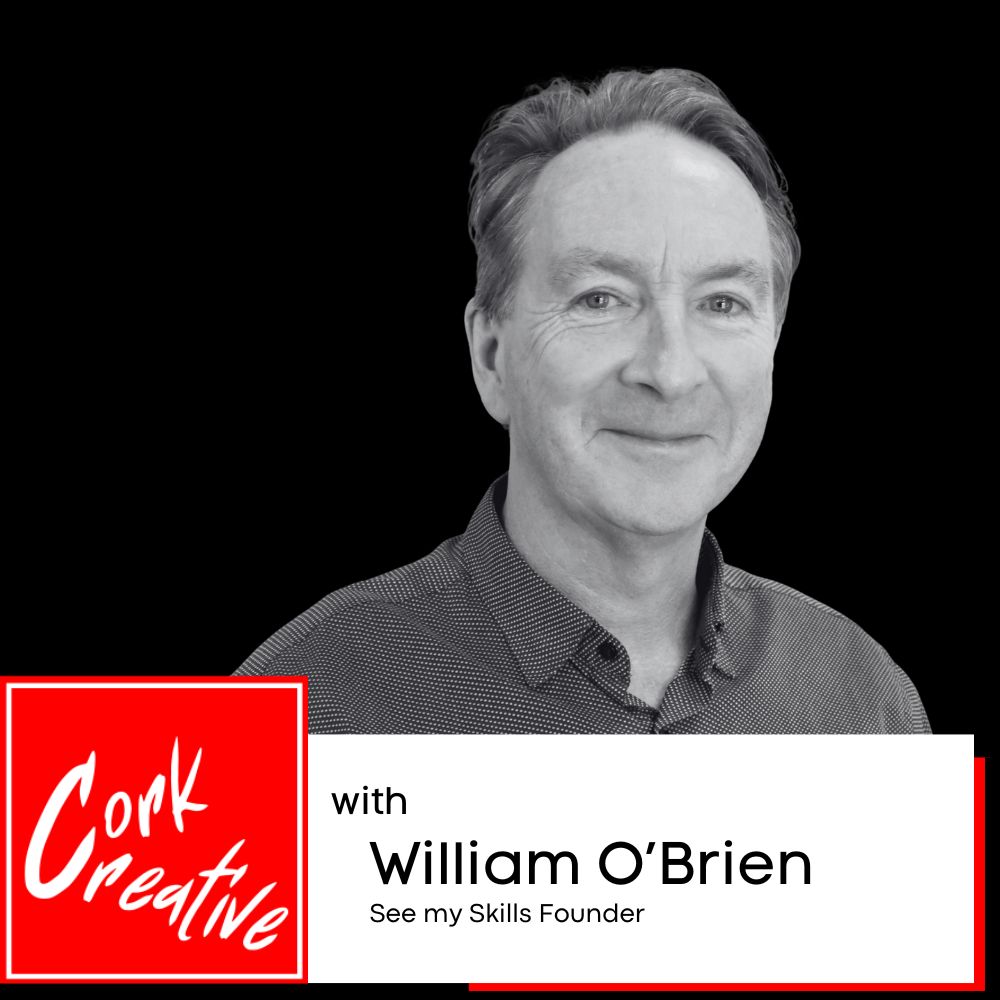
William O Brien is the CEO of Wm O’Brien Plant Hire and Wm O’Brien Self-Storage, where he has spent decades growing a local Irish business into a global operation. In 2023, he founded See My Skills, a social enterprise focused on supporting people with disabilities to realise their potential. William now brings his entrepreneurial drive and business know-how to help create a fairer, more inclusive Ireland, one opportunity at a time.
The organisation works to empower individuals with disabilities to build confidence, grow their skills, and access meaningful opportunities in employment or education. Rooted in the belief that everyone deserves the chance to thrive, See my Skills runs innovative programmes in schools and communities across Ireland that support real progress and lasting impact.
In this episode, William shares his background, the organisation’s mission, and its evolution. He highlights the Accelerator and Empowered programmes which are designed to build confidence and provide practical skills for people with different abilities. The episode also touches on the importance of community involvement, challenges faced, and future expansion plans, underscoring a core message of positivity and social impact.
About this podcast
Date: 05/08/2025
Duration: 37:54 mins
William's takeaway tip
“First of all, you’ve got to enjoy whatever you’re thinking about doing. You’ve got to be passionate about it.”
Listen ....
Episode Chapters
00:00 Podcast Highlights
01:00 William O’Brien’s Background
01:58 The Inspiration Behind See My Skills
05:08 Programmes and Initiatives
08:37 Personal Reflections and Family Influence
11:40 Addressing Employment Gaps
18:17 Challenges and Scaling
19:55 Broadening Career Horizons
20:44 Inspiring Real-Life Stories
22:07 Financial Challenges and Donations
24:33 Building a Strong Team
25:47 Defining Success
28:20 Empowering Through Visualization and Meditation
29:35 Community Engagement
30:53 Advice for Aspiring Social Entrepreneurs
31:38 Future Expansion Plans
35:33 Call for Volunteers and Final Thoughts
Share this page
Transcript
Download transcript as a PDF here
Requires Adobe Acrobat or Equivalent. Also opens in web browsers.
[00:00:00] William O’Brien: We started See my Skills with a global ambition of solving a problem where there was people who have disabilities and employers who are more than willing to employ people with disabilities. And bring them both together. And that ambition still resonates with us, but they will succeed. Yeah. And we’ve seen this here ourselves.
We’ve employed people who are physically disabled, who are neurodivergent. And they bring a whole different way of thinking to the table.
[00:00:29] Geraldine Hennessy: Absolutely. Yeah.
[00:00:30] William O’Brien: Yeah. Whole different way of thinking to the table. They’re loyal, they turn up on time, they’re interested, but they also bring in energy. In Ireland, 63% of people who are diagnosed…who are…who describe themselves as having a disability are unemployed.
European average is 51%.
[00:00:47] Geraldine Hennessy: Yeah.
[00:00:47] William O’Brien: So there’s a big difference there. There’s a gap. So off we went.
[00:00:56] Geraldine Hennessy: So you’re very welcome to Cork Creative.
[00:00:58] William O’Brien: Thank you very much.
[00:00:59] Geraldine Hennessy: So, William, can you tell us a little about you, about your background and how you came to found See my Skills?
[00:01:05] William O’Brien: Okay. So when you say to me, tell me a little, you’re going to have to stop me here.
[00:01:11] Geraldine Hennessy: Okay. Okay. Okay.
[00:01:12] William O’Brien: So, William O’Brien, I’m 57 years of age. Born and bred here in Cork.
Mom from Macroom and my dad from Glenflesk. Lisk. I have five grown children, two girls, three boys. The girls are 34 and 19. The boys are in their mid twenties. We have two of them living in San Francisco shortly. Two we are living in England. And then the youngest is just finished first year in UCD in Dublin going to second year.
Myself, I love the outdoors. I hike every weekend cycle, swimming, all the usual stuff. And I recently bought a camper van.
[00:01:45] Geraldine Hennessy: Very good.
[00:01:46] William O’Brien: Yeah. Yeah. So, and for the summer I moved down to Garretstown. I have a mobile home down there. Okay.
[00:01:50] Geraldine Hennessy: Yeah. Yeah. Well with weather like this anyway, there is nowhere better.
And how did you come to find or found to See my Skills?
[00:01:57] William O’Brien: When I was growing up, there was a young man in our community who was quite active in the community, had an accident, he ended up in a wheelchair. And he disappeared out of the community.
[00:02:07] Geraldine Hennessy: Okay.
[00:02:07] William O’Brien: And as a young person, I could never understand where he went. For someone being so active, next thing not seeing him around the place.
And when I suppose I had my own business I used to often think about him.
And at one stage then life was going well. My mother was a great believer in blessings.
And I thought, you know. Spoke to Cathy, who was head of HR with me saying, you know, we should go out and look for someone who have a different ability or disability.
[00:02:31] Geraldine Hennessy: Okay. Yeah.
[00:02:32] William O’Brien: And bring him in and give them an opportunity for a meaningful life, someone who’s unemployed or underemployed, and just do something small.
[00:02:40] Geraldine Hennessy: Okay.
[00:02:40] William O’Brien: And we began the journey 22 years ago. Yeah. And we repeated that process several times, bringing in people with different abilities. And that was the very beginning.
[00:02:50] Geraldine Hennessy: It kind of snowballed so then from that, yeah.
[00:02:53] William O’Brien: I suppose what happened then is the years rolled on. We developed skills in this whole area. And nearly three years ago, I exited the crane hire business. And I said to Cathy, I said, do you know what, we always found it hard to find individuals with a disability
[00:03:09] Geraldine Hennessy: Okay.
[00:03:10] William O’Brien: To come in and work with us.
[00:03:11] Geraldine Hennessy: Okay.
[00:03:12] William O’Brien: And we knew there was like employers like us out there. Yeah. Who are willing to give people a hand up rather than a handout. Yeah. And would, you know, support an individual to build their career. I said, why don’t we try and set up an organisation that can match the two employers on one hand and people with different abilities. Because in Ireland, 63% of people who are diagnosed, who are….who describe themselves as having a disability are unemployed. The European average is 51%.
[00:03:38] Geraldine Hennessy: Yeah.
[00:03:38] William O’Brien: So there’s a big difference there. There’s a gap. So off we went. And I suppose when we were thinking about building, starting setting up See my Skills, there was great fear.
Would it work? What do we know about it? And we are… we have no background in education, no background in social care of any description.
But we’re parents. Or entrepreneurs. We’ve lived life.
And we can see a gap there.
And the one thing I fear more than failure is regret.
[00:04:04] Geraldine Hennessy: Yeah, exactly. Yeah. Yeah.
[00:04:05] William O’Brien: And I didn’t want to be an old man sitting in a rocking chair. Thinking back, I wonder would that have worked out?
[00:04:11] Geraldine Hennessy: And do you think that the…you said there about you found it difficult for people to come in, you know, if they had or if they class themselves as having a disability.
Is that because they had lacked the skills, do you think? As in the, or the motivation to come in to work? Or what do you think was the reason behind that?
[00:04:30] William O’Brien: Just to be clear, the people we work with are all either in mainstream education or post mainstream education. Okay. That could be secondary school or got onto a third level education and what we saw was that for people transitioning from school to work with a disability, quite often that could be quite challenging. Yeah. And stressful.
[00:04:51] Geraldine Hennessy: Stress for, you know, a completely able person. Yeah. Yeah.
[00:04:54] William O’Brien: But not only stressful for the individuals but also for their families. And we saw that gap there.
[00:04:59] Geraldine Hennessy: Yeah.
[00:04:59] William O’Brien: And we felt we could do something about that. Okay. Fill the gap. And that’s where the whole idea started to snowball in for different aspects of See my Skills. Because within See my Skills, we have two different sides.
We’ve got the Empower Programme where we take people who are in post mainstream education , who are unemployed or underemployed and they might have a physical disability, they might have a learning disability or neurodivergent, and we bring them in. There’s a kind of a one-on-one programme for six weeks. And we work with a company called Sigma Recruitment who totally on a volunteer basis support us and we work with a candidate to find out initially what they’d love to do in life run, what they’re trained to do. We look at their LinkedIn profile, we looked at their cv, we update that. We do mock interview preparation, mock interview skills with them. And then we start applying with them for jobs.
[00:05:51] Geraldine Hennessy: Okay.
[00:05:52] William O’Brien: And at the end of the six weeks, if they haven’t found a role, we set a target of every week they need to report back to us that they’ve identified two jobs and have applied for them.
[00:06:02] Geraldine Hennessy: Okay. Okay. Okay.
[00:06:04] William O’Brien: Go from there. And then that’s the Empower Programme. The Accelerator programme, which is when we work with secondary schools, and this is all about building up the confidence in young people. And when I say secondary schools, now it’s Transition year students, Fifth and sixth years.
[00:06:17] Geraldine Hennessy: The senior cycle so as such..
[00:06:19] William O’Brien: Senior cycle. And we have a four day programme where we take them out of the school. The first day is all about giving them skills and how to quieten the voice in your mind that criticizes you.
So if I can give you a simple example. You, me and four others are standing in a photograph. You show me the photograph, the first person I look at is me and I’m thinking, oh, sweet Jesus. Look at the dopey way you’re standing. Look at the way your hand is. Two eyes closed, not just one.
[00:06:44] Geraldine Hennessy: Yeah.
[00:06:44] William O’Brien: So we give them skills on how to quieten the voice in your mind that criticizes and the skills are simply at the end of the day, ask yourself two empowering questions. What’s one thing I did well today and what’s one thing I could improve tomorrow? The rest of the week then is about opening windows in these teenagers minds about career opportunities that they may not have thought about.
So we bring in the colleges, the PLCs, we bring in entrepreneurs who have had trades or have had no training and have started enterprises. We bring in the guards, the army and all these. We also give them workplace experience, like mock interviews. We do a day of barista training, so they bounce home going.
[00:07:21] Geraldine Hennessy: Yeah,
[00:07:22] William O’Brien: I’m a barista mom. Yeah,
[00:07:24] Geraldine Hennessy: Exactly.
[00:07:25] William O’Brien: And you can see them standing six foot tall.
[00:07:27] Geraldine Hennessy: Yeah. It opens their mind and opens their worlds a little bit. Yeah.
[00:07:30] William O’Brien: And the last thing we do, which is very important, is we give them role models to aspire to.
[00:07:36] Geraldine Hennessy: Okay.
[00:07:36] William O’Brien: So we introduce them to people that look like them, that have the same attributes of them.
So they might be neurodivergent, they may be physically disabled. They may have a learning difficulty or they may just learn differently. And they’ve built successful careers in enterprise.
[00:07:51] Geraldine Hennessy: Okay.
[00:07:52] William O’Brien: And that’s what we do. Because the last day is a trip to a manufacturing plant, a farm, a dairy, newspaper, car, showroom.
[00:07:59] Geraldine Hennessy: And that’s how it goes, yeah.
Okay. And growing up yourself with an entrepreneurial father, what distinct advantages or challenges to that family history present, as you said, on your own path?
[00:08:13] William O’Brien: Let me kick back to 1943.
[00:08:14] Geraldine Hennessy: Oh gosh. It’s a great year. Because my father was born in 1943 too.
[00:08:19] William O’Brien: Well, my dad was 15 years of age and it was a summertime.
[00:08:23] Geraldine Hennessy: Yeah
[00:08:23] William O’Brien: And he was above in Dublin visiting his sister, which was a big journey. Now Glenflesk to Dublin. And he was walking down the street on his second day in Dublin, and he saw a sweet shop and he went in and he could see that the man was making the sweets in the back room.
Just behind. And he said to him.
“ I’ll work free for you until I go back to Kerry next week if you’ll show me how to make the sweets”.
At 15 years of age.
And the man was delighted. Free labour for a week. Yeah. Dad went off to Glenflesk and in the little room at the side of the shop, which he grew up in, he started to make sweets
[00:08:59] Geraldine Hennessy: Gosh
[00:09:00] William O’Brien: And sell them on fair day.
And it just went on from there. Because my dad was involved in plastics and crane hire and waste disposal and plant hire, making toys, all different things over the years.
[00:09:12] Geraldine Hennessy: Do you think he was an inspiration to you?
William O’Brien: Oh, sure he was.
Geraldine Hennessy: Absolutely.
[00:09:16] William O’Brien: He couldn’t but. You didn’t realise it when you were growing up.
Yeah, but you know, you just, it was just natural around us all the time.
[00:09:23] Geraldine Hennessy: And did you ever think that it was difficult to go on your own path or…because of his legacy, or it was always just an advantage as opposed to a disadvantage so was it?
[00:09:35] William O’Brien: So easy to go down the road that I could never fill those shoe s.
[00:09:38] Geraldine Hennessy: Yeah.
[00:09:39] William O’Brien: So easy to have that kind of thing, but it’s really in how you look at it. Yeah. Is the glass half full or is it half empty? Poor me. Or how lucky I am.
[00:09:46] Geraldine Hennessy: Yeah.
[00:09:46] William O’Brien: And I opted to go down the “how lucky I am” road. I also opted not to follow my dad in his footsteps. But to go on my own path.
[00:09:54] Geraldine Hennessy: Yeah.
[00:09:54] William O’Brien: And that’s what I’ve been trying to do. But yes, you do look back and God bless my father. He had such success.
[00:10:01] Geraldine Hennessy: Yeah. Yeah.
[00:10:01] William O’Brien: See, but that’s my dad on the commercial aspect. Yeah. But my dad also showed me how to live.
[00:10:07] Geraldine Hennessy: Yeah.
[00:10:07] William O’Brien: Like, you know, my dad just had a camper van.
[00:10:10] Geraldine Hennessy: Yeah.
[00:10:11] William O’Brien: And he’d say, well, you go away for the weekend with me, William.
Like, oh my god. I could think of nothing worse going off with my parents at 16, 18 years of age in the camper van for the weekend. Here I am. I’m after buying my own camper van, I’ll tell you a little story. My dad, when he bought the camper van initially was 1984, and he was down in Baltimore the very first weekend he had it.
And he was cooking breakfast on the Sunday morning for himself and mum. The next thing he heard a knock, he opened a door. There was no one outside. That’s strange. So he kept doing the fry. Two minutes later heard another knock. He realised it was coming from the large window.
[00:10:47] Geraldine Hennessy: Okay.
[00:10:47] William O’Brien: So he got out and he went around the side, he says, can I help you?
He man said, what time do you open? Thought it was a chipper .
[00:10:56] Geraldine Hennessy: Oh Jesus. Fair play. A good story.
How does See my Skills directly address the gap between job seekers with disabilities and potential employers?
[00:11:06] William O’Brien: So I suppose as ourselves, we took on people with different abilities. And. We use the term different abilities, and there’s a whole host of terms-disability, neurodivergent, and I suppose we don’t like any of them really because while we are a charity, See my Skills is a recognised charity, the people we represent are not charity cases. So we refer to ourselves as a social enterprise.
Geraldine Hennessy: Yeah.
[00:11:28] William O’Brien: Because that’s what we’re doing and the people we’re working with are the same people I sat next to in school in Carrignavar back in the eighties.
No one told them back in the eighties they had a disability.
You were wild, unruly. You were nerdy. You couldn’t learn your sums.
You were no good at a language. All these things. You couldn’t write for, you know? But today people are told you’re neurodivergent. You are dyslexic. You’re dysgraph ia.
See, and it just takes a small bit of confidence out of these teenagers. Now I have a disability and I understand why. Yeah. If you get it, you get more support.
Geraldine Hennessy: Yeah. You get the right support.
William O’Brien: But it does take a small bit of confidence away from them. So I suppose the people we’re looking to place in industry.
30 years ago, they’d been going out there applying for these roles themselves. Because the people out to school were guards, school teachers, labourers, block layers. They work in retail and hospitality or entrepreneurs. See, so I suppose if you have an employer listening to this and they’d like to broaden their workforce because we place people in industry, they could contact us. What I’d say to them is we won’t put somebody in to set them up to fail. We will only match you with a team member that will probably stay with you for life.
That will take a bit of time, maybe a couple of weeks, couple of months, maybe 18 months, to really start to stand on their own two feet.
But they will succeed. Yeah. And we’ve seen this here ourselves. We’ve employed people who are physically disabled, who are neurodivergent. They bring a whole different way of thinking to the table.
[00:13:05] Geraldine Hennessy: Absolutely. Yeah.
[00:13:05] William O’Brien: Yeah. Whole different way of thinking to the table. They’re loyal, they turn up on time, they’re interested, but they also bring an energy.
That, you know, you just don’t have without it.
[00:13:15] Geraldine Hennessy: Yeah, absolutely. Absolutely.
And how does the Accelerator programme and the Empower Programme, your insights on business and social impact?
[00:13:25] William O’Brien: Oh God, that’s, could you not come up with a couple of easy questions? God, Geraldine, you know, now just to the people listening before the mic was turned on, she says, oh, I’m very easy going, relaxed.
So how does it reflect my purpose? Okay, let me start here. Okay. And my mother, was a great believer in blessings. Just explain to people who aren’t familiar what blessings are. If you do a bit of good over here, it comes back over there. Okay. My mother had great faith. Very private woman.
All she ever wanted was a full fridge and people calling. Never asked to go out at night or anything.
And I suppose I have a great faith myself. And not the best mass goer or most certainly post COVID, that fell off. But it’s a very personal fate to me.
[00:14:08] Geraldine Hennessy: Yeah.
[00:14:08] William O’Brien: And that reflects in just helping people.
You know, like the whole thing about helping people is, I suppose if I just go back a small bit, is that when you get up in the morning, the first thing you got to do is love yourself. If you love yourself, love others. Yeah. And I suppose that’s why we try and instil in the programme that we run and See my Skills is about, you know, loving yourself.
You know. I’m rambling now and rolling that on. Then going on to the faith part. That’s a big part of, of how I live my life. And how it’s reflected in See my Skills and in my own business when we’re buying self storage. It’s really just back to doing the right thing every day.
Geraldine Hennessy: Yeah.
William O’Brien: Just doing the right thing.
[00:14:52] Geraldine Hennessy: So there’s really a core of positivity behind everything really.
[00:14:56] William O’Brien: That’s a great way of putting it.
[00:14:58] Geraldine Hennessy: Okay. Okay. And you mentioned there earlier about Ireland’s disability employment rate lags considerably behind the EU average. Should the government take more responsibility in addressing this disparity? Or should the onus lie more with employers?
[00:15:13] William O’Brien: I think it’s very easy to blame the government for anything. Yeah.
[00:15:16] Geraldine Hennessy: It’s, isn’t it? Yeah.
[00:15:18] William O’Brien: I suppose we as individuals need to take action ourselves. And what I would say to, there’s anybody listening is, you know, you’re working in an enterprise or you know, if you’re the leader in enterprise have a look within your own organisation.
How divergent are your team members? If you think that it could be more divergent, more different, why not contact us? There’s no pressure at all on our side. If you contact us, we will not be emailing you and contact you every 10 minutes. We’ll have a discussion with you. We’ll tell you the kind of candidates we have on our books at the moment, and if it suits you, brilliant.
If it doesn’t, we’ll work on something down the road together.
Geraldine Hennessy: Okay.
[00:15:54] William O’Brien: But no, I don’t blame the government for it. The government are quite doing quite a lot. We as individuals need to take a bit of responsibility and take action. And this isn’t just an enterprise, this is in, you know, in, in local charities as well.
There’s nothing wrong with taking on people you know, who are neurodivergent or have disabilities. And when you’re talking about taking on, it doesn’t have to be 40 hours a week. Like there’s people out there who aren’t capable of doing 40 hours a week because of their disability.
It could be four hours a week. That four hours a week can be meaningful in a way that we can’t even understand.
[00:16:33] Geraldine Hennessy: For both the organisation and the person.
[00:16:36] William O’Brien: Without a doubt. Yeah. And what people don’t realise, and I never realised myself when I got more involved, was, you know, if you are in a wheelchair, like the amount of time in the morning that it takes to get ready is far longer than someone who’s not in a wheelchair. Or if you’re visually impaired, all this takes a lot longer. And as employers, we don’t realise that at all. Yeah. It’s just that you assume the person starts at eight, that you know they live 20 minutes away, they’re getting out of bed at seven and rolling in.
You’re in a wheelchair, visually compare impaired, or have a different disability. You might be up at 4:00 AM to get organised to be in for eight.
[00:17:11] Geraldine Hennessy: Yeah. Yeah. Yeah. What are some of the significant challenges you faced in building and scaling See my Skills?
[00:17:19] William O’Brien: Initially the challenge was do we roll the dice or not?
[00:17:22] Geraldine Hennessy: Okay.
[00:17:23] William O’Brien: And my co-founder and I decided, yeah, let’s go for it. The first year then was developing a programme because as I said, we’re parents. We don’t have any background in education, entrepreneurs, but we said, Hey, let’s go for it. And we developed a four day programme. The next challenge was finding a school that would run a pilot project with us.
Contacted Coláiste Column, Michelle outside there and she was willing to go with us.
Geraldine Hennessy: Okay.
[00:17:46] William O’Brien: And huge success. The next challenge, year two. Because we needed more schools. To find 10 schools. Plus, just remember now we need volunteers to support us. We need people to do mock interviews. And that fell to family and friends.
So that was a challenge. The following year we had 20 schools, more volunteers needed, but now we’re running into problems. Because the last day. We need 20 site visits. So we need pharmaceuticals, construction companies to come on board, farms, dairies, you see? Come on board. And that became a challenge. And this year, now we’ve 30 schools going ahead, so we need a lot more for the coming 12 months.
So if there’s anybody out there listening who’s involved in an enterprise who would be willing to take 15 teenagers in for between two and four hours. Once a year and show them around give them a bit of food. It could be pizzas brought in or sitting in the canteen. We’d love to hear from you.
[00:18:43] Geraldine Hennessy: It’d be something so small, but can, as you said, mean so much. Yeah.
[00:18:47] William O’Brien: Means so much. And there I was talking about we’ve gone to farms.
[00:18:50] Geraldine Hennessy: Yeah.
[00:18:51] William O’Brien: We’ve gone to pharmaceuticals, we’ve gone to construction sites, we’ve gone to motor dealers, newspapers. It’s so broad and this is all about opening windows in these teenagers minds about career opportunities.
Because one of the things to remember is not everybody’s suited for sitting inside in college.
[00:19:07] Geraldine Hennessy: Yeah.
[00:19:08] William O’Brien: And the other thing is that a career guidance teacher isn’t across every single career opportunity out there. And you know, we all talk to our teens, to our kids when they’re doing the leaving cert.
You know, pick something you’d love to do for the rest of your life. Yeah. I was 55 when I realised what I love to do first of my life.
[00:19:27] Geraldine Hennessy: Until I started this job, I was the same.
[00:19:29] William O’Brien: Yeah. See, so yeah. It can be so difficult. So going to those visits
[00:19:32] Geraldine Hennessy: Yeah.
[00:19:33] William O’Brien: Is brilliant. Yeah. It just opens the teenager’s minds.
[00:19:36] William O’Brien: It also brings them role models..
[00:19:38] Geraldine Hennessy: Yeah
[00:19:38] William O’Brien: Into their life that they can aspire to.
[00:19:40] Geraldine Hennessy: Real people. Yeah.
[00:19:41] William O’Brien: Real people. We go to a particular plant and the head of the plant came in and he charted his highs and lows of his life for the teenagers and when he was 15 years of age, he was pulled aside at the end of May and told “You are one of the thickest guys in this school. We think you shouldn’t come back in September”. And that crushed,
[00:20:02] Geraldine Hennessy: oh my God.
[00:20:02] William O’Brien: His confidence. Yeah. For the next couple of years he kind of worked in farms and got labour jobs. And in his twenties, late twenties, he found his self, he’s found his way back into education. He realised. He wasn’t stupid.
He just learned differently to others.
[00:20:17] Geraldine Hennessy: Yeah.
[00:20:18] William O’Brien: And he said, I’m standing in front of you here today. I’m 47 years of age. I have three children. I’m married for 20 years. We’ve just done a tour of this plant. It’s a billion dollar plant and I am the lead on this plant. I’m running it.
You could hear a pin drop.
Because so many of those young people sitting, listening to him find the academic life very challenging. Yeah. Like the Leaving Cert is designed to test you in one area.
There’s so many other facets to people out there, so that’s why, you know.
[00:20:49] Geraldine Hennessy: Okay.
[00:20:50] William O’Brien: There is one other challenge and it comes back to cash.
[00:20:53] Geraldine Hennessy: Oh, it always comes back to cash.
[00:20:57] William O’Brien: To run a programme for a school is 5,000 Euros.
[00:21:01] Geraldine Hennessy: Gosh. Yeah.
[00:21:02] William O’Brien: The barista training. For the school. For the day is 500 Euros. And as we scale and grow, we need more resources. Now we self-fund this up to a level and we’ve started looking for other sources. So if you’re listening to this and you’d like to give 50 Euros, or you’d like to sponsor as an organisation or individual a barista training day, we’d love to hear it from you.
Or if you’d like to donate, you’d like to sponsor one school for 5,000. We’d love to hear from you.
Geraldine Hennessy: Okay.
[00:21:32] William O’Brien: Can I just say we got a very significant donation 18 months ago from a cork trust. Very substantial. And I met the chairperson last December, a year after we got the money. And she was saying, you know, I was just updating her on where we were. She said, and I noticed in your account you haven’t spent any of the money. She was right. The sense of responsibility we feel. I never anticipated that. I have no problem spending money.
[00:21:59] Geraldine Hennessy: Yeah. Yeah.
[00:22:00] William O’Brien: But giving me money for the social enterprise, the responsibility that I felt, that we felt as a team, was incredible. And we couldn’t get our head around spending it.
[00:22:08] Geraldine Hennessy: Yeah.
[00:22:09] William O’Brien: And she was great. She unlocked, she kind of got rid of that blind spots. And look, this is the area you need to start looking at spending. And we spent 500 the following week on a sign, and we’ve started using it since.
Yeah.
[00:22:19] Geraldine Hennessy: Well, that’s a good sign. You and you’re not taking it lightly.
[00:22:23] William O’Brien: Not taking lightly. Yeah. And actually one of the greatest challenges we’ve had across the board from day one is developing our reputation. Because initially people said to us, oh yeah, there was a guy below and whatever started that.
Oh, I heard about that. Some guy in Cork started that. Like other, what they were saying is, you won’t last.
[00:22:41] Geraldine Hennessy: Yeah.
[00:22:41] William O’Brien: Here we are…
[00:22:42] Geraldine Hennessy: I know.
[00:22:42] William O’Brien: Heading on to four years later, three years later, and we’re growing and multiplying. Yeah. So a reputation and guarding that reputation, Geraldine.
[00:22:51] Geraldine Hennessy: Yeah.
[00:22:51] William O’Brien: Guarding that reputation is very important.
Because if you give us a penny, you need to know where that’s going. And as a someone who’s, you know, we have all donated to charities. You’re always wondering
[00:23:02] Geraldine Hennessy: Where is it going?.
[00:23:04] William O’Brien: Where is it going? Are the lads and the beer on a Friday evening after a programme? And that’s a justifiable expense.
[00:23:08] Geraldine Hennessy: Yeah.
[00:23:09] William O’Brien: No it’s not.
[00:23:09] Geraldine Hennessy: No. Yeah. That’s not, yeah. Very good. And what valuable lessons did you learn from establishing and growing William O’Brien Public Storage that you’ve applied to See my Skills?
[00:23:19] William O’Brien: Do you know what? I suppose there’s an old, it’s a cliche and people are going to say, oh, for God’s sake, team, without the team, there’s nothing.
[00:23:25] Geraldine Hennessy: Yeah.
[00:23:26] William O’Brien: Without the team, there’s absolutely nothing. We took a small crane hire business back in 2007 when the recession hit, and we grew that into basically an engineering services business. And we did projects all over the world. Heavy engineering initially in Scotland, then in Europe. We took that to Africa.
During COVID, we did projects in Australia, America, the Caribbean. That only happened because of one thing. That team in William O’Brien Crane Hire.
Yeah.
[00:23:57] William O’Brien: And rolling on in self storage. It’s the same here. We have an incredible team.
[00:24:01] William O’Brien: But here, they’re just not involved in self storage. They’re involved in See my Skills.
So when someone doesn’t turn up to do a mock interview, one of the team falls in. Yeah. If there’s something to be picked and dropped or done, the team are involved. So like they’re both…all… both one organisation. Yeah.
[00:24:17] Geraldine Hennessy: So the team is really important. So team is everything. Okay?
Okay.
[00:24:20] William O’Brien: Team is everything.
[00:24:21] Geraldine Hennessy: And how do you personally define success in the context of both the social enterprise and the for-profit enterprises that you run?
[00:24:30] William O’Brien: So it’s easy in self storage. Because in October, November, we as a team sat down, developed the goals for next year.
Okay.
[00:24:39] William O’Brien: And tick them off during the year.
From a more personal point of view, it’s every January if the same people are there.
Yeah.
[00:24:45] William O’Brien: And generally they are.
Yeah.
[00:24:47] William O’Brien: We have a great team and they stay with us. And I love….because it’s quite a young team, I love seeing them grow during the year. Take on new challenges, be it public speaking and See my Skills are taking on more responsibility in managing the business day to day. Because I’m 57, the management team here are similar.
We’re not going to be running this business in 10, 15 years time. Yeah. Yeah. So the people that are here are those who are going to grow and develop the business. So that’s what I love to see.
Okay.
[00:25:14] William O’Brien: And See my Skills. It’s changing lives.
I don’t wanna sound like a shit here now, but like we change lives. Yeah. Yeah. We literally, and we have seen it
Where it’s an individual that comes in that’s been on continuous education since they finished UCC , repeat of six month, nine months programmes to getting off that carousel. To working
[00:25:36] Geraldine Hennessy: Yeah.Yeah.
[00:25:37] William O’Brien: Working,
Or it’s the individual, a teenager who doesn’t say hello to anybody any morning and after the programme starts saying Good morning to the principal every day. Or as a teenager who’s extremely shy and they’re a member of the family, moves into self storage two years later and say, you are part to See my Skills.
Yes. I want to tell you about, and I knew straight away this particular person who they were talking about, this young well guy. Three weeks after the programme got a part-time job and is still in that part-time job.
[00:26:10] Geraldine Hennessy: Gosh. Yeah.
[00:26:10] William O’Brien: Like across the board, we have so many examples of changing lives.
[00:26:16] Geraldine Hennessy: It sounds like it really does give confidence the people who do the programmes, just to give them that little, like, I can do this.
You know? Yeah. You See my Skills, see me kind of thing. Yeah.
[00:26:24] William O’Brien: A hundred percent. A hundred percent. And it’s all about building up confidence. Yeah. The confidence is there. We just need to strip away the bit of negativity and it comes back to the subconscious. The subconscious is so powerful and if you let the subconscious wander, it’ll see the negative.
[00:26:42] Geraldine Hennessy: Yeah, yeah, its almost like stripping away kind of the disability. Like, yes, I can do this. Absolutely. Yeah. Yeah.
[00:26:47] William O’Brien: The first day is all about empowering you to be in control of your life. And positivity. And I live my life like this. So I do a bit of visualization every morning.
And the programme, the first day is we teach them about visualization. We teach them about meditation. And we explain that meditation isn’t like zen, like sitting there. Everybody is a monkey mind. It’s only getting a split second of pay you know.Yeah. Between each thought to calm down.
Yeah.
[00:27:12] William O’Brien: And we just teach them a couple of minutes during the programme about meditation.
We talk about positive affirmations, so we work with them on writing out positive affirmations for themselves. That again, trains the subconscious. And then we talk about, at the end of the day, asking yourself empowering questions. Okay. Plus we teach them how to set small goals to achieve large goals.
Geraldine Hennessy: Okay.
[00:27:38] William O’Brien: And just one of the stories, one of the principals I was recently in with mentioned, as you remember, and she named off a particular student just. Every morning I see her in the atrium doing her goals for the day and ticking off the previous day’s ones.
[00:27:52] Geraldine Hennessy: Hopefully that that student will passed that on to others.
It’s a good life lesson for everyone. Yeah, exactly. And what role does community play in your business philosophy?
[00:28:04] William O’Brien: Self storage is a cross section of community.
And we treat our customers as our neighbours. Because quite often they are our neighbours.
And we meet our community, our customers, at the highest and most exciting times in their life.
So when there’s a new baby born, they need space at home. When there’s a marriage or you know, they’re moving into their new home.
They need space or moving out of the old home. On the other side, we’ve seen them at the lowest levels also. When there’s a death in the family, or divorce and separation, they need space.
Yeah.
[00:28:42] William O’Brien: And we are here to support them at both ends of it. Or it may well be at the highs. We see people who are full-time employed have an idea for business, and they don’t want to give up their full-time job. They don’t want to take out a five-year lease on a premises. So they come in and take a short term lease with us.
Because all you have to stay is, all you have to commit to us is a week.
And 18 months later you see them after taking a large unit and talking about giving up their career. Yeah. And going full time into their business. Yeah. So that’s our community.
[00:29:12] Geraldine Hennessy: Okay, perfect. And what’s one piece of advice you’d offer to someone considering a career path that blends business and social impact?
And if someone has an idea for a social enterprise, what would be the first step you would recommend?
[00:29:25] William O’Brien: Very simple. Okay. First of all, you got to enjoy what, whatever you’re thinking about doing. You’ve got to be passionate about it. Secondly, my father just used to say, just do it.
Richard Branson wrote a book all about, he was just feck it, just do it.
Do it. Yeah. Screw, you know, worry about how to do afterwards. Screw it, just do. It was his book.
[00:29:43] Geraldine Hennessy: Yeah. Yeah.
[00:29:43] William O’Brien: And that’s what I’d say. Okay. Now if anybody has an idea and they’d like to talk it through with us. We’d love to help them. So just make contact through our website and we’ll set up a phone call.
[00:29:54] Geraldine Hennessy: Perfect. Great. And how does See my Skills plan to expand its reach and influence in the coming years?
[00:30:02] William O’Brien: That’s a great question. So when we started See my Skills, we envisioned us going to the schools and engaging with your students and you’ve one school and you’re 10 schools, and then 20 this year and 30 lined up for next year.
All of a sudden we see how labour intensive it is. Yeah. All the moving parts. So it’s great. We’re delivering it, but like next year when we are at 10 schools, that’s 150 students. We want to reach 5,000 students, 10,000 students extra every year. Yeah. So over the next couple of months, we have a programme in place to review how we’re delivering the Empower programme that’s going to schools.
And how we can embrace technology to deliver this with the same powerful impact we have to more schools all over the country. And you spoke earlier about my father and advice. My father had a great saying, start out small, but think big. Yeah. We started See my Skills with a global ambition of solving a problem where there was people who have disabilities.
And employers who are more than willing to employ people with disabilities and bring them both together. And that ambition still resonates with us. So we’ve started small, however, we’re thinking big.
[00:31:23] Geraldine Hennessy: So are you’re going to embrace technology is it to try and get…expand the reach of it is it?
[00:31:27] William O’Brien: So we’re going to explore technologies that are available out there. And see how we can incorporate them. So we have a few entrepreneurs who’ve started their own enterprises. There was Jerry Kennelly below in Stockbyte, with Jim Breen, who’s Pulse Learning. Both of them have started social enterprises and embrace technology fully.
So they’re going to sit with us and if there’s anybody listening who’d like to help us on that journey, be giving us some strategic advice or insight on how to use it we’d love to hear from you and I suppose the ideas here we sit in with in front of students today and talk to them, okay. How we could engage technology…one way is getting the president of Ireland to deliver, not a,” I am the president of Ireland, blah, blah, blah.”
But something that’s engaging, get personalities such as the likes of Roy Keane. Like what an inspiration. I know this guy. Ok. Bono to deliver a message about their life. Starting out and on their journey. So we get entrepreneurs, personalities, influencers, to talk about their career.
Particularly ones that didn’t find life as easy as others. See.
[00:32:41] Geraldine Hennessy: I suppose always like, if you can put a person in front you, it’s a story. It’s an easier sell, isn’t it? Yeah,
[00:32:46] William O’Brien: Definitely. And if we could have 50 of those stories there that a school on a particular week say, right, we’re going to take a week of See my Skills, the first day could be delivered in person, you know, the rest of it could be using technology and you know, one of the gaps I see there is one of the biggest challenges that young people face going into third level is…. what is an engineering course?
What is a, an….engineers come to mind because they have the highest dropout rate of so many courses. As young people don’t realise that there’s a huge amount of mathematics, physics in engineering courses. And one of the things we probably look at is doing videos for 11 minutes long that you have an insight into what different courses are all about from a first year’s perspective? Not from the college.
[00:33:38] Geraldine Hennessy: And if any our listeners want to volunteer with See my Skills, how do they contact you and your team?
[00:33:46] William O’Brien: So through the website. And thank you so much. Because I would be in the height of trouble with a certain lady that will remain nameless who was a co-founder with me.
If I didn’t bring this up, volunteers. Oh my God. It’s a challenge constantly and to all the people who volunteer. Great. And if you can wash a cup, we have a space for you.
Geraldine Hennessy: Yeah.
[00:34:10] William O’Brien: And what I’m talking about there is during the programme, there’s teas and coffees being made. We just need someone with us to keep it clean, to keep the canteen clean.
[00:34:21] Geraldine Hennessy: It might not necessarily be like a big….like a 20 hours a week, just, it might be just like a few hours. I
[00:34:26] William O’Brien: t might be we’re doing programmes in Bandon, in West Cork. If you live in those areas, just contact us. You know, we do it Femoy, Coachford, and we’re going down to Macroom, all these schools coming in.
We need people just to come wash cups.
And if you’ll do it once for us, that’s brilliant. If you’ll be willing to do a couple of schools for us, even better, again, mock interviews. How many talented people are sitting at home listening to this going, I could do a mock interview. Yeah.
[00:34:50] Geraldine Hennessy: Yeah.
[00:34:50] William O’Brien: There’ll be people.
If you’ve never been on the, you know….If you’ve never interviewed someone, don’t worry. If you’ve been interviewed, if you’re sitting at home and you’re a mom listening to this, hell, you’re more than qualified to do it.
[00:35:03] William O’Brien: So we’re looking for volunteers there across the board and businesses as well to come in and offer up their facility.
[00:35:10] Geraldine Hennessy: Every little helps.
[00:35:12] William O’Brien: Every little helps.
[00:35:14] Geraldine Hennessy: Well, thank you so much, William, for taking the time to chat to us on Cork Creative If you want to find out more about William and See my Skills, you can find out more on corkcreative.ie.
[00:35:24] William O’Brien: Geraldine, you’re a rockstar. I love your energy.
Honestly now it’s been a pleasure chatting.
[00:35:28] Geraldine Hennessy: Thank you.
